Specific heat at constant pressure

Click For Summary
SUMMARY

The discussion centers on the behavior of specific heat at constant pressure (Cp) when pressure increases from 1 atm to 5 atm at constant temperature. It is established that Cp does not remain constant with pressure changes, and the relationship can be described using thermodynamic principles, specifically through the partial derivative of Cp with respect to pressure at constant temperature. The discussion references Maxwell relations and suggests that the change in Cp is related to the second derivative of volume with respect to temperature, particularly for real gases. Recommended literature includes Zemansky's thermodynamics book for further exploration of these concepts.

PREREQUISITES
  • Understanding of thermodynamic principles, particularly specific heat
  • Familiarity with Maxwell relations in thermodynamics
  • Knowledge of partial derivatives in the context of thermodynamic properties
  • Basic concepts of ideal and real gases
NEXT STEPS
  • Research the relationship between specific heat and pressure changes in real gases
  • Study Maxwell relations and their applications in thermodynamics
  • Explore the derivation of specific heat equations in thermodynamic literature
  • Investigate the second derivative of volume with respect to temperature for various substances
USEFUL FOR

Students and professionals in thermodynamics, chemical engineers, and anyone involved in the study of specific heat and its dependence on pressure and temperature.

rabbahs
Messages
16
Reaction score
0
Dear Forum members,

I have a bit confusion about the "Specific Heat at constant pressure".

Normally it only varies with the temperature (As given by many book at their Appendixs). But these values are only given at 1 atm pressure and with a wide range of temperature. Most of the books also specify the polynomial related to the specific heat (that only change with temperature, because pressure is held fixed at 1 atm).

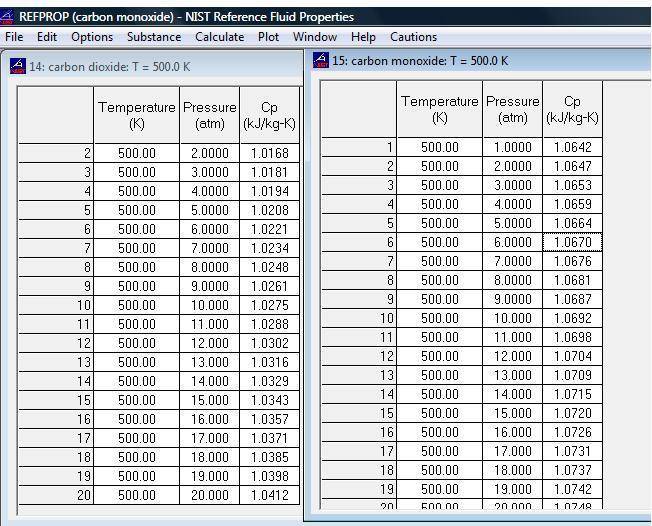
My question is that what happen to Cp when the pressure increase from 1 atm to 5 atm at constant temperature. is Cp increase with increase or decrease of pressure ??

I know that its sounds bit odd that asking for Cp (which is indeed sp. heat at CONSTANT PRESSURE)

is there any polynomial which describe the change of Cp with both pressure and temperature ?

Please also view the attached file which clearly shows that Cp is changing with pressure.

I want to know that polynomial having both temperature and pressure.

Thanks a lot
nist.jpg
 
Engineering news on Phys.org
I don't know if this will get you anywhere, but the change in C_P with pressure is a classic problem in thermo (I remember getting it on an exam before I was familiar with it):

\left(\frac{\partial C_P}{\partial P}\right)_T=\frac{\partial}{\partial P}\left[\left(T\frac{\partial S}{\partial T}\right)_P\right]_T=T\frac{\partial}{\partial P}\left[\left(\frac{\partial S}{\partial T}\right)_P\right]_T=T\frac{\partial}{\partial T}\left[\left(\frac{\partial S}{\partial P}\right)_T\right]_P

Then we use a Maxwell relation to get

T\frac{\partial}{\partial T}\left[\left(-\frac{\partial V}{\partial T}\right)_P\right]_P=-T\left(\frac{\partial^2 V}{\partial T^2}\right)_P

Thus, the change you're looking for is related to the second derivative of volume with temperature. This is zero for an ideal gas, but it may get you somewhere if you have a constitutive equation for a real gas.
 
thanks Mapes, i will look it to these equations and let you know
 
could you kindly give me the reference of the book in which these relations related to specific heat are discussed ??
 
Actually, nearly every thermodynamics book will define specific heat and explain Maxwell relations. Zemansky is pretty good.
 
thanks
 

Similar threads

  • · Replies 2 ·
Replies
2
Views
2K
  • · Replies 2 ·
Replies
2
Views
2K
Replies
11
Views
4K
Replies
4
Views
2K
  • · Replies 23 ·
Replies
23
Views
4K
  • · Replies 9 ·
Replies
9
Views
4K
  • · Replies 53 ·
2
Replies
53
Views
5K
  • · Replies 3 ·
Replies
3
Views
2K
  • · Replies 6 ·
Replies
6
Views
6K
  • · Replies 2 ·
Replies
2
Views
2K