benagastov said:
Thank you for your reply! Is this how I do it? I use Bose_einstein statistics since it was Photon
I think you have misunderstood the physics involved.
This is primarily a
classical system. The atoms, if stationary, would emit waves of frequency 8x10¹⁴ Hz.
But each atom is a
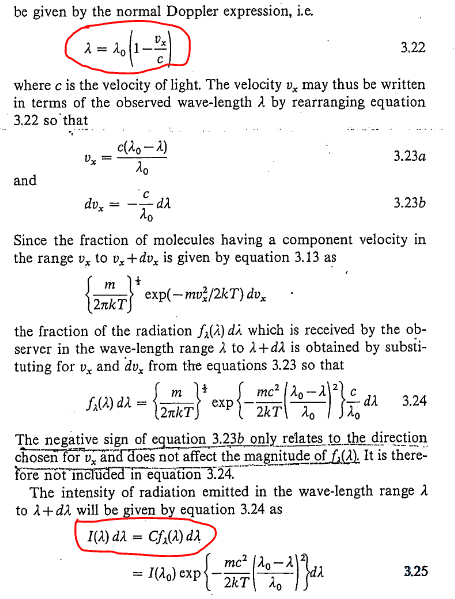
moving source with a velocity component in the observed x-direction of ##v_x##. The Doppler shift is due to having having moving sources (moving atoms). That’s how a distribution of frequencies arises.
The atoms are assumed to have a (classical) Maxwell-Boltzmann velocity distribution. So we know the distribution of the ##v_x##s.
Bose-Einstein statistics are not relevant in the context of this question.
If you don’t understand this, you need to:
- revise the Doppler effect;
- revise the Maxwell-Boltzmann velocity distribution;
- make sure you fully understand the working used in your Post #1 attachment.
You have ignored the instructions I gave in Post #2. So I will repeat them for you:
"Since ##\lambda = \frac c F## some simple algebra allows you to rewrite equation 3.23a (from your attachment) in terms of frequency.
Then you can use the same method as shown in your attachment.”
So your first task is to produce a new version of equation 3.23a with frequency instead of wavelength.
(Also, consider using ‘F’ rather than ##\omega## for frequency, for the reasons I’ve already explained.)