"Speed limit of light" analogy

  • Context: Graduate 
  • Thread starter Thread starter DaveC426913
  • Start date Start date
  • Tags Tags
    Analogy Light Limit
Click For Summary

Discussion Overview

The discussion revolves around the concept of the speed limit of light, specifically exploring analogies and interpretations related to relativistic speed limits and the geometry of spacetime. Participants engage with both analogical reasoning and theoretical considerations, examining how these ideas relate to the fundamental nature of speed and motion in physics.

Discussion Character

  • Exploratory
  • Conceptual clarification
  • Debate/contested
  • Mathematical reasoning

Main Points Raised

  • One participant proposes an analogy involving a swing merry-go-round to illustrate how geometry can impose limits on movement, suggesting that altitude approaches a maximum value without ever exceeding it.
  • Another participant notes the idea that as one pushes harder, the object becomes heavier, hinting at the relativistic mass concept.
  • A different participant appreciates the analogy but emphasizes that the mass of a person on a swing does not actually change, raising questions about the nature of mass in relativity.
  • One participant introduces a counterpoint, suggesting that if the child androids were to throw a stone, it could lead to oscillations, challenging the analogy's limitations.
  • Another participant discusses the implications of a self-propelled body developing an event horizon, suggesting that there are regions of the universe beyond which light-speed cannot be achieved.
  • One participant presents an alternative view, arguing that fundamental interactions occur at the speed of light, and reaching that speed would result in a lack of interaction with the universe, making it impossible to attain.
  • Another participant questions the nature of the limit in the analogy, pondering the forces at play and their implications for motion and stability.
  • Some participants note that without gravity, the analogy does not fully capture the physics involved, emphasizing the role of gravity in shaping spacetime geometry.

Areas of Agreement / Disagreement

Participants express a range of views on the analogy's effectiveness and the underlying physics of speed limits. While some appreciate the analogy, others raise challenges and alternative interpretations, indicating that the discussion remains unresolved with multiple competing perspectives.

Contextual Notes

Participants highlight limitations in the analogy, particularly regarding its inability to model the physics accurately and the dependence on gravitational effects in real-world scenarios.

DaveC426913
Gold Member
2025 Award
Messages
24,482
Reaction score
8,745
Thought of this while driving home from the lofters.

As if we need one more analogy for relativistic speed limits, but here goes...

Q: How is c a speed limit? Why can't we just go a little faster and exceed it?

A: Behold an analogy as to how geometry can limit movement, no matter how fast you go.

Think of one of those swing merry-go-rounds at the fair. Here's a small one:
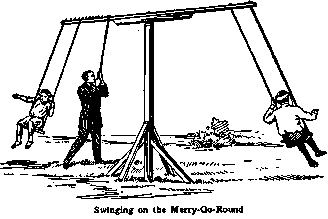
Swinging-on-the-Merry-Go-Round.png

(Those are Indestructible High-G Robot Child-Androids.)

The pole is exactly 2.99792458 metres tall, a value we will call p.
The Propulsion unit of the merry-go-round has complete freedom to increase or decrease the device's revolutions, but has no ability to directly affect its altitude.
As the IHGRCAs increase their revolutions, their altitude will approach p.
At 100revs, they will reach .99p.
At 200revs, they will reach .999p.
At 300revs, they will reach .9999p.
They can continually increase their revs without bound, yet their altitude will never reach p, merely asymptotically approach p. And no amount of revs will ever allow them to exceed p; the attempt is obviously preposterous.

So the limit of their altitude is dictated, not by some retarding factor, or by some inability to put more effort into it, but by the mere geometry between revs and altitude.

Clearly, this does not explain the physics of c as a speed limit - there will be more questions - but what it does do is get relativity students to start thinking about spacetime as a geometry. A big step, IMHO.
 
Last edited:
  • Like
Likes   Reactions: nitsuj, phinds, BiGyElLoWhAt and 2 others
Physics news on Phys.org
That is thought provoking. The harder you push the heavier it gets.

On a lighter note I was reminded of the centrifugal speed controller we used to have on our old steam cyclotron
 

Attachments

  • regulator.png
    regulator.png
    77.5 KB · Views: 525
Beautiful analogy, I love it! Especially the relativistic mass aspect. Obviously the "mass" of a person on a swing doesn't really change.
 
Mentz114 said:
On a lighter note I was reminded of the centrifugal speed controller we used to have on our old steam cyclotron
Lol... it was sometimes called a "flyball" governor.

And no amount of revs will ever allow them to exceed p; the attempt is obviously preposterous.
It is a good analogy... :oldcool:
 
Last edited:
Unfortunately, those child andriods could simply bring a big stone and once close to the horizontal throw it in the transversal direction. This would lead to oscillations around the minimum of the effective potential.
 
  • Like
Likes   Reactions: Noctisdark
Orodruin said:
Unfortunately, those child andriods could simply bring a big stone and once close to the horizontal throw it in the transversal direction. This would lead to oscillations around the minimum of the effective potential.
This shows something else about relativity - a self-propelled body is not subject to the restriction and can develop an horizon. Although there are no coordinates in which light-speed is achieved, part of the universe has gone awol behind the horizon.

I don't know, maybe this is pushing the analogy too far.
 
  • Like
Likes   Reactions: nitsuj
I loved that analogy, but a better way of thinking of it (without analogy) is the all fundamental interaction happen to be mediated at the speed of light (all bosons only move at the speed of light), if you are getting to c, you are not well interacting with the outer world, so you see times dilates and length contracts, you can never get to c because at that particular speed because you'll be "out of the universe" even your atoms don't interact with the universe, the only way they feel each other is by sending photons that move very fast to be aware of each other and interact, so if you reach c we can't feel you, but we do, that mean that it's impossible to get to c .
 
Last edited:
I like the analogy. What is true about it is that regardless of the angular momentum there is a limit. However what is this limit? In this analogy it is due to that the direction of the force vector changes based on the height of the chairs. Where do the force vectors end up? It ends up pulling a string with infinite tolerance keeping it in place. So in terms of real space or space-time what really happens? Two infinitely large forces keeping each other in check? I could translate it into that it would be as fast as a wave can travel without breaking apart. But why do they not simply break apart then? If it cannot break apart, why is there a limit to its motion?
 
The analogy is interesting, in that without gravity, our child swings horizontally at exactly the height p, whereas also without Gravity, space time geometry is not curved. Gravity with a capital G...the Universe's mystery. Now if I knew what a 'lofter' was, I might head there to do some more thinking about this...
 
  • Like
Likes   Reactions: BiGyElLoWhAt
  • #10
PhanthomJay said:
The analogy is interesting, in that without gravity, our child swings horizontally at exactly the height p, whereas also without Gravity, space time geometry is not curved. Gravity with a capital G...the Universe's mystery.
That's the caveat. It does not model the physics, all it does is demonstrate a geomretical limit.

PhanthomJay said:
Now if I knew what a 'lofter' was, I might head there to do some more thinking about this...
Sailmaking and canvas. I am adding a set of handrails to my dodger.
 

Similar threads

  • · Replies 47 ·
2
Replies
47
Views
6K
  • · Replies 28 ·
Replies
28
Views
4K
  • · Replies 15 ·
Replies
15
Views
4K
  • · Replies 12 ·
Replies
12
Views
4K
  • · Replies 8 ·
Replies
8
Views
5K
  • · Replies 54 ·
2
Replies
54
Views
8K
  • · Replies 19 ·
Replies
19
Views
6K
  • · Replies 2 ·
Replies
2
Views
622
  • · Replies 2 ·
Replies
2
Views
3K
  • · Replies 1 ·
Replies
1
Views
4K