Speed of sound related to absolute temperature

Click For Summary
SUMMARY

The speed of sound is directly proportional to the square root of absolute temperature, represented mathematically as v ∝ √T. In practical applications, the velocity can be scaled using the formula √T1 / √T0, eliminating the need for the multiplier k in calculations. This method simplifies the process of determining sound velocity at different temperatures. Users confirmed the effectiveness of this approach in their calculations.

PREREQUISITES
  • Understanding of the relationship between temperature and sound velocity
  • Familiarity with mathematical concepts such as square roots
  • Basic knowledge of thermodynamics
  • Ability to perform unit conversions related to temperature
NEXT STEPS
  • Research the derivation of the speed of sound formula in gases
  • Explore the impact of humidity and pressure on sound velocity
  • Learn about the applications of sound velocity in various scientific fields
  • Investigate how temperature affects sound propagation in different mediums
USEFUL FOR

Students studying physics, engineers working with acoustics, and anyone interested in the principles of sound propagation and thermodynamics.
Bolter
Messages
262
Reaction score
31
Homework Statement
See image attached below
Relevant Equations
v = k * sqrt(T)
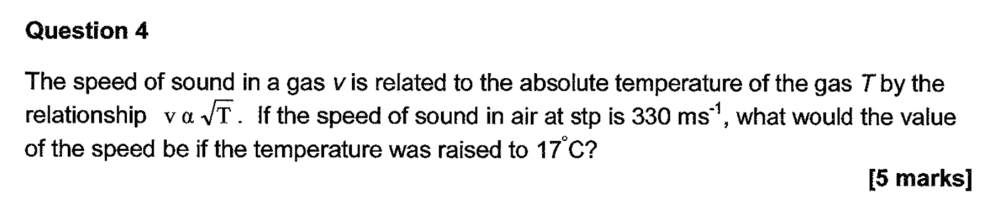
Here is the Q

Screenshot 2020-03-23 at 12.50.08.png

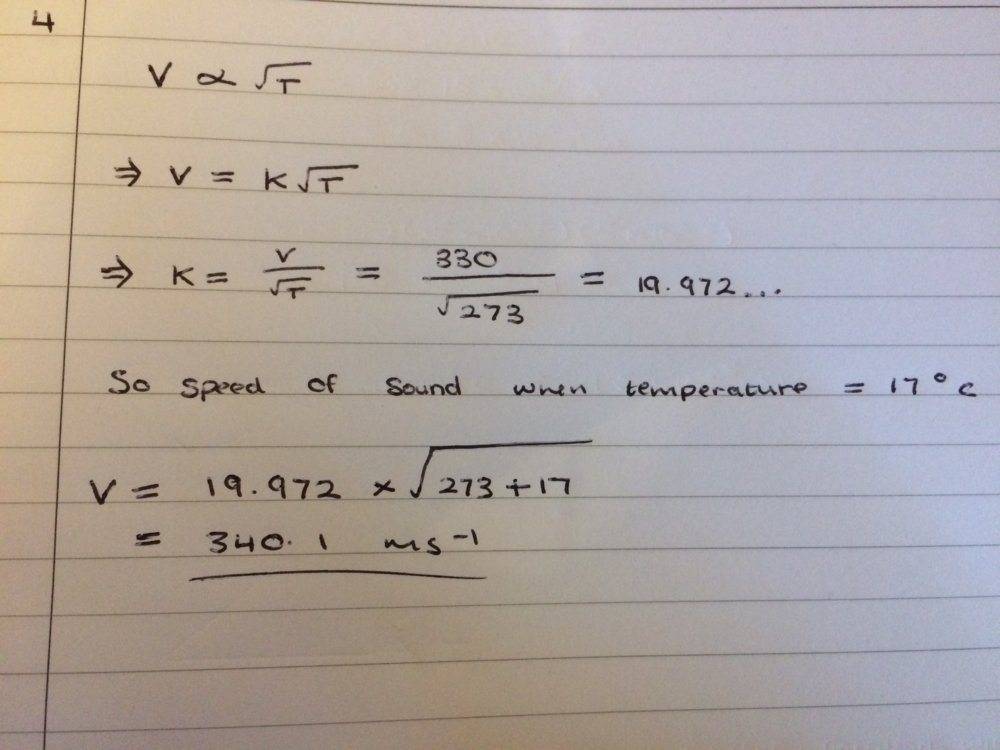
Very unsure about how to approach this question but this is what I have tried

IMG_4316.JPG


Any help would be really appreciated! Thanks
 
Physics news on Phys.org
Your calculation of the multiplier, k, is not really necessary. The velocity of sound will change in proportion to ##\sqrt T ##, so you can scale velocity by ##\sqrt {T_1} / \sqrt {T_0} ## without even knowing what k is.
 
  • Like
Likes   Reactions: Bolter and berkeman
FactChecker said:
Your calculation of the multiplier, k, is not really necessary. The velocity of sound will change in proportion to ##\sqrt T ##, so you can scale velocity by ##\sqrt {T_1} / \sqrt {T_0} ## without even knowing what k is.

Thank you, I have tried this and get the same value again. I'll keep a note of using next time I get a similar problem :)
 
  • Like
Likes   Reactions: berkeman and FactChecker

Similar threads

Replies
5
Views
2K
Replies
16
Views
2K
Replies
9
Views
2K
  • · Replies 4 ·
Replies
4
Views
1K
  • · Replies 8 ·
Replies
8
Views
851
  • · Replies 2 ·
Replies
2
Views
773
  • · Replies 7 ·
Replies
7
Views
2K
  • · Replies 2 ·
Replies
2
Views
1K
  • · Replies 12 ·
Replies
12
Views
2K
Replies
4
Views
2K