Spinning block begins to twist in mid-air?

  • Context: Undergrad 
  • Thread starter Thread starter mrneglect
  • Start date Start date
  • Tags Tags
    Block Spinning
Click For Summary

Discussion Overview

The discussion revolves around the behavior of a spinning object, particularly when thrown into the air. Participants explore the dynamics of rotational motion along different axes (x, y, z) and the resulting twisting behavior, referencing concepts from classical mechanics and specific examples.

Discussion Character

  • Exploratory
  • Technical explanation
  • Conceptual clarification
  • Debate/contested

Main Points Raised

  • Some participants note that the behavior of the object depends on its shape and the differences in rotational inertia about each principal axis.
  • It is suggested that spinning an object on its y-axis leads to instability, causing it to twist in mid-air, a phenomenon linked to Euler's equations for rotational motion.
  • One participant references the "Tennis Racket Theorem" to explain the twisting behavior of certain objects when thrown.
  • Others share personal experiences of throwing various objects and observing similar twisting motions, expressing curiosity about the underlying physics.
  • A participant mentions a scene from the movie "2010" to illustrate real-world examples of rotational behavior in objects, noting the accuracy of the physics depicted.
  • There are discussions about the difficulty of preventing twisting when tossing objects, with some asserting that even a slight initial twist can lead to significant twisting during the motion.
  • One participant provides a video link to demonstrate the twisting behavior in a practical scenario, highlighting the complexity of flips and twists in motion.

Areas of Agreement / Disagreement

Participants generally agree on the observation of twisting behavior when spinning objects are thrown, but there are competing views regarding the conditions under which twisting occurs and the influence of initial conditions on the motion. The discussion remains unresolved on some technical aspects of the phenomena.

Contextual Notes

Some claims depend on specific assumptions about the object's shape and density, and there are unresolved questions regarding the influence of air resistance and gravity on the observed behavior.

mrneglect
Messages
11
Reaction score
0
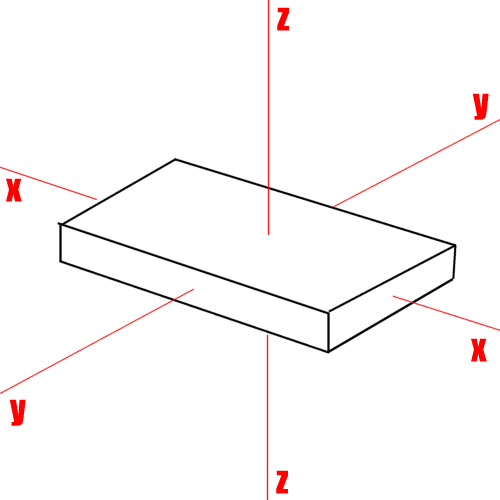
Consider the following object:

Block.png


The exact dimensions are unimportant, but its x, y and z dimensions must not be too similar (so I'm told).

I have been told that an object such as the one above will behave strangely when thrown up into the air whilst spinning.

If it is sent spinning on its x-axis then it will continue to do so until it falls back into your hands.
If it is sent spinning on its z-axis then it will continue to do so until it falls back into your hands.
But if it is sent spinning on its y-axis, it will begin to twist in mid-air.

At first I didn't believe it, and I certainly could see any physical reason for it to behave like this, but I've been trying this out by throwing my calculator up in the air and it works!

What's going on? Is it because the calculator isn't uniformly dense? Is it to do with air resistance? Is it to do with gravity? I'm told that it works in a vacuum with uniformly dense objects too, but I can't check that.

Please help to fix my intuition -- this one's baffling me! :smile:
 
Physics news on Phys.org
mrneglect said:
The exact dimensions are unimportant, but its x, y and z dimensions must not be too similar (so I'm told).
The effect depends on the shape of the object. The rotational inertia about each principal axis must be different.

I have been told that an object such as the one above will behave strangely when thrown up into the air whilst spinning.

If it is sent spinning on its x-axis then it will continue to do so until it falls back into your hands.
If it is sent spinning on its z-axis then it will continue to do so until it falls back into your hands.
But if it is sent spinning on its y-axis, it will begin to twist in mid-air.
This is a consequence of Euler's equations for rotational motion. Motion about the axis with the intermediate rotational inertia--the y-axis in this case--is unstable.

In classical mechanics this is often called the "Tennis Racket Theorem".

Check this out: http://www.physics.usyd.edu.au/~cross/RacquetTheorem.mov"
 
Last edited by a moderator:
Thank you, this is exactly what I was looking for!
 
Cool, I never knew that either. I am always throwing things like that in the air, such as the remote, calculators, erasers, etc, and I've always wondered why it always does a twist, as well as a flip :p It's very hard to make it do a proper 'backflip' without the twist actually!
 
Ever see the movie 2010 (sequel to 2001)? Roy Scheider and Jon Lithgow visit the long, thin Discovery spaceship tumbling end over end. It's rotating because the "hamster wheel" that Keir Dullea was running in in the original movie seized up. The thing is, the hamster wheel wasn't rotating along that axis.

However, as Doc Al pointed out, objects shaped like pencils don't like to rotate on the axis of their lead. They prefer to tumble end over end, because that rotation has a lower energy for the same momentum. It's kind of neat that they get the Physics right (or nearly right) in the movies sometimes.
 
"The polhode rolls without slipping on the herpolhode..." from Goldstein "Classical Mechanics"
 
mrneglect said:
But if it is sent spinning on its y-axis, it will begin to twist in mid-air.
Doc Al said:
In classical mechanics this is often called the "Tennis Racket Theorem".
Tennis rackets and hammers can be tossed so they flip without twisting with the racket face or hammer head parallel to the axis of rotation, as long the the toss is done without imparting an initial twist. Either can also be tossed so it does a 1/2 twist or a full twist. Either can also be tossed and spun hard so it does a lot of twists. Divers, gymnasts, and trampolinists routinely do flips in the layout position without twisting.
 
Last edited:
Of course you can stop it from twisting, but it's very hard. Even the slightest initial twist will send it spinning at least half a twist.
 
Nick89 said:
Of course you can stop it from twisting, but it's very hard. Even the slightest initial twist will send it spinning at least half a twist.
So an intial twist might be increased, but without the initial twist, a twist doesn't develop?

I'ts not always 1/2 twist per flip either. In this video, it's 2 1/2 flips, 1/2 twist mostly near the end. Driver (Peter Dunbreck) was OK.

http://www.youtube.com/watch?v=SFN_Gp1eHN0&fmt=18
 

Similar threads

  • · Replies 10 ·
Replies
10
Views
4K
  • · Replies 23 ·
Replies
23
Views
4K
  • · Replies 3 ·
Replies
3
Views
2K
Replies
7
Views
11K
  • · Replies 6 ·
Replies
6
Views
3K
  • · Replies 10 ·
Replies
10
Views
3K
  • · Replies 1 ·
Replies
1
Views
2K
  • · Replies 2 ·
Replies
2
Views
2K
  • · Replies 41 ·
2
Replies
41
Views
6K
  • · Replies 1 ·
Replies
1
Views
4K