Split Short Exact Sequences .... Bland, Proposition 3.2.6 ....

  • Context: Undergrad 
  • Thread starter Thread starter Math Amateur
  • Start date Start date
  • Tags Tags
    Sequences Short Split
Click For Summary
SUMMARY

This discussion centers on Proposition 3.2.6 from Paul E. Bland's book "Rings and Their Modules," specifically regarding the proof's details. The proof demonstrates that the expression \( (x - x') - f(f'(x - x')) \) belongs to the intersection of the kernel of \( f' \) and the image of \( f \), confirming that \( g' \) is well-defined. The participants clarify that the well-defined nature of \( g' \) relies on the equality \( (x - f(f'(x))) - (x' - f(f'(x'))) = 0 \) when \( g(x) = g(x') \), ensuring consistent output regardless of the choice of \( x \).

PREREQUISITES
  • Understanding of exact sequences in module theory
  • Familiarity with kernel and image concepts in linear algebra
  • Knowledge of linear maps and their properties
  • Basic comprehension of the notation used in algebraic structures
NEXT STEPS
  • Study the properties of exact sequences in module theory
  • Learn about kernels and images in linear transformations
  • Explore the implications of well-defined functions in algebra
  • Review additional examples of propositions in "Rings and Their Modules" by Paul E. Bland
USEFUL FOR

Mathematicians, algebraists, and students studying module theory or linear algebra who seek a deeper understanding of exact sequences and their applications in abstract algebra.

Math Amateur
Gold Member
MHB
Messages
3,920
Reaction score
48
I am reading Paul E. Bland's book "Rings and Their Modules" ...

Currently I am focused on Section 3.2 Exact Sequences in ##\text{Mod}_R##... ...

I need some help in order to fully understand the proof of Proposition 3.2.6 ...

Proposition 3.2.6 and its proof read as follows:
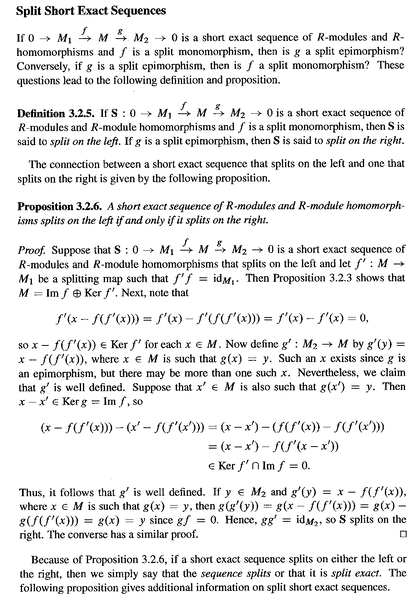
Bland - Prposition 3.2.6 ... .....png

In the above proof of Proposition 3.2.6 we read the following:"... ... Then ##x - x'\in \text{Ker } g = \text{Im } f##, so##(x - f( f' (x))) - (x' - f( f' (x'))) = ( x - x') - ( f ( f'(x) ) - f ( f'(x') ) )##

##= ( x - x') - f ( f' ( x - x') )##

##\in \text{Ker } f' \cap \text{Im } f = 0 ## ... ...

Thus it follows that ##g'## is well-defined ... ... "Can someone please explain exactly why/how ##( x - x') - f ( f' ( x - x') ) \in \text{Ker } f' \cap \text{Im } f = 0## ... ...Further, can someone please explain in some detail how the above working shows that ##g'## is well-defined ...
Help will be much appreciated ...

Peter
 

Attachments

  • Bland - Prposition 3.2.6 ... .....png
    Bland - Prposition 3.2.6 ... .....png
    44.8 KB · Views: 574
Physics news on Phys.org
I am reading Paul E. Bland's book "Rings and Their Modules" ...

Currently I am focused on Section 3.2 Exact Sequences in ##\text{Mod}_R## ... ...

I need some further help in order to fully understand the proof of Proposition 3.2.6 ...

Proposition 3.2.6 and its proof read as follows:
Bland - Prposition 3.2.6 ... .....png

In the above proof of Proposition 3.2.6 we read the following:"... ... now define ##g' \ : \ M_2 \longrightarrow M## by ##g'(y) = x - f(f'(x))##, where ##x \in M## is such that ##g(x) = y## ... ... ... ...

... ... Suppose that ##x' \in M## is also such that ##g(x') = y## ... ... Does the above text imply that ##g'(y) = x' - f( f'(x') )## ... ... ?

Peter
 

Attachments

  • Bland - Prposition 3.2.6 ... .....png
    Bland - Prposition 3.2.6 ... .....png
    44.8 KB · Views: 484
Math Amateur said:
"... ... Then ##x - x'\in \text{Ker } g = \text{Im } f##, so##(x - f( f' (x))) - (x' - f( f' (x'))) = ( x - x') - ( f ( f'(x) ) - f ( f'(x') ) )##

##= ( x - x') - f ( f' ( x - x') )##

##\in \text{Ker } f' \cap \text{Im } f = 0 ## ... ...
The LHS of the first line has two terms, ##(x - f( f' (x)))## and ## (x' - f( f' (x')))## with ##x,x'\in M##. The 6th line of the proof of Proposition 3.2.6 concludes that terms of that form are in Ker ##f'##. Since the kernel of a linear map is a subspace, that means the LHS of that line, which is a linear comb of the two terms, is also in the kernel.

Now look at the last equality: ##= ( x - x') - f ( f' ( x - x') )##. The second term is in I am ##f##, and the first term was shown to be in I am ##f## in the extract's line immediately before that series of equalities you quoted. Again, since Images of linear maps are subspaces, the linear combination of the two terms must be in the image. So the item is both in I am ##f## and in Ker ##f'##, hence in their intersection.
Further, can someone please explain in some detail how the above working shows that ##g'## is well-defined ...
##g'## was defined as ##g'(y) = x-f(f'(x))## where ##g(x)=y##, ie where ##x\in g^{-1}(y)##. There may be more than one ##x## such that ##g(x)=y##. That doesn't matter, ie does not make the definition 'not well-defined', as long as changing the ##x## doesn't change the value of ##g'(y)##, ie of ##x-f(f'(x))##. So what is needed is to prove that if there is another such ##x##, call it ##x'##, such that ##g(x')=y=g(x)##, we will have ##x-f(f'(x))=x'-f(f'(x'))##, ie ##(x-f(f'(x))-(x'-f(f'(x'))=0##.

And that is what has just been proved by that series of equalities.
To be absolutely formal, what was proved was:
$$(x-f(f'(x))-(x'-f(f'(x')) \in \mathrm{Ker }f'\cap \mathrm{Im }f=\{0\}$$
from which it follows that
$$(x-f(f'(x))-(x'-f(f'(x'))=0$$
 
  • Like
Likes   Reactions: Math Amateur
Well! That was extremely helpful!

Thanks Andrew ...

Peter
 

Similar threads

  • · Replies 2 ·
Replies
2
Views
1K
  • · Replies 1 ·
Replies
1
Views
1K
  • · Replies 7 ·
Replies
7
Views
1K
  • · Replies 2 ·
Replies
2
Views
1K
  • · Replies 25 ·
Replies
25
Views
4K
Replies
2
Views
2K
Replies
2
Views
1K
  • · Replies 5 ·
Replies
5
Views
2K
  • · Replies 12 ·
Replies
12
Views
3K
  • · Replies 9 ·
Replies
9
Views
2K