Finding the Coefficient of Friction in a Spring-Block Incline System

  • Thread starter Thread starter Puneet Tanwar
  • Start date Start date
  • Tags Tags
    Work Work done
Click For Summary
To find the coefficient of friction in a spring-block incline system, the problem involves a 1 kg block on a rough incline connected to a spring with a spring constant of 100 N/m. The block moves 10 cm down the incline before stopping, and the solution requires understanding the forces at equilibrium. The initial approach incorrectly assumes friction acts when the block is at rest, but friction is a reaction force that only applies when the block is moving. The correct method involves setting the forces in equilibrium, leading to the relationship between spring force and gravitational components. Understanding these dynamics is crucial for accurately determining the coefficient of friction.
Puneet Tanwar
Messages
4
Reaction score
0
Moved from technical forum, so no template
Hi - I'm looking for some help with the solution of this problem

"A 1 kg block situated on a rough incline is connected to a spring with spring constant 100 Nm-1 as shown in Figure. The block is released from rest with the spring in the unstretched position. The block moves 10 cm down the incline before coming to rest. Find the coefficient of friction between the block and the incline. Assume that the spring has negligible mass and the pulley is friction less."
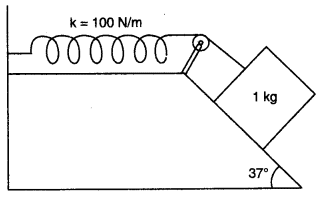
28765499061_81e18a0887_o.png


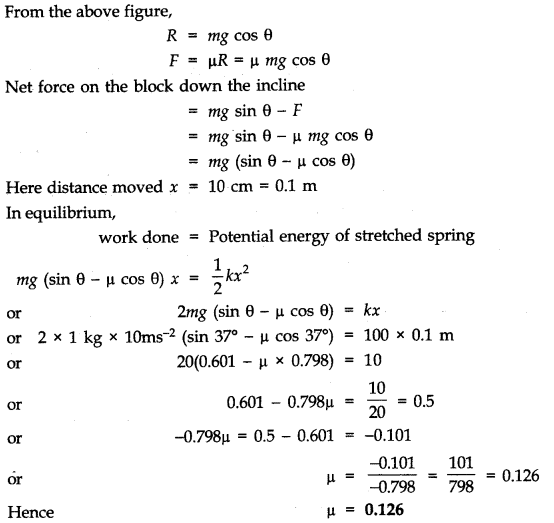
The solution given is :
28841587685_728ffc9ff8_o.png


I tried to solve the problem based on the final equilibrium state - without calculating the work done. The equations I end up with are:

Block: mg sin θ = µ mg cos θ + T
Spring end: T = kx

Leading to : mg (sin θ - µ cos θ) = kx

This is off by factor of 2 compared to the solution above.

What's the right approach to solve the problem?
 

Attachments

  • 28765499061_81e18a0887_o.png
    28765499061_81e18a0887_o.png
    4.2 KB · Views: 730
  • 28841587685_728ffc9ff8_o.png
    28841587685_728ffc9ff8_o.png
    16.8 KB · Views: 818
Physics news on Phys.org
Puneet Tanwar said:
Block: mg sin θ = µ mg cos θ + T

Unfortunately, that's a wrong assumption in this scenario. The friction force is a reaction force. Imagine ##\mu## to have exactely a value, so that the block stops at a position ##x## for which ##kx=mg\;sin \theta##. Then the two forces are in equilibrium, the block does not move and no friction force is acting on it. Therefore your approach in this case is not applicable.
 
stockzahn said:
Unfortunately, that's a wrong assumption in this scenario. The friction force is a reaction force. Imagine ##\mu## to have exactely a value, so that the block stops at a position ##x## for which ##kx=mg\;sin \theta##. Then the two forces are in equilibrium, the block does not move and no friction force is acting on it. Therefore your approach in this case is not applicable.

Understood. Thanks!
 
The book claims the answer is that all the magnitudes are the same because "the gravitational force on the penguin is the same". I'm having trouble understanding this. I thought the buoyant force was equal to the weight of the fluid displaced. Weight depends on mass which depends on density. Therefore, due to the differing densities the buoyant force will be different in each case? Is this incorrect?

Similar threads

  • · Replies 4 ·
Replies
4
Views
3K
Replies
22
Views
924
  • · Replies 27 ·
Replies
27
Views
9K
Replies
24
Views
3K
  • · Replies 58 ·
2
Replies
58
Views
3K
Replies
17
Views
2K
  • · Replies 2 ·
Replies
2
Views
1K
  • · Replies 14 ·
Replies
14
Views
2K
Replies
2
Views
2K
Replies
5
Views
2K