High School Square root differential problem

Click For Summary
The discussion focuses on a mathematical problem involving the differentiation of a function using Taylor series. The original poster is confused about how the second term of an equation is derived and questions the absence of certain terms in the denominator of the second equation. They clarify that the variable epsilon (ε) represents the difference between x and a, specifically when a is zero. The conversation emphasizes the application of the chain rule in deriving the terms, particularly how εh is treated when evaluating the derivative at zero. Ultimately, the resolution hinges on understanding how terms simplify during differentiation.
knockout_artist
Messages
70
Reaction score
2
Hi,

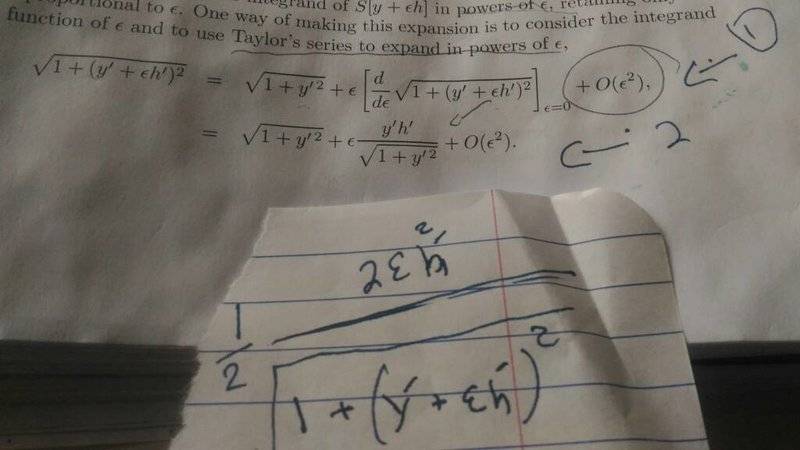
I working on their text this equation did not make sense to me.

From equation 1 it differentiate second term , I wonder how he got second term of equation 2.

What I think is, what I wrote at the bottom
P_20170713_121813.jpg
 
Physics news on Phys.org
They are doing a Taylor series and writing ## f(x)=f(a)+f'(a)(x-a) +... ## In this case ## x=\epsilon ## and ## a=0 ##. ## \\ ## I agree with their result.
 
but how did they resolve
f(x)=f(a)+f′(a)(x−a)+..
to get second term in eq 2.
 
knockout_artist said:
but how did they resolve
f(x)=f(a)+f′(a)(x−a)+..
to get second term in eq 2.
The chain rule. In numerator of ## f'(\epsilon) ## you have ## 2(y'+\epsilon h) h ##. You then compute ## f'(0) ##.
 
  • Like
Likes knockout_artist
but then why there is no ϵh' term in denominator in second term in equation 2 ?
It should have stayed there.

and if were to consider ϵ = 0 then why there is still e multiplying second term in equation 2 ?
 
knockout_artist said:
but then why there is no ϵh' term in denominator in second term in equation 2 ?
It should have stayed there.

and if were to consider ϵ = 0 then why there is still e multiplying second term in equation 2 ?
The ## \epsilon ## is from ## (x-a)=(\epsilon-0)= \epsilon ##. Meanwhile, the ## \epsilon h ## in tthe denominator gets put equal to zero as part of taking ## f'(0) ##. (The entire term is the product of both of these which is ## f'(0)(x-a) ##.)
 
So like this ?
 

Attachments

  • phy-formum.jpeg
    phy-formum.jpeg
    23.2 KB · Views: 483
Last edited:
  • Like
Likes Charles Link

Similar threads

  • · Replies 4 ·
Replies
4
Views
2K
  • · Replies 7 ·
Replies
7
Views
1K
  • · Replies 3 ·
Replies
3
Views
2K
  • · Replies 14 ·
Replies
14
Views
1K
  • · Replies 2 ·
Replies
2
Views
1K
  • · Replies 6 ·
Replies
6
Views
2K
  • · Replies 13 ·
Replies
13
Views
6K
  • · Replies 14 ·
Replies
14
Views
2K
  • · Replies 6 ·
Replies
6
Views
4K
  • · Replies 1 ·
Replies
1
Views
2K