Standing Waves in a tube closed at both ends

Click For Summary
SUMMARY

The discussion centers on the behavior of standing waves in a tube closed at both ends, specifically addressing the calculation of fundamental frequency and harmonics. The fundamental frequency is calculated as f = c/(2L) resulting in 340 Hz, with the first harmonic at 680 Hz. Participants clarify the correct application of the speed of sound formula, noting that the base speed at 0°C is 331 m/s, which corrects the initial assumption of 340 m/s. Misunderstandings regarding nodes and antinodes are also addressed, emphasizing their definitions and positions in closed and open tubes.

PREREQUISITES
  • Understanding of standing wave theory
  • Familiarity with the speed of sound in different temperatures
  • Knowledge of nodes and antinodes in wave mechanics
  • Ability to apply formulas for frequency and wavelength calculations
NEXT STEPS
  • Study the relationship between temperature and the speed of sound in air
  • Learn about the behavior of standing waves in tubes of varying boundary conditions
  • Explore the mathematical derivation of wave equations for closed and open tubes
  • Investigate practical applications of standing wave principles in musical instruments
USEFUL FOR

Students of physics, acoustics researchers, and educators seeking to deepen their understanding of wave behavior in closed and open tubes.

physicslover2012
Messages
3
Reaction score
0
Homework Statement
A sound tube, which measures 50 cm, is closed AT BOTH ENDS and has a reed that produces vibrations in the middle. The air is at 0°C and the speed of sound is c= 340 m/s.
a) What is the fundamental frequency of the tub?
b) How much should the air be cooled in order to obtain the next harmonic?
Relevant Equations
λ = v / f
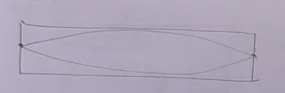
During our classes, we haven't discussed the situation of a tube closed at both ends. But, assuming the position of the nodes and antinodes, I think it's a case similar to the one where the tube is open at both ends, so I think that f = v/λ = nv/(2L). Using the numeric data, my frequency would be 340 Hz. But I am not sure and I need some other opinions. As for the second question, I found a formula online that shows the dependence between the speed of sound and temperature, but using the formula I get an absurdly big number. If you can, please help me understand this particular case!
 
Physics news on Phys.org
physicslover2012 said:
similar to the one where the tube is open at both ends
Yes, just swapping nodes with antinodes. But you have not taken into account that the sound source is in the middle. I can see why that might change things.. not sure.
physicslover2012 said:
using the formula I get an absurdly big number
Please post your working and result.
 
haruspex said:
Please post your working and result.
The fundamental frequency I calculated is f=c/(2*l)= 340 Hz. I calculated the next harmonic, which was f1=2*c/(2*l)=680 Hz. Then, I wrote again the formula, using this time another speed: f1=c'/(2*l) From here, I deducted that c'=680 m/s, and I found this formula online: c'=c+0,6*t. From here I deducted the temperature, t=566,66 s. But, to me, it seems a number way too big.
Yes, just swapping nodes with antinodes. But you have not taken into account that the sound source is in the middle. I can see why that might change things.
haruspex said:
Yes, just swapping nodes with antinodes. But you have not taken into account that the sound source is in the middle. I can see why that might change things.. not sure.
I assumed that it was a similar case because we learned that where the reed is situated, there is an antinode.
 
physicslover2012 said:
From here I deducted the temperature, t=566,66 s.
You have slightly misused the formula. The base speed in that (the c on the right) is at 0C, so is 331m/s. But your answer is about right.
physicslover2012 said:
we learned that where the reed is situated, there is an antinode.
That's what bothered me. If the tube is open at both ends, for a wavelength of 2L, where are the nodes and antinodes?
 
haruspex said:
You have slightly misused the formula. The base speed in that (the c on the right) is at 0C, so is 331m/s. But your answer is about right.
In the problem, it was assumed that at 0C, the speed of sound is 340 m/s. I also found out that the speed of sound at 0C is 331, so I think it is a mistake on the teachers' part.
haruspex said:
That's what bothered me. If the tube is open at both ends, for a wavelength of 2L, where are the nodes and antinodes?
If the tube is open at both ends, we have the antinodes at the ends of the tube. I watched an online lesson where the subject of a tube closed at both ends was discussed, and, despite the fact that practically it isn't possible to exist (since the sound must exit the tube somewhere), the teacher used this graphic for the waves: download.png
Technically, if the sound starts in the middle, I thought that there would be antinodes that go both ways, thus making a full form.
 
physicslover2012 said:
In the problem, it was assumed that at 0C
Sorry, I missed that.
physicslover2012 said:
despite the fact that practically it isn't possible to exist (since the sound must exit the tube somewhere)
You maybe misunderstand what nodes and antinodes are. A node is where the displacement amplitude of the oscillating molecules is zero (and correspondingly where the pressure amplitude is max). At an antinode, displacement amplitude is max and pressure variation is zero.
At a closed end the molecules have nowhere to move, so that's a node; at an open end they can move freely but are at constant pressure. (In practice, the pressure variation extends a bit beyond the end, leading to a slightly longer effective tube length.)
physicslover2012 said:
I thought that there would be antinodes that go both ways,
In the diagrams, an antinode is not a shape; it is the point where the curved lines are furthest apart. They don't "go" anywhere.
physicslover2012 said:
If the tube is open at both ends, we have the antinodes at the ends of the tube.
Yes, but in the question you also have an antinode in the middle. So what does the diagram look like?
 

Similar threads

  • · Replies 1 ·
Replies
1
Views
2K
  • · Replies 6 ·
Replies
6
Views
2K
  • · Replies 1 ·
Replies
1
Views
2K
  • · Replies 8 ·
Replies
8
Views
2K
  • · Replies 4 ·
Replies
4
Views
2K
  • · Replies 7 ·
Replies
7
Views
2K
  • · Replies 14 ·
Replies
14
Views
2K
  • · Replies 5 ·
Replies
5
Views
6K
  • · Replies 4 ·
Replies
4
Views
3K
Replies
3
Views
4K