Static Mechanics: Aircraft Nosewheel Linkage Torque

  • Thread starter Thread starter jojosg
  • Start date Start date
Click For Summary
SUMMARY

The discussion centers on analyzing the torque in the aircraft nosewheel linkage system using free body diagrams (FBDs). Participants emphasize the necessity of creating separate FBDs for each moving part, particularly focusing on the forces and torques acting on the linkage. It is established that links BC and CD can be considered massless for simplification, and the torque at point M is crucial for maintaining equilibrium in the assembly. The vertical force at point G, representing a combined mass of 50 kg, remains constant while the moment M varies during the wheel's elevation.

PREREQUISITES
  • Understanding of free body diagrams (FBDs)
  • Knowledge of static mechanics principles
  • Familiarity with torque and force analysis
  • Basic concepts of rigid body dynamics
NEXT STEPS
  • Study the principles of static equilibrium in mechanical systems
  • Learn how to construct free body diagrams for complex linkages
  • Explore torque calculations in multi-body systems
  • Review case studies on static force analysis in mechanisms
USEFUL FOR

Mechanical engineers, students in engineering mechanics, and professionals involved in aircraft design and analysis will benefit from this discussion.

jojosg
Messages
24
Reaction score
2
Homework Statement
Hi I'm stuck at how to draw the free body diagram for thise nose wheel question
Relevant Equations
Moment equal 0
see attached

mmexport1760866157266.webp


IMG_20251019_172253.webp
 
Last edited by a moderator:
Physics news on Phys.org
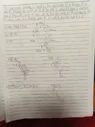
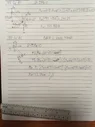
A free body diagram shows the forces on a single rigid body. Here you have a linkage, so you need an FBD for each moving part. This will involve defining unknowns for forces and torques between connected bodies, each such force being represented in the FBDs for both bodies.
What are the moving rigid bodies in this problem? Pick one and list the forces on it. Then post your attempt at its FBD.
 
I think it is safe to assume that links BC and CD are massless because no masses are given for them. Assume that the torque at M gives rise to a force ##F_D## at D that is just right to prevent the combined (arm + wheel) assembly AO from rotating either clockwise or counterclockwise.
 
Consider the external force and moment acting on the whole mechanism first.
One is the represented M, which is necessary to raise the combined mass of 50 kg, which can be represented as a vertical force applied at point G.

Note that the value of that vertical force will be constant, while the value of the necessary moment M will change as the wheel is being raised, reason for which the problem asks for the value of moment M at that specific position of the mechanism's stroke.

Please, see this example:
https://www.school-mechademic.com/blog/static-force-analysis-on-a-4-bar-link-mechanism

:cool:
 
Last edited:
ok I think I got it thanks everyone
 

Attachments

  • IMG_20251020_190101.webp
    IMG_20251020_190101.webp
    30.5 KB · Views: 17
  • IMG_20251020_190106.webp
    IMG_20251020_190106.webp
    30.8 KB · Views: 13
The book claims the answer is that all the magnitudes are the same because "the gravitational force on the penguin is the same". I'm having trouble understanding this. I thought the buoyant force was equal to the weight of the fluid displaced. Weight depends on mass which depends on density. Therefore, due to the differing densities the buoyant force will be different in each case? Is this incorrect?

Similar threads

  • · Replies 6 ·
Replies
6
Views
2K
  • · Replies 1 ·
Replies
1
Views
2K
  • · Replies 13 ·
Replies
13
Views
2K
  • · Replies 7 ·
Replies
7
Views
3K
Replies
12
Views
1K
  • · Replies 6 ·
Replies
6
Views
2K
Replies
43
Views
2K
  • · Replies 10 ·
Replies
10
Views
816
  • · Replies 2 ·
Replies
2
Views
1K
  • · Replies 6 ·
Replies
6
Views
2K