Statically indeterminate (deflection)

Join the discussion
Ask a follow-up here, or get your own question answered by working scientists, mathematicians and engineers — people, not an autocomplete.
Real named experts · corrections over time · the nuance an AI answer skips
1 reply · 9K views
feedingjax
Messages
2
Reaction score
0
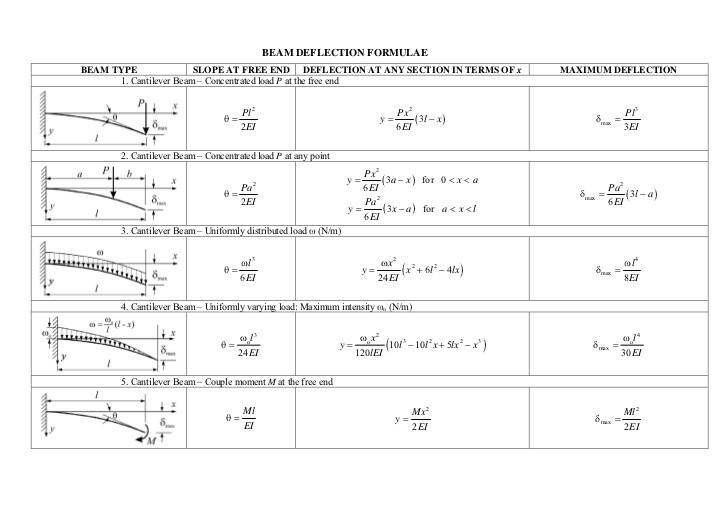
For these types of question, I know deflection equation is needed to find the reaction.
However, my question is that when should i use the max. deflection equation and when should i use only simple deflection equation for my calculation ?

Thank you very much!
23hrd5v.png

w18t5e.jpg


beam-deflection-formulae-1-728.jpg
 
Physics news on Phys.org
feedingjax said:
For these types of question, I know deflection equation is needed to find the reaction.
However, my question is that when should i use the max. deflection equation and when should i use only simple deflection equation for my calculation ?

Thank you very much!
23hrd5v.png

w18t5e.jpg


beam-deflection-formulae-1-728.jpg

I think you are trying to be too choosy with your equations here.

Don't worry about which particular cases to use the max. deflection formula to solve an indeterminate problem. Pick the most general deflection formula for a particular beam and loading arrangement. If the location of the redundant support in question requires the use of a max. deflection formula, as in the case of the propped cantilever, then substituting the length of the cantilever into the general deflection equation should give the same equation as that for the max. deflection.

The max. deflection formulas in the table above are all special cases of the general deflection equation for the type of loading indicated for the cantilever. You should be able to verify this by evaluating the cantilever formulas above for x = L.