Statics and Strength of Materials

Click For Summary
SUMMARY

The discussion revolves around challenges faced by a student seeking help with problems from "Statics and Strength of Materials, Second Edition" by Cheng. The student has struggled for two days to find assistance and has received minimal guidance from their instructor. Key advice includes the importance of typing out problem statements and work instead of posting images, as this increases the likelihood of receiving help. The discussion emphasizes applying static equilibrium equations, specifically ∑Fx = 0 and ∑Fy = 0, to solve the problems presented.

PREREQUISITES
  • Understanding of static equilibrium principles
  • Familiarity with the equations of motion in statics
  • Basic knowledge of forces and moments
  • Experience with problem-solving in mechanics
NEXT STEPS
  • Review the principles of static equilibrium in detail
  • Practice solving problems using the equations ∑Fx = 0 and ∑Fy = 0
  • Explore the "How to Ask for Homework Help" guidelines on forums
  • Study examples from "Statics and Strength of Materials" to reinforce concepts
USEFUL FOR

Students studying engineering mechanics, particularly those enrolled in courses related to statics and strength of materials, as well as educators looking for effective strategies to assist students in problem-solving.

MiTCHaPaLOOUZA
Messages
2
Reaction score
0
Ive been trying to work out these problems for 2 days now. I've read through the book "Statics and Strength of Materials, Second Edition" By: Cheng. I've googled Everything. I've been on other Forums and have got no reply. I've tried Facebook Math Pages. No Answers. I've been Looking for free help everywhere and I can't Find ANYTHING. I've even asked my instructor for help and he only gives me small hints on where to start.

These make no sense to me and I have no clue where to begin and how to go about solving any of these. This is my last resort. I am going to fail if none of you can help me out. I would love for someone to send pics of working it out if its possible. I've got some of my shown work Written down but I'm 100% Sure I'm going the exact opposite way of where I'm supposed to be headed.


1. Homework Statement
1.png

Screen Shot 2016-11-06 at 9.00.30 PM.png

3.png

4.png


Homework Equations

The Attempt at a Solution


14970989_10157766071965078_112542166_o.jpg

14971452_10157766072105078_1604782865_o.jpg
 
Physics news on Phys.org
Scroll to the bottom of the page and you'll find a 'help' link, find the section, 'How to Ask for Homework Help' and give it a read, particularly this passage:
  • Do not simply post images of the problem statement or your work.
    While posting images may be convenient for you, it's actually one of the most effective ways of getting your request for help ignored. Images are often too big, too small, rotated, upside down, out of focus, dimly lit, or of otherwise poor quality, and your handwriting probably isn't as easy to read as you think it is. Images are a hindrance to the helpers as portions of the problem statement or your work can't easily be quoted. Using images also doesn't qualify as filling out the homework template, so your post may be deleted.

    So type up the problem statement and your work. Think "If I can't be bothered to spend my time typing it, why should they be bothered to spend their time reading it?" Use scans or photos for supporting figures. You may, of course, attach an image of the problem statement in addition to the typed version; in fact, if it's a complicated or long problem, you probably should. But you should always provide a typed version as well.

    When you do use an image to your post, make sure it's in focus, oriented the right way, well lit, etc. It seems like this should be obvious, but experience has shown that people frequently post incredibly poor images. Add it as an attachment to the post. Don't host it externally. That way it will remain on PF indefinitely, and your thread will remain useful to future visitors.
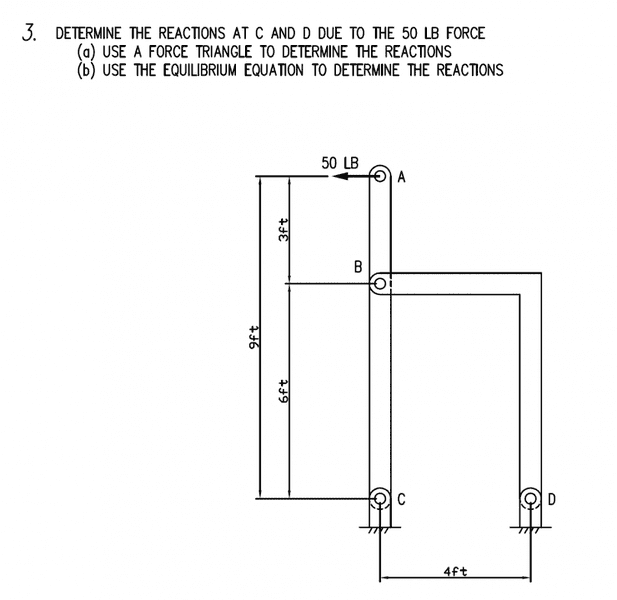
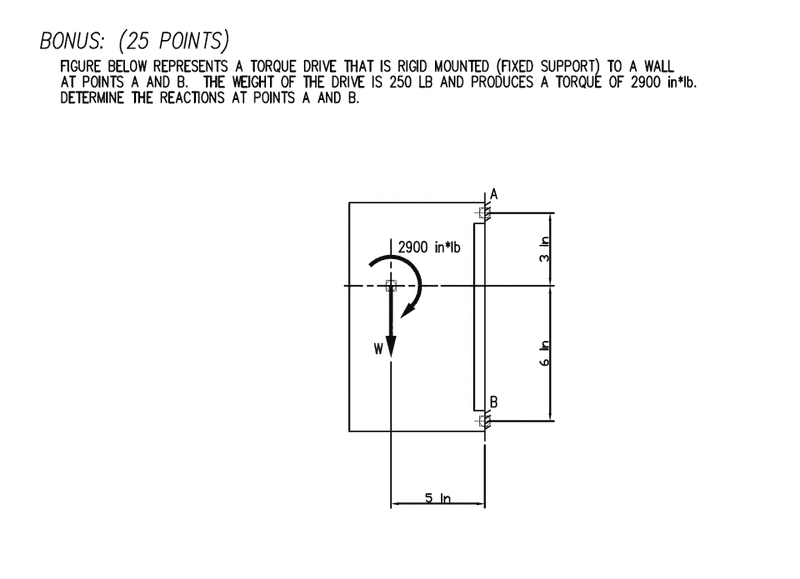
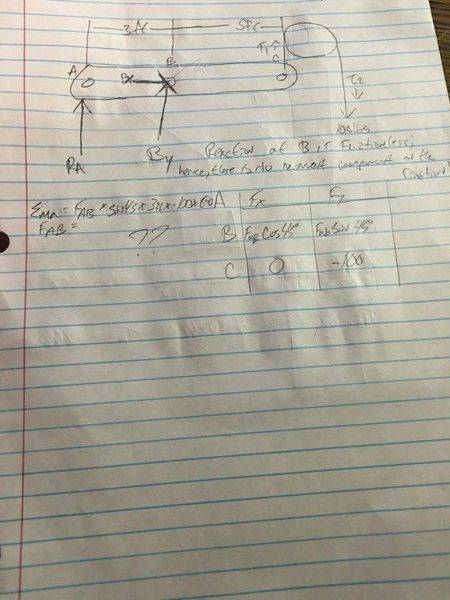
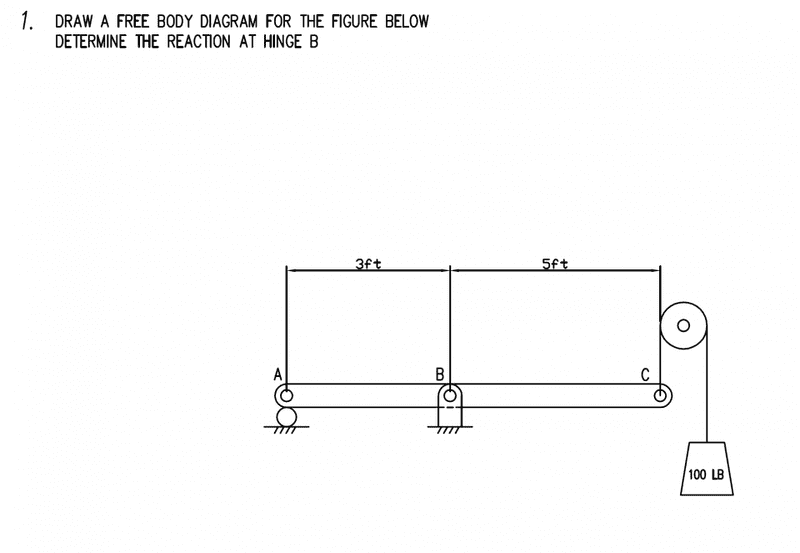
For question 1), BX is zero, by inspection. To find BY, take moments about A. No trigonometry is required.

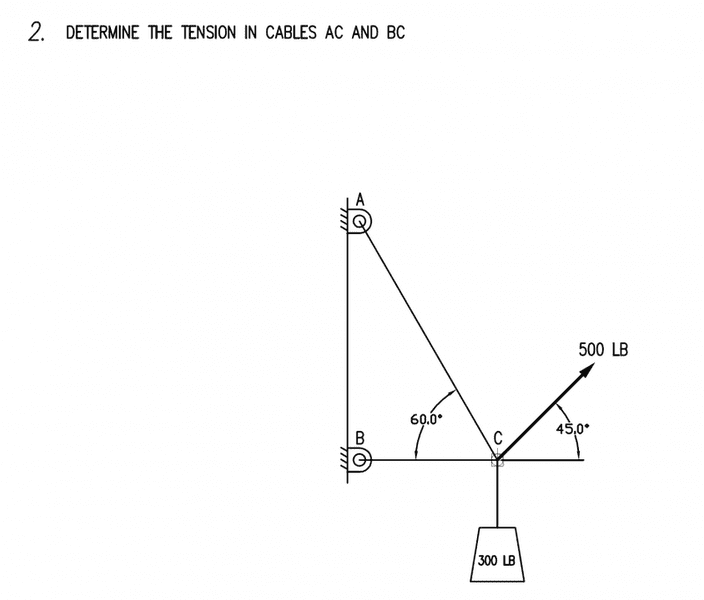
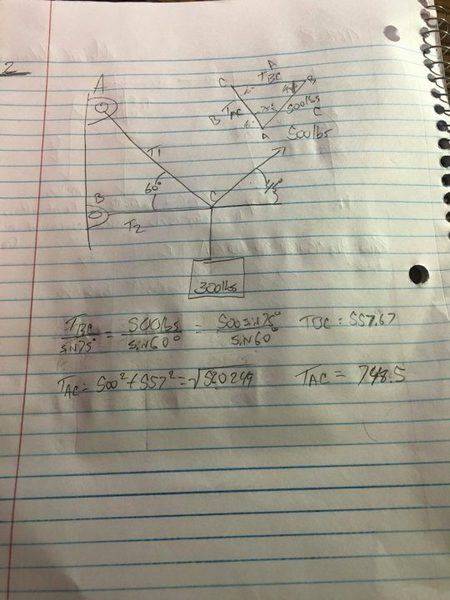
For question 2) It looks like you've completely ignored the hanging mass and the fact that Tac has an X component.
apply the equations of static equilibrium:
∑Fx = 0
∑Fy = 0
 
  • Like
Likes   Reactions: berkeman
billy_joule said:
Scroll to the bottom of the page and you'll find a 'help' link, find the section, 'How to Ask for Homework Help' and give it a read, particularly this passage:
For question 1), BX is zero, by inspection. To find BY, take moments about A. No trigonometry is required.

For question 2) It looks like you've completely ignored the hanging mass and the fact that Tac has an X component.
apply the equations of static equilibrium:
∑Fx = 0
∑Fy = 0
Alright thanks ill start there. And I know I'm not supposed to just post pics but i can't explain the problem or what's going on if I don't know how to start or what to do. I can't believe how hard it has been to get just a LITTLE bit of help from the whole internet. Its been exhausting trying to find an active forum or anyone to talk to about it.
 

Similar threads

  • · Replies 12 ·
Replies
12
Views
3K
  • · Replies 6 ·
Replies
6
Views
2K
  • · Replies 5 ·
Replies
5
Views
3K
  • · Replies 1 ·
Replies
1
Views
2K
  • · Replies 10 ·
Replies
10
Views
2K
  • · Replies 11 ·
Replies
11
Views
5K
  • · Replies 1 ·
Replies
1
Views
2K
  • · Replies 9 ·
Replies
9
Views
2K
  • · Replies 18 ·
Replies
18
Views
3K
  • · Replies 12 ·
Replies
12
Views
1K