neergmas
- 18
- 1
I have a 5-wire unipolar J835L. I have not been able to find a data sheet on it, but I have found this diagram:
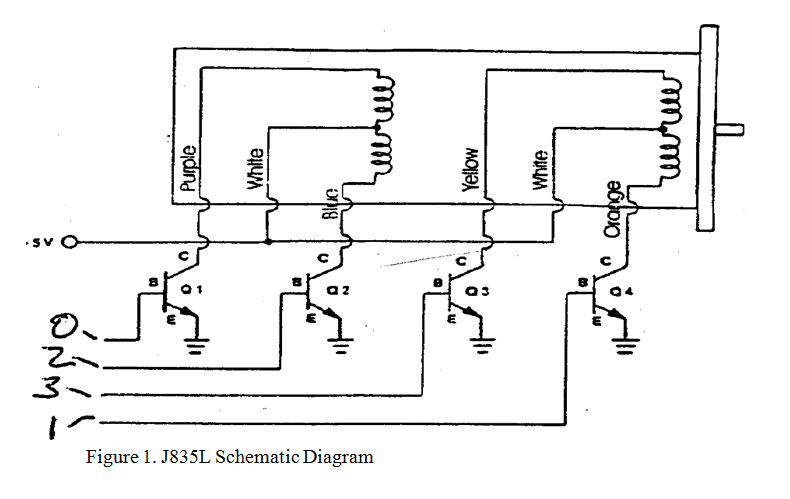
also, the motor has the following information printed on its label:
Uni-Polar, Bi-Filar
120 Ohms
7.5° per step or 48 full steps per revolution
JARL J835L PM 24P
I have connected a ULN2003A ("focus.ti.com/lit/ds/symlink/uln2003a.pdf"[/URL]) between my uC and the motor like this:
[ATTACH=full]130959[/ATTACH]
where:
B = blue wire
P = purple wire
Y = yellow wire
O = orange wire
W = white wire
I have tried driving the circuit in these two orders:
Step POBY and PYBO
1 1000 1000
2 0100 0100
3 0010 0010
4 0001 0001
5 1000 1000
. . .
. . .
Where 1 has been verified to be 10v and 0 is 0v. I set each step and then wait for .1ms. The motor then just vibrates. Can anyone give me a pointer?
Thanks!
Sam
also, the motor has the following information printed on its label:
Uni-Polar, Bi-Filar
120 Ohms
7.5° per step or 48 full steps per revolution
JARL J835L PM 24P
I have connected a ULN2003A ("focus.ti.com/lit/ds/symlink/uln2003a.pdf"[/URL]) between my uC and the motor like this:
[ATTACH=full]130959[/ATTACH]
where:
B = blue wire
P = purple wire
Y = yellow wire
O = orange wire
W = white wire
I have tried driving the circuit in these two orders:
Step POBY and PYBO
1 1000 1000
2 0100 0100
3 0010 0010
4 0001 0001
5 1000 1000
. . .
. . .
Where 1 has been verified to be 10v and 0 is 0v. I set each step and then wait for .1ms. The motor then just vibrates. Can anyone give me a pointer?
Thanks!
Sam
Attachments

Last edited by a moderator: