Strange Nucleation Sites Inside a Diet Pepsi Bottle?

Click For Summary
SUMMARY

The discussion centers on the observation of nucleation points inside Diet Pepsi bottles, specifically in the top area near the cap of 1.25-liter bottles. Participants debate the nature of these sites, questioning whether they are true nucleation sites or merely surface irregularities caused by the bottle production process. The consensus suggests that these points may facilitate the release of carbon dioxide, similar to the effect seen with Mentos, but are not classified as nucleation sites in the traditional sense due to the absence of a phase transition. Further testing and exploration of the bottle's surface characteristics are recommended to understand the phenomenon better.

PREREQUISITES
  • Understanding of nucleation processes in physical chemistry
  • Familiarity with the properties of carbonated beverages
  • Knowledge of plastic manufacturing processes
  • Basic principles of surface chemistry and hydrophilicity/hydrophobicity
NEXT STEPS
  • Research the role of surface irregularities in nucleation processes
  • Investigate the effects of different bottle materials on carbonation retention
  • Explore the chemistry of carbon dioxide release in carbonated beverages
  • Examine the production processes of plastic bottles and their impact on surface properties
USEFUL FOR

This discussion is beneficial for food scientists, beverage manufacturers, and anyone interested in the physical chemistry of carbonated drinks and packaging materials.

GraphicNerdity333
Messages
2
Reaction score
0
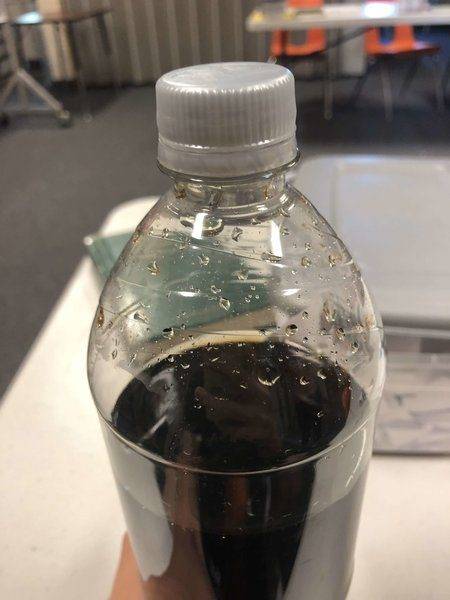
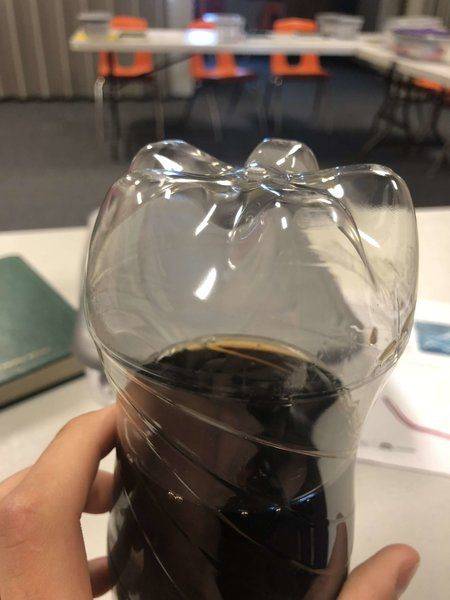
I have found some odd Nucleation points that appear inside of the top area of a bottle of Diet Pepsi (the area right near the cap as shown in pictures below).
Snapchat-1697212459.jpg
The nucleation sites appear either as soon as you open the bottle, or after the first drink (I will test this once more and see exactly when it happens and will update this thread). I have only seen this on the 1.25 liter bottles, but have not looked specifically for them on the regular bottles or the 1 liter bottles. I have not tested this with regular Pepsi, but only diet at the moment. Further testing will ensue, and this thread will remain updated. My questions are: what causes these Nucleation sites? Are these put in by the manufacturer (and if so, what purpose do they serve)? What exactly are they (scratches, tiny irregularities, dust, saliva, etc.)? Why do they only appear near the top, while the rest of the bottle does not have them(as shown below)?
Snapchat-1697212459.jpg
Snapchat-548894044.jpg
Snapchat-49386621.jpg
Are they even nucleation sites (I assume they are because of the way the diet Pepsi is able to stick to them, and the way they cause the diet Pepsi to release small amounts of carbon), or am I misinterpreting what I am seeing? Any and all answers would be helpful.
 

Attachments

  • Snapchat-548894044.jpg
    Snapchat-548894044.jpg
    30.6 KB · Views: 806
  • Snapchat-1697212459.jpg
    Snapchat-1697212459.jpg
    31.3 KB · Views: 1,224
  • Snapchat-49386621.jpg
    Snapchat-49386621.jpg
    28.3 KB · Views: 721
Chemistry news on Phys.org
Do I understand you correctly that by "nucleation sites" you mean places where the droplets of the liquid stay on the internal surface of bottle?

I am not sure I would not call them "nucleation sites" as IMHO nucleation typically refers to the phase transition process and there is no phase transition here, you start with a liquid and the liquid is present all the time. Then, there is kind of resemblance of what is happening to the nucleation processes, apparently plastic surface is not homogeneous.

My bet is that it is some side effect of the bottle production process. Most likely these inhomogeneities are initially present on the whole surface, but whatever causes them gets dissolved in the Pepsi.
 
Borek said:
Do I understand you correctly that by "nucleation sites" you mean places where the droplets of the liquid stay on the internal surface of bottle?

I am not sure I would not call them "nucleation sites" as IMHO nucleation typically refers to the phase transition process and there is no phase transition here, you start with a liquid and the liquid is present all the time. Then, there is kind of resemblance of what is happening to the nucleation processes, apparently plastic surface is not homogeneous.

My bet is that it is some side effect of the bottle production process. Most likely these inhomogeneities are initially present on the whole surface, but whatever causes them gets dissolved in the Pepsi.

That makes a lot of sense to me. The reason I thought of them as Nucleation points is because they are able to draw the carbon dioxide out of the diet Pepsi (much like mentos but at a much much MUCH slower rate. I tried to include a video of this, but could not) when the diet Pepsi is in contact with them. I had heard that the surface of mentos were covered in tiny pores that acted as Nucleation sites. Would this new information still be consistent with your theory?
 
As I wrote - what you observe is in a way related to the processes in which we use the name "nucleation site", so the analogy is OK, I just don't think I have ever seen the name "nucleation sites" used in such a context.

Actually it is not just pores that are important, it is more about places where some surface property is discontinuous. It can be a difference in curvature (pores and bumps), it can be a difference in hydrophilicicty or hydrophobicity, it can even be something as small as crystallographic defect. Not every such place will serve as a nucleation site, some will behave as "antinucleation sites".

GraphicNerdity333 said:
Would this new information still be consistent with your theory?

Yes, it is all perfectly consistent.
 

Similar threads

  • · Replies 15 ·
Replies
15
Views
1K
  • · Replies 43 ·
2
Replies
43
Views
14K
  • · Replies 19 ·
Replies
19
Views
9K
  • · Replies 20 ·
Replies
20
Views
11K
  • · Replies 14 ·
Replies
14
Views
7K
  • · Replies 186 ·
7
Replies
186
Views
92K
  • · Replies 3 ·
Replies
3
Views
3K
  • · Replies 30 ·
2
Replies
30
Views
4K
  • · Replies 16 ·
Replies
16
Views
3K
Replies
3
Views
459