Stress analysis for a Bent Pipe

Click For Summary
SUMMARY

The discussion focuses on the stress analysis required for designing a gooseneck, a 45-degree bent pipe used in sub-sea pipelines. The group has successfully calculated burst pressure, longitudinal loads, collapse pressure, and bending stress using API standard 1111. However, they are struggling with calculating shear stresses and axial stresses. The conversation highlights the need for understanding curved beam analysis, which differs from traditional straight beam methods, and suggests resources for further learning.

PREREQUISITES
  • Understanding of API standard 1111 for pipeline design
  • Knowledge of bending moments, tension, and shear in mechanical engineering
  • Familiarity with curved beam theory and its application in stress analysis
  • Basic principles of strength of materials and stress calculations
NEXT STEPS
  • Research "curved beam bending" techniques and formulas
  • Study shear stress calculations specific to curved beams
  • Explore axial stress analysis methods for bent pipes
  • Review advanced strength of materials resources for deeper insights
USEFUL FOR

This discussion is beneficial for mechanical engineering students, pipeline design engineers, and professionals involved in stress analysis of curved structures.

Runeforged
Messages
1
Reaction score
0
I am a student currently working on a group project regarding the design of a gooseneck for a sub-sea pipeline. For those not familiar, a gooseneck is essentially a 45 degree bent pipe, to be used as a connection between a manifold and a longer pipeline (a flexible riser). part of this design is a stress analysis to prove its strength. This has proven to be much harder than anticipated, so i would like to ask for some pointers.

We already know our bending moment, tension and shear.

So far we've been able to calculate for burst pressure,longitudinal and combined longitudinal loads, collapse pressure (all from the API standard 1111), and bending stress. We have however not been able to calculate for shear stresses (would calculating the hoop stress be sufficient for this?) and axial stresses, how would we go about this? Any other calculation you feel need to be added for a more complete stress analysis? Any feedback is welcome as we are very much amateurs when it comes to mechanical engineering.

Below is a force diagram of how we've understood the forces acting on the pipe.
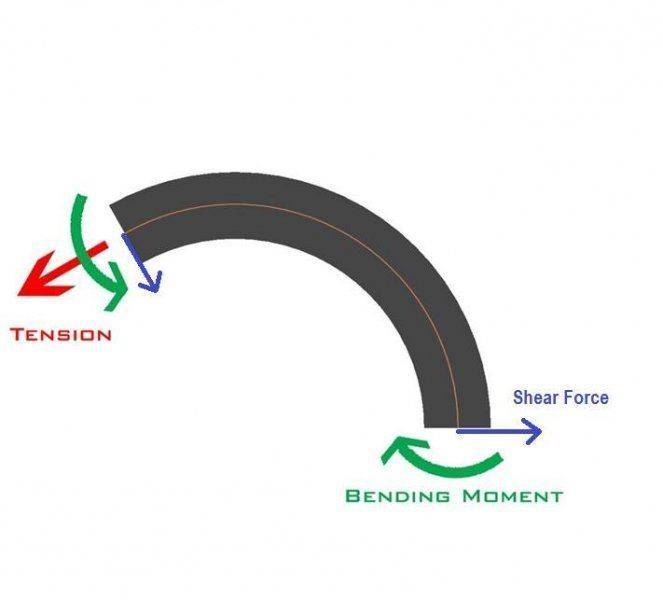
10833920_10203974435375861_7346814_n.jpg
 
Last edited:
Engineering news on Phys.org
It looks like you've got a curved beam here, which is analyzed in a slightly different manner than a regular straight beam. Things like the location of the neutral axis and calculating the bending stress in a curved beam use different formulas than the regular formulas every engineering student is taught about straight beams.

Most of this stuff gets taught in advanced strength of materials courses, but here are some articles to show some of the basics:

https://www.clear.rice.edu/mech400/Winkler_curved_beam_theory.pdf

http://www.roymech.co.uk/Useful_Tables/Beams/Curved_beams.html

Googling "curved beam bending" and such will bring up additional articles.
 
  • Like
Likes   Reactions: Runeforged

Similar threads

  • · Replies 3 ·
Replies
3
Views
6K
  • · Replies 9 ·
Replies
9
Views
3K
  • · Replies 2 ·
Replies
2
Views
2K
  • · Replies 2 ·
Replies
2
Views
3K
  • · Replies 3 ·
Replies
3
Views
4K
  • · Replies 11 ·
Replies
11
Views
3K
  • · Replies 21 ·
Replies
21
Views
14K
  • · Replies 2 ·
Replies
2
Views
2K
  • · Replies 4 ·
Replies
4
Views
6K
  • · Replies 3 ·
Replies
3
Views
8K