Stresses on a 3/16" fillet weld due to bending

  • Thread starter Thread starter Satonam
  • Start date Start date
  • Tags Tags
    Bending
Click For Summary
SUMMARY

The discussion focuses on the stresses experienced by a 3/16" fillet weld subjected to a bending moment due to a 125 lb load applied 2.5" from the weld. The calculations involve determining direct stress, bending stress, and the second moment of inertia using the parallel axis theorem. Key corrections were made regarding the treatment of shear stress and the use of full penetration bevel welds instead of fillet welds for enhanced structural integrity. Participants emphasized the importance of accurately calculating stress components and considering weld types based on plate thickness.

PREREQUISITES
  • Understanding of stress analysis in welded structures
  • Familiarity with the parallel axis theorem
  • Knowledge of fillet welds and full penetration bevel welds
  • Experience with calculating moments and stresses in mechanical design
NEXT STEPS
  • Study the calculation of shear stress in welded connections
  • Learn about full penetration bevel weld design and applications
  • Research the implications of using different weld types on structural integrity
  • Explore advanced stress analysis techniques such as Von Mises stress
USEFUL FOR

Mechanical engineers, structural designers, and welders involved in the design and analysis of welded joints, particularly those working with thin plate materials and load-bearing structures.

Satonam
Messages
38
Reaction score
1
Hello,

The resource I'm using is "Design of Machine Elements" by Spotts and, although they have examples of tensile and torsional stress, they don't show any examples with a load which causes a moment.

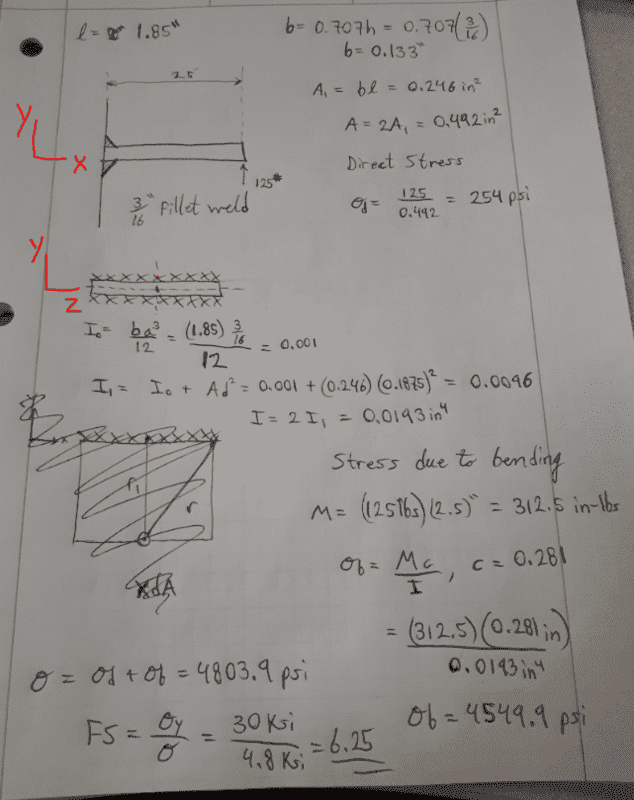
What we have here is web of 3/16" thickness and 1.85" depth welded onto a rigid body from both sides along its entire depth. In other words, 3/16" fillet welds with a 1.85" length. The 125 lb load is applied 2.5" from the weld.

My reasoning:

I calculated the direct stress by dividing the 125 lb load by the total throat area of the fillets. Next, I want to find the stress due to bending. Because the welds are on the same plane and symmetrical, the center of gravity of the weld group (cg) is located 3/32" into the thickness of the web. I then calculated the second moment of inertia of a single weld about its individual center of gravity (cgo), where b = length of weld = 1.85" and a = height of weld = 3/16", so,

Io = ba^3/12

Next, I used the parallel axis theorem to find the inertia at the center of gravity of both welds, where the distance between cg and cgo is d = 3/16"

I = Io + Ad^2

Due to symmetry, I is then multiplied by 2 to account for the second weldment.

Finally, the moment acting at the weld location M = (125 lbs)(2.5")

Stress due to bending is Mc/I, where c is the distance from cg to top of weld (c = 9/32")

Lastly, I added the direct stress to the bending stress. With a given yield stress, I calculated FS as usual.

Is this clear enough? Does my reasoning make sense?

If required, I can add better images later to clarify.
244688
 
Last edited:
Engineering news on Phys.org
Satonam said:
Hello,

The resource I'm using is "Design of Machine Elements" by Spotts and, although they have examples of tensile and torsional stress, they don't show any examples with a load which causes a moment.

What we have here is web of 3/16" thickness and 1.85" depth welded onto a rigid body from both sides along its entire depth. In other words, 3/16" fillet welds with a 1.85" length. The 125 lb load is applied 2.5" from the weld.

My reasoning:

I calculated the direct stress by dividing the 125 lb load by the total throat area of the fillets. Next, I want to find the stress due to bending. Because the welds are on the same plane and symmetrical, the center of gravity of the weld group (cg) is located 3/32" into the thickness of the web. I then calculated the second moment of inertia of a single weld about its individual center of gravity (cgo), where b = length of weld = 1.85" and a = height of weld = 3/16", so,

Io = ba^3/12

Next, I used the parallel axis theorem to find the inertia at the center of gravity of both welds, where the distance between cg and cgo is d = 3/16"

I = Io + Ad^2

Due to symmetry, I is then multiplied by 2 to account for the second weldment.

Finally, the moment acting at the weld location M = (125 lbs)(2.5")

Stress due to bending is Mc/I, where c is the distance from cg to top of weld (c = 9/32")

Lastly, I added the direct stress to the bending stress. With a given yield stress, I calculated FS as usual.

Is this clear enough? Does my reasoning make sense?

If required, I can add better images later to clarify.

View attachment 244688
That's almost right, but when you doubled the I for symmetry, you should instead double the Ad^2 term, where A is the area of one weld, and add it to I_o. Don't double the I_o. Also, when you add the weld shear stress from the vertical load to the weld bending stress, you need to get the vector sum (sq rt of sum of squares) or use Von Mise.
It seems that the 3/16 inch plate is rather flimsy, the welds might hold but the plate seems to be above yield stress, based on a quick calc I did.
Also, I don't particularly like using fillet welds for a weak axis cantilever moment fixed connection , I prefer to use full penetration bevel welds.
 
  • Like
Likes   Reactions: berkeman
PhanthomJay said:
That's almost right, but when you doubled the I for symmetry, you should instead double the Ad^2 term, where A is the area of one weld, and add it to I_o. Don't double the I_o. Also, when you add the weld shear stress from the vertical load to the weld bending stress, you need to get the vector sum (sq rt of sum of squares) or use Von Mise.

Thanks! Those are very good points. I mislabeled the stress due to the vertical load as "direct stress" when it's actually a shear stress, which can't be added directly to the stress due to bending since it's an axial stress.

244868


It seems that the 3/16 inch plate is rather flimsy, the welds might hold but the plate seems to be above yield stress, based on a quick calc I did.

True, I actually don't expect the plate to support 125 lbs, I just used that value to make sure I have the math and reasoning down. However, I might have to beef up the plate regardless depending on how close to that value the load becomes.

Also, I don't particularly like using fillet welds for a weak axis cantilever moment fixed connection , I prefer to use full penetration bevel welds.

I didn't consider bevel welds because, according to my reference (Pg. 411), welded joints should be beveled if the thickness is 1/4" thick or heavier, is that not your experience in practice?
 
I typically use 1/4 inch minimum plate thicknesses because when thinner, they are prone to handling damage and also when corrosion occurs, there is a higher loss percentage of steel thickness (perhaps). But complete penetration bevel welds are still ok with 3/16 inch plate (root opening about 1/4 inch). Then its nice to finish off the joint with a 3/16 inch fillet weld all around or both sides.
 

Similar threads

  • · Replies 5 ·
Replies
5
Views
6K
  • · Replies 30 ·
2
Replies
30
Views
8K
  • · Replies 5 ·
Replies
5
Views
14K
Replies
33
Views
5K
  • · Replies 4 ·
Replies
4
Views
3K
  • · Replies 2 ·
Replies
2
Views
2K
  • · Replies 2 ·
Replies
2
Views
2K
  • · Replies 8 ·
Replies
8
Views
9K
  • · Replies 3 ·
Replies
3
Views
5K
  • · Replies 5 ·
Replies
5
Views
12K