Stunning 2017 Eclipse Photos of the Corona Chromosphere
Join the discussion
Registration is free. Start your own thread to ask a follow-up.
68 replies · 11K views
Astronomy news on Phys.org
Discussion
hsdrop
- 324
- 114
hsdrop
- 324
- 114
I was in Carbondale, Ill if anyone was wondering.
- 22,832
- 14,880
https://www.gimp.org/hsdrop said:I would love to have some help finding a photoshop like program to help me doctor up the pics a bit. If anyone could suggest any to me it would be wonderful.
hsdrop
- 324
- 114
hoooooo thank you so muchOrodruin said:
GetOffMyLawn
From Manning, SC


Science Advisor
Gold Member
- 1,753
- 143
My 360 Video:
- 20,002
- 11,121
Keep posting your photos! I'd love to select about a dozen of the best and put them in an Insight!
OmCheeto
Gold Member
- 2,536
- 3,663
tony873004 said:My 360 Video:
On a scale of 1 to 10, I give your video a 1000 rating.

OmCheeto
Gold Member
- 2,536
- 3,663
.Scott said:I wasn't anywhere near totality, but I would like to see photos of the shadow banding - if anyone has some of those.
I found one image:
Oh. Wait. Did you say banding? And not "handing"?
My bad.
Science Advisor
Homework Helper
- 4,072
- 2,122
In my experience, you would need a much larger area than the sheet they are using.OmCheeto said:I found one image:
Oh. Wait. Did you say banding? And not "handing"?
My bad.
I saw it on the surface of a parking lot in Virginia a few decades ago.
OmCheeto
Gold Member
- 2,536
- 3,663
Best/worst pun of the eclipse I've seen so far:

Totalitea. (It took me a minute. I'm old. And my brain doesn't think that fast anymore.)
- 3,777
- 2,002
A couple of points of interest in the photo I got. The colored dots on the edge of the disk are caused by solar prominences. ( I didn't realize this until I saw some higher res photos that showed them clearer in those positions.
I also caught the star Regulus in the shot. it is the white dot in the lower left of the image.
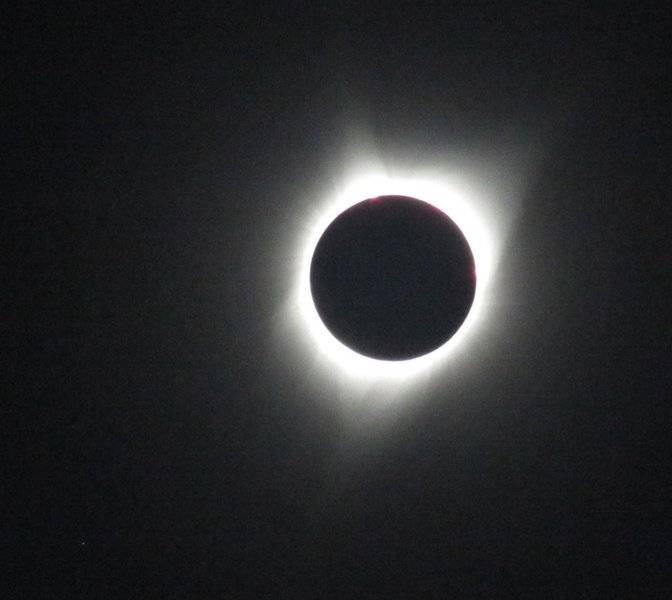
I also caught the star Regulus in the shot. it is the white dot in the lower left of the image.
OmCheeto
Gold Member
- 2,536
- 3,663
Janus said:A couple of points of interest in the photo I got. The colored dots on the edge of the disk are caused by solar prominences. ( I didn't realize this until I saw some higher res photos that showed them clearer in those positions.
I also caught the star Regulus in the shot. it is the white dot in the lower left of the image.
View attachment 209606
I also caught Regulus.
Though, I thought I should edit the photo, as it's a bit difficult to find.
David_777
- 13
- 10
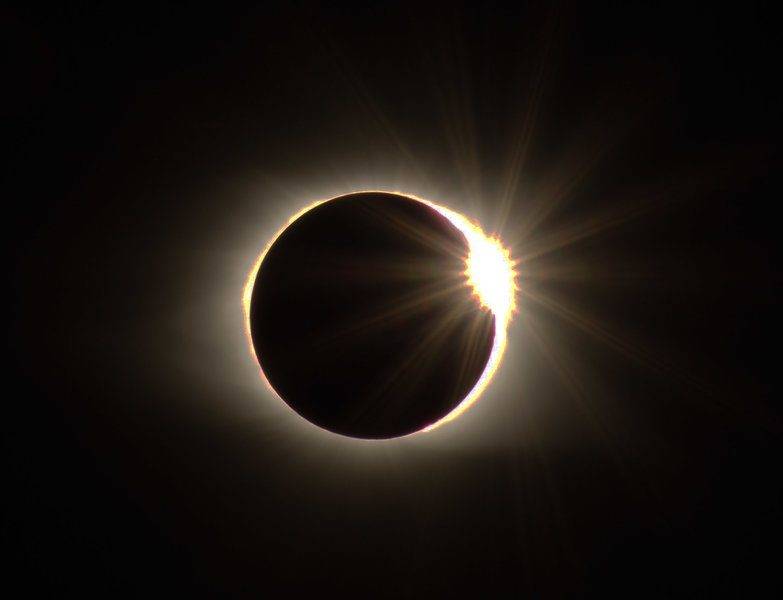
About 10:18am Monday August 21, 2017 from Riverfront Park within a large crowd in Salem, Oregon at the totality exit stage.
Sony SEL55210 zoom at 210mm on A6000 , Aperture Priority, F14, Exposure Compensation -3, ISO 200, 1/5 second, Spot Auto Focus on sun/moon edge, on tripod. Cropped to 3500x4600 pixels though not tack sharp.
Not a very serious image on my part as I don't have specialized astronomy gear. After watching eclipse totality, at end decided to try to get a single token shot during the diamond ring phase. Without much time to monkey with my camera controls I changed the Exposure Compensation from -1 where it had been prior to totality while taking crowd photos down to -3 hoping that might be about right. Was very lucky with that as histogram shows just a bit of the diamond clipping. Although I pushed my Infrared Remote Shutter just as the sun re-appeared, there is a delay so I got a larger diamond than intended but maybe that worked out for the better as it caused more rays across the face of the dark moon enhancing its graphic. Although nicely sunny clear skies, that west central Oregon region has marine air with considerable water vapor that I'd expect contributes to more atmospheric scattering rays beyond the suns own corona light. Note other post identifies the star lower left of the sun. There is also something with a blue streak at frame bottom left corner that I also saw on another photo from the Salem area? Notice the prismic colors radiating between ray bands both above and below the diamond axis? Is that also something due to polarized light from the diamond being affected by water vapor? Certainly adds a nice effect. What about the slight halo around the moon edge, is that chromatic aberation or real? On the upper left quadrant that is yellow while at lower right is blue. Below is a 100% pixels crop.
David
Last edited:
Morph46
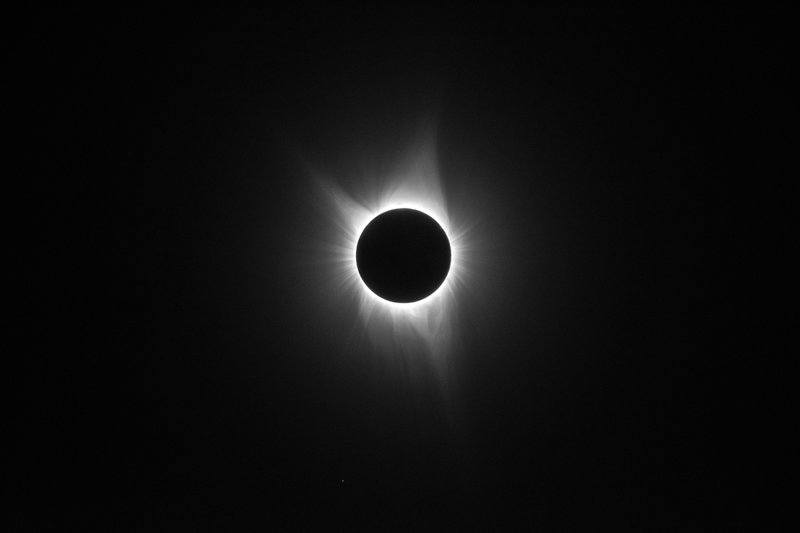
300mm f/8 400ISO post processed in Lightroom 6
Stavros Kiri
- 1,148
- 1,014
Due to the moon's craters? (The moon surface is not perfect round etc.)Janus said:The colored dots on the edge of the disk are caused by solar prominences.
- 3,777
- 2,002
No, due to eruptions on the surface of the Sun like this:Stavros Kiri said:Due to the moon's craters? (The moon surface is not perfect round etc.)
Stavros Kiri
- 1,148
- 1,014
Isn't that kind of rare? NASA on the live streaming mentioned the explanation that I quoted. I am not sure which one is true.Janus said:No, due to eruptions on the surface of the Sun like this:
View attachment 209626
[Specifically, there was a lady from NASA saying that ~"the orange/purple colour effects on the edge of the sun is just sun light escaping though the imperfections of the moon (small bites, you can see), e.g. craters etc., because the moon surface is not a perfect round ..."]
But what is definitely true is that big flares are kind of rare (not a common everyday thing). Are small eruptions visible during the eclipse, e.g. with your instrument set up? I am not sure, but I kind of doubt that.
Last edited:
- 3,777
- 2,002
I wouldn't have been sure myself but my wife came across a photo taken of this eclipse that showed the prominences like this one does from a different eclipse.Stavros Kiri said:Isn't that kind of rare? NASA on the live streaming mentioned the explanation that I quoted. I am not sure which one is true.
[Specifically, there was a lady from NASA saying that ~"the orange/purple colour effects on the edge of the sun is just sun light escaping though the imperfections of the moon (small bites, you can see), e.g. craters etc., because the moon surface is not a perfect round ..."]
But what is definitely true is that big flares are kind of rare (not a common everyday thing). Are small eruptions visible during the eclipse, e.g. with your instrument set up? I am not sure, but I kind of doubt that.
https://cdn.vox-cdn.com/uploads/chorus_asset/file/8889861/Solar_eclipse_1999_4_NR.jpg
and they were positioned exactly where the colored spots are in my photo.
Stavros Kiri
- 1,148
- 1,014
But eruptions cannot be in the same places since 1999, while moon craters can. I think on the contrary that supports NASA's interpretation, with which I tend to agree myself. You can actually see the openings of the craters as small bites under the colored spots. Now that I recall they also said on the broadcast that "it's an optical tricking of light escaping through the craters, and no sun activity!", because, "other than the two spot groups" (AR2671, AR2672), "there is nothing else significant on the sun right now" [/then]. [i.e. no solar flares - the last one was Sun Aug. 20]Janus said:and they were positioned exactly where the colored spots are in my photo.
See also:
https://www.physicsforums.com/threads/solar-activity-and-space-weather-update-thread.923468/
- 3,777
- 2,002
The photo I linked to was from a different eclipse. I was just using it to illustrate what the prominences looked like in the photo my wife found of this eclipse, where the positions of the prominences matched those of the spots on my photo. Besides, solar prominences are not the same thing as solar flares.Stavros Kiri said:But eruptions cannot be in the same places since 1999, while moon craters can. I think on the contrary that supports NASA's interpretation, with which I tend to agree myself. You can actually see the openings of the craters as small bites under the colored spots. Now that I recall they also said on the broadcast that "it's an optical tricking of light escaping through the craters, and no sun activity!", because, "other than the two spot groups" (AR2671, AR2672), "there is nothing else significant on the sun right now" [/then]. [i.e. no solar flares - the last one was Sun Aug. 20]
See also:
https://www.physicsforums.com/threads/solar-activity-and-space-weather-update-thread.923468/
In addition, this photo and the I took prior to it were taken at the beginning of totality, where the the Sun peaking through craters would have been on the other side of the moon. Further, in both photos I took, the spots look identical. If they had been caused by light through craters, they would have changed even in the little time between the two exposures or showed up in one and not the other.. Prominences, on the other hand, can last for months.
hsdrop
- 324
- 114
OmCheeto said:Best/worst pun of the eclipse I've seen so far:
View attachment 209605
Totalitea. (It took me a minute. I'm old. And my brain doesn't think that fast anymore.)
I thought it would have been teatality
Science Advisor
Gold Member
- 9,747
- 11,967
Janus said:No, due to eruptions on the surface of the Sun like this:
correct
and like this...
https://www.bing.com/images/search?q=solar+prominences&FORM=HDRSC2
Stavros Kiri said:Isn't that kind of rare?
NO, they are happening all the time ... you just have a gap and misunderstanding

no bit hassle ... easily solved
Stavros Kiri said:NASA on the live streaming mentioned the explanation that I quoted. I am not sure which one is true.
[Specifically, there was a lady from NASA saying that ~"the orange/purple colour effects on the edge of the sun is just sun light escaping though the imperfections of the moon (small bites, you can see), e.g. craters etc., because the moon surface is not a perfect round ..."]
That occurs ... its called Bailey's Beads ...
here's baileys beads AND prominences ...
Baileys Beads are ALWAYS white ( bright)
Prominences are ALWAYS red to orangeDave
Science Advisor
Gold Member
- 9,747
- 11,967
Stavros Kiri said:But what is definitely true is that big flares are kind of rare (not a common everyday thing).
another misunderstanding ... Flares and Prominences are two different animals
Flares can cause prominences BUT prominences are occurring on their own ALL the time
Dave
Science Advisor
Gold Member
- 9,747
- 11,967
Stavros Kiri said:I think on the contrary that supports NASA's interpretation, with which I tend to agree myself. You can actually see the openings of the craters as small bites under the colored spots. Now that I recall they also said on the broadcast that "it's an optical tricking of light escaping through the craters, and no sun activity!",
Again you are misunderstanding the NASA explanations with which there is no problem with, see my earlier posts
Stavros Kiri
- 1,148
- 1,014
Back in 1999Janus said:The photo I linked to was from a different eclipse.
That's the problem! They haven't changed since 1999? Whereas most craters haven't ...Janus said:where the positions of the prominences matched those of the spots on my photo.
I am aware of that. But solar activity reports included none of those during or after the eclipse. (There could be some small prominences though, but I think that what you saw was due to the craters of the moon, and NASA seems to agree. However I am researching this further. [That lady, representative of NASA, could still be wrong. And they look like prominences, I agree. That was my first impression too. I hope we'll find out, to be sure.])Janus said:Besides, solar prominences are not the same thing as solar flares.
(We also have to keep in mind that as we are heading towards solar minimum, the solar activity is limitted and is winding down.)
I am not sure if I know what you mean here. In any case the moon's shape and craters definitelly remains unchanged during all phases of totality. Sun's light passing through the craters though can vary, probably causing that effect.Janus said:where the the Sun peaking through craters would have been on the other side of the moon.
But not since your wife's photo back in 1999! It's probably due to craters (most of the fire glows that you captured in both cases (other people did too); it's more logical). There may have been some small prominences too though, but I can't say unless I research this further and look at official reports.Janus said:Prominences, on the other hand, can last for months.
arydberg
- 244
- 31
These probably will not post but here is a link to some pictures.
http://www.maverickexperiments.com/eclipse/eclipse.html
Al
http://www.maverickexperiments.com/eclipse/eclipse.html
Al
Science Advisor
Gold Member
- 9,747
- 11,967
Stavros Kiri said:But solar activity reports included none of those during or after the eclipse.
there were prominences visible during the eclipse, many people photo'ed them
It is difficult, due to the longer exposure of Janus's pic, whether he really caught prominences.
needs a much shorter exposure to see them clearly as they are totally overridden by the brightness of the corona
I personally wouldn't be quick to say an absolute yes to them being that
Stavros Kiri said:(There could be some small prominences though, but I think that what you saw was due to the craters of the moon, and NASA seems to agree. However I am researching this further. [That lady, representative of NASA, could still be wrong. And they look like prominences, I agree. That was my first impression too. I hope we'll find out, to be sure.])
I have given you a response to that ... NASA wasn't wrong

Stavros Kiri said:I am not sure if I know what you mean here. In any case the moon's shape and craters definitelly remains unchanged during all phases of totality.
but not between different eclipses
Stavros Kiri said:(We also have to keep in mind that as we are heading towards solar minimum, the solar activity is limitted and is winding down.)
yes, but that doesn't slow down prominence activity to any great extent, just the number of sunspots and flares
Dave
Similar threads
- smodak
- · Replies 5 ·
- Special and General Relativity
- Replies
- 5
- sphyics
- · Replies 1 ·
- Astronomy, Astrophysics, Cosmology
- Replies
- 1