- 11,420
- 750
corona
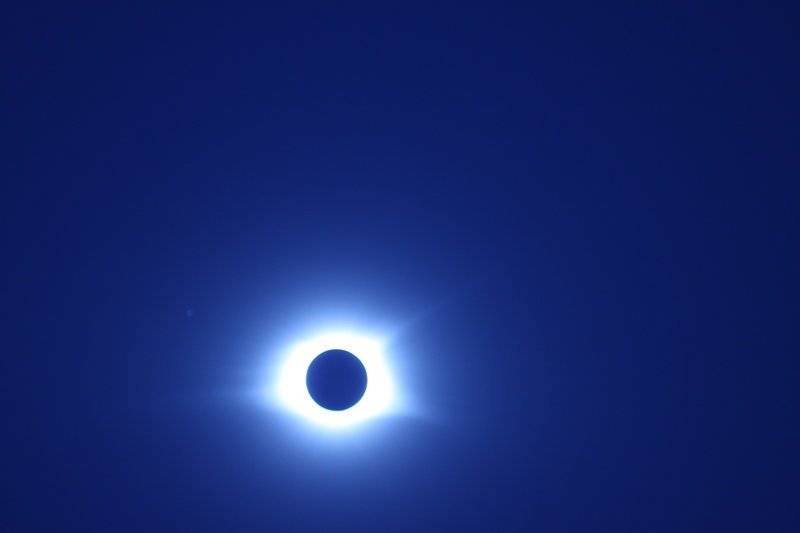
chromosphere
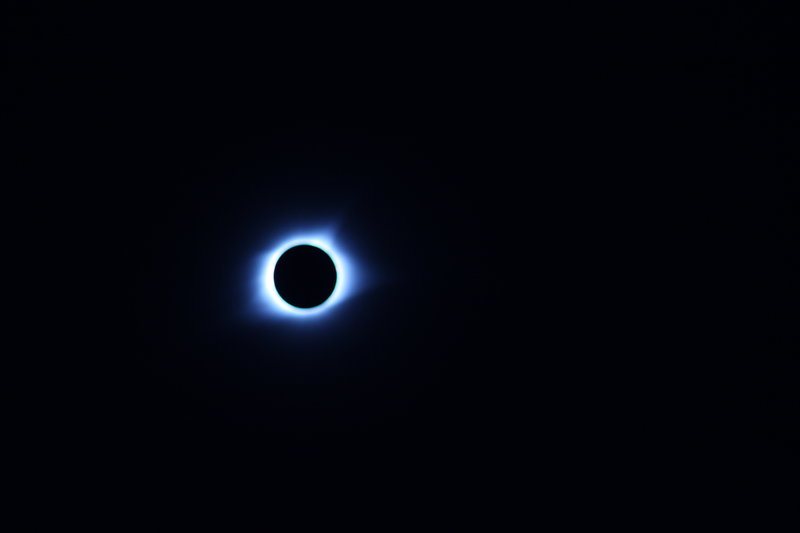
chromosphere
The discussion revolves around the 2017 solar eclipse, specifically focusing on the visual phenomena observed during the event, such as the corona and chromosphere, as well as the sharing of personal photographs and experiences. Participants also explore the scientific explanations behind certain visual effects, including solar prominences and the appearance of the moon's surface.
Participants express differing views on the causes of the colored dots observed during the eclipse, with some supporting NASA's explanation while others advocate for the prominence theory. The discussion remains unresolved regarding the accuracy of these interpretations.
Participants reference various photographic techniques and conditions that may affect the appearance of images taken during the eclipse, highlighting the complexity of capturing such phenomena. There is also a reliance on anecdotal evidence and personal experiences, which may not be universally applicable.

https://www.gimp.org/hsdrop said:I would love to have some help finding a photoshop like program to help me doctor up the pics a bit. If anyone could suggest any to me it would be wonderful.
hoooooo thank you so muchOrodruin said:
tony873004 said:My 360 Video:

.Scott said:I wasn't anywhere near totality, but I would like to see photos of the shadow banding - if anyone has some of those.
In my experience, you would need a much larger area than the sheet they are using.OmCheeto said:I found one image:
Oh. Wait. Did you say banding? And not "handing"?
My bad.
Janus said:A couple of points of interest in the photo I got. The colored dots on the edge of the disk are caused by solar prominences. ( I didn't realize this until I saw some higher res photos that showed them clearer in those positions.
I also caught the star Regulus in the shot. it is the white dot in the lower left of the image.
View attachment 209606
Due to the moon's craters? (The moon surface is not perfect round etc.)Janus said:The colored dots on the edge of the disk are caused by solar prominences.
No, due to eruptions on the surface of the Sun like this:Stavros Kiri said:Due to the moon's craters? (The moon surface is not perfect round etc.)
Isn't that kind of rare? NASA on the live streaming mentioned the explanation that I quoted. I am not sure which one is true.Janus said:No, due to eruptions on the surface of the Sun like this:
View attachment 209626
I wouldn't have been sure myself but my wife came across a photo taken of this eclipse that showed the prominences like this one does from a different eclipse.Stavros Kiri said:Isn't that kind of rare? NASA on the live streaming mentioned the explanation that I quoted. I am not sure which one is true.
[Specifically, there was a lady from NASA saying that ~"the orange/purple colour effects on the edge of the sun is just sun light escaping though the imperfections of the moon (small bites, you can see), e.g. craters etc., because the moon surface is not a perfect round ..."]
But what is definitely true is that big flares are kind of rare (not a common everyday thing). Are small eruptions visible during the eclipse, e.g. with your instrument set up? I am not sure, but I kind of doubt that.
But eruptions cannot be in the same places since 1999, while moon craters can. I think on the contrary that supports NASA's interpretation, with which I tend to agree myself. You can actually see the openings of the craters as small bites under the colored spots. Now that I recall they also said on the broadcast that "it's an optical tricking of light escaping through the craters, and no sun activity!", because, "other than the two spot groups" (AR2671, AR2672), "there is nothing else significant on the sun right now" [/then]. [i.e. no solar flares - the last one was Sun Aug. 20]Janus said:and they were positioned exactly where the colored spots are in my photo.
The photo I linked to was from a different eclipse. I was just using it to illustrate what the prominences looked like in the photo my wife found of this eclipse, where the positions of the prominences matched those of the spots on my photo. Besides, solar prominences are not the same thing as solar flares.Stavros Kiri said:But eruptions cannot be in the same places since 1999, while moon craters can. I think on the contrary that supports NASA's interpretation, with which I tend to agree myself. You can actually see the openings of the craters as small bites under the colored spots. Now that I recall they also said on the broadcast that "it's an optical tricking of light escaping through the craters, and no sun activity!", because, "other than the two spot groups" (AR2671, AR2672), "there is nothing else significant on the sun right now" [/then]. [i.e. no solar flares - the last one was Sun Aug. 20]
See also:
https://www.physicsforums.com/threads/solar-activity-and-space-weather-update-thread.923468/
OmCheeto said:Best/worst pun of the eclipse I've seen so far:
View attachment 209605
Totalitea. (It took me a minute. I'm old. And my brain doesn't think that fast anymore.)
Janus said:No, due to eruptions on the surface of the Sun like this:
Stavros Kiri said:Isn't that kind of rare?

Stavros Kiri said:NASA on the live streaming mentioned the explanation that I quoted. I am not sure which one is true.
[Specifically, there was a lady from NASA saying that ~"the orange/purple colour effects on the edge of the sun is just sun light escaping though the imperfections of the moon (small bites, you can see), e.g. craters etc., because the moon surface is not a perfect round ..."]
Stavros Kiri said:But what is definitely true is that big flares are kind of rare (not a common everyday thing).
Stavros Kiri said:I think on the contrary that supports NASA's interpretation, with which I tend to agree myself. You can actually see the openings of the craters as small bites under the colored spots. Now that I recall they also said on the broadcast that "it's an optical tricking of light escaping through the craters, and no sun activity!",
Back in 1999Janus said:The photo I linked to was from a different eclipse.
That's the problem! They haven't changed since 1999? Whereas most craters haven't ...Janus said:where the positions of the prominences matched those of the spots on my photo.
I am aware of that. But solar activity reports included none of those during or after the eclipse. (There could be some small prominences though, but I think that what you saw was due to the craters of the moon, and NASA seems to agree. However I am researching this further. [That lady, representative of NASA, could still be wrong. And they look like prominences, I agree. That was my first impression too. I hope we'll find out, to be sure.])Janus said:Besides, solar prominences are not the same thing as solar flares.
I am not sure if I know what you mean here. In any case the moon's shape and craters definitelly remains unchanged during all phases of totality. Sun's light passing through the craters though can vary, probably causing that effect.Janus said:where the the Sun peaking through craters would have been on the other side of the moon.
But not since your wife's photo back in 1999! It's probably due to craters (most of the fire glows that you captured in both cases (other people did too); it's more logical). There may have been some small prominences too though, but I can't say unless I research this further and look at official reports.Janus said:Prominences, on the other hand, can last for months.
Stavros Kiri said:But solar activity reports included none of those during or after the eclipse.
Stavros Kiri said:(There could be some small prominences though, but I think that what you saw was due to the craters of the moon, and NASA seems to agree. However I am researching this further. [That lady, representative of NASA, could still be wrong. And they look like prominences, I agree. That was my first impression too. I hope we'll find out, to be sure.])

Stavros Kiri said:I am not sure if I know what you mean here. In any case the moon's shape and craters definitelly remains unchanged during all phases of totality.
Stavros Kiri said:(We also have to keep in mind that as we are heading towards solar minimum, the solar activity is limitted and is winding down.)