'Subducing head': pneumatic engine idea

  • Thread starter Thread starter Uncanny3
  • Start date Start date
  • Tags Tags
    Idea
Click For Summary
SUMMARY

The discussion centers on the concept of a 'subducing head', a proposed pneumatic engine that relies on pressure differentials within an air compression chamber. Participants assert that the design fails to account for essential principles of physics, particularly the conservation of energy and the necessity for airflow. Key criticisms include the lack of an exhaust mechanism and the impossibility of achieving movement without a continuous energy supply. Ultimately, the consensus is that the design resembles a perpetual motion machine, which is not feasible according to established engineering principles.

PREREQUISITES
  • Understanding of pneumatic systems and their mechanics
  • Knowledge of conservation of energy principles in engineering
  • Familiarity with airflow dynamics and pressure differentials
  • Basic grasp of mechanical design and functionality
NEXT STEPS
  • Study the principles of pneumatic motor design and efficiency
  • Research airflow dynamics and pressure management in mechanical systems
  • Learn about conservation of energy and its implications in engineering
  • Explore existing pneumatic engines and their operational mechanisms
USEFUL FOR

Inventors, mechanical engineers, students of physics, and anyone interested in the principles of pneumatic systems and energy conservation in mechanical designs.

Uncanny3
Messages
8
Reaction score
1
Hi,
I want to share my thought on what I have called a 'subducing head',
it's a pneumatic engine.
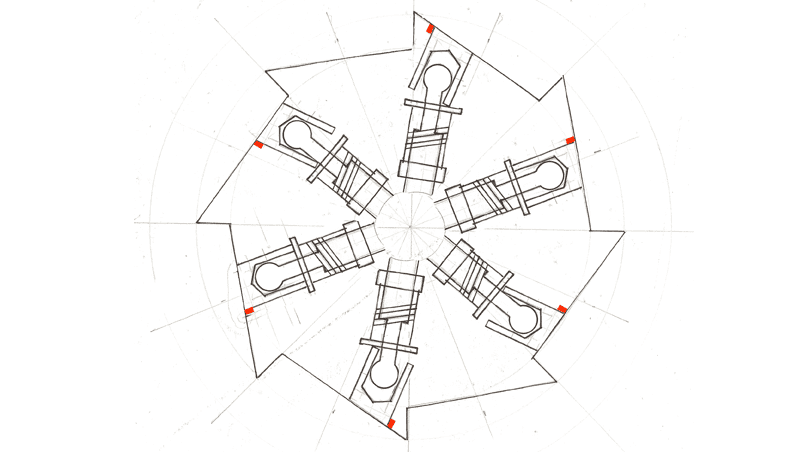
Here's the first drawing==>
gofund me power areas hand drawing.png

The concept is to apply more pressure on one side of a shape within an air compression chamber.
So the red squares are areas of pressure, which don't occur on the other side of the shape,
as the steps mating(wrung) allow the backward pressure face to be culled. Their area in practice ceases to exist.
However this does mean that the feet have to move uphill, and the air pressure will jam them outward,
meaning that inclination has to be overcome.
Would this provide circular movement?
-The thing about this motor, is that requires no more force than compression, it doesn't need relief.
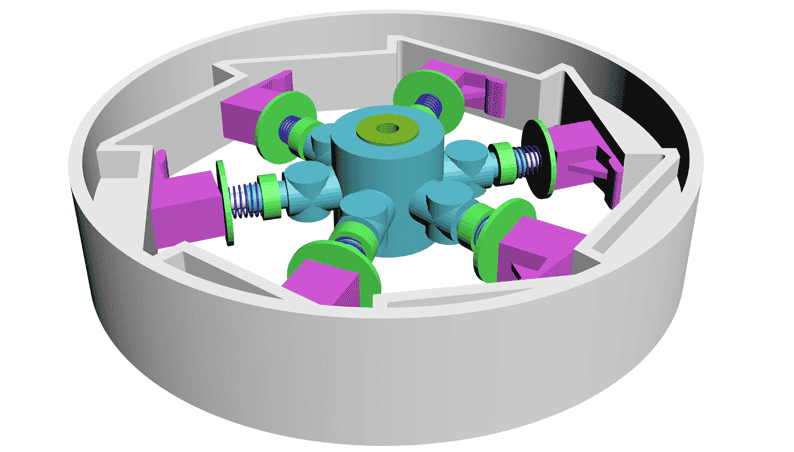
Here's a 3d model:-
gofund me perspective.png

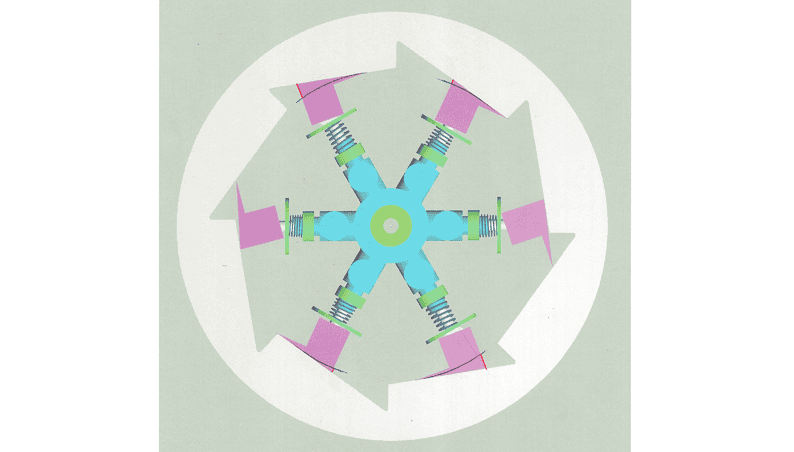
...and the forward pressure areas of such:-
gofund me power areas.png

I would like to share, and get this built. Do you think it would work?
...I'd love anyone to get involved
If you'd like to help, please reply with your thoughts
-I hope this is interesting,
if you would just like to comment on why or why this doesn't work,
I'd be curious to hear
Cheers
 
Last edited:
Engineering news on Phys.org
Welcome to PF.

No, it will not work.

The mechanical power produced by a pneumatic motor cannot exceed the product of the pressure difference by the volume of airflow.

Where is the air inlet, and where is the air exhaust?
There can be no flow. It will settle in one position.
 
  • Like
Likes   Reactions: russ_watters and berkeman
thanks!
there is no exhaust, the inlet is a push fitting in the sealed outer plate(which isn't shown)
the conjecture is that there is more area on one side of the feet,
allowing a not infinitesimal pressure(either) to exist

the backwards face of the feet is flat to the outer case, so they do not catch the usually equal compression

they are pushed, I put contentiously, but can they climb while they are jammed into the outer?
 
There are principles, such as conservation of energy, that must be obeyed in engineering. You have designed something so complex that you cannot understand how it works all at one time. By focusing on a small difference in area, you have neglected the supply of energy from the through-flow of air. The steepness of the ramp will exactly balance the difference in the small areas. Air will leak between the ramp and the slider, so the slider will actually have a balanced area of equal pressure air. If you turn it by hand, it will make a noise, you must provide that noise energy by hand.

There can be no airflow through the device. Where does the energy come from, that must overcome the sliding friction? It appears you have designed a "perpetual motion machine", something that we do not discuss on this forum.
 
  • Like
Likes   Reactions: DOGE3500, Ranger Mike, russ_watters and 1 other person
it's meant to be energy in psi,
which overcomes sliding friction by being vast, if needed

the noise will be a click, if it surprisingly did anything

-I agree, the steepness of the ratchet-like form can overcome movement perfectly

thanks so much for your thoughts

I find that interesting, that the partial un-meeting of faces may be darn near entire
 
Uncanny3 said:
it's meant to be energy in psi, which overcomes sliding friction by being vast, if needed
To awaken from a beautiful dream, is always sad, but there is no such thing as a free lunch, free energy, or perpetual motion.

Unfortunately, energy has different dimensional units to pressure.
To determine if you are dreaming, you must follow the flow of energy.

Before inventing new machines, study how existing machines operate. Be brave. Take faulty things apart, identify how they work, their problems, and maybe fix or improve some.

Learn to ask yourself questions, then answer them, then question your answers.
If you still don't know, ask others. That is why we are here.
 
  • Like
  • Love
Likes   Reactions: Ranger Mike, Bystander, russ_watters and 1 other person
And with those wise words from @Baluncore this thread is now closed.

@Uncanny3 -- It is a very good thing to be creative and strive to think up creative ideas, but be sure to keep taking science and math classes, so you can consider things like conservation of energy, etc., in your creative work. A big part of being successfully creative is to be able to quickly arrive at "non-existence proofs" for some of your ideas that cannot work, so you can understand why they would not work and move on to better versions and alternate ideas. :smile:
 
  • Like
Likes   Reactions: Tom.G, Ranger Mike, Bystander and 1 other person

Similar threads

  • · Replies 45 ·
2
Replies
45
Views
6K
Replies
5
Views
2K
  • · Replies 26 ·
Replies
26
Views
7K
  • · Replies 4 ·
Replies
4
Views
3K
  • · Replies 6 ·
Replies
6
Views
5K
  • · Replies 39 ·
2
Replies
39
Views
3K
Replies
13
Views
4K
  • · Replies 5 ·
Replies
5
Views
2K
Replies
2
Views
2K
  • · Replies 28 ·
Replies
28
Views
6K