Summing a Sequence: Finite or Infinite?

  • Thread starter Thread starter Firepanda
  • Start date Start date
  • Tags Tags
    Sequence
Click For Summary

Homework Help Overview

The discussion revolves around determining whether two summations are finite or infinite, with a focus on the behavior of the terms in the sequences involved. The subject area is related to sequences and series in mathematics.

Discussion Character

  • Exploratory, Assumption checking, Conceptual clarification

Approaches and Questions Raised

  • Participants discuss the nature of the summations and the implications of adding a term (n/2) to the sequence. Questions arise about the divergence of the first series and the reasoning behind it, including inquiries about the steps taken to analyze the limit of the nth term.

Discussion Status

The discussion is active, with participants exploring different interpretations of convergence and divergence. Some guidance is offered regarding textbook definitions, and there is a focus on understanding the reasoning behind the conclusions drawn about the series.

Contextual Notes

There are indications of potential confusion regarding the notation used in the summations, as well as a mention of the original poster's uncertainty about their previous conclusions.

Firepanda
Messages
425
Reaction score
0
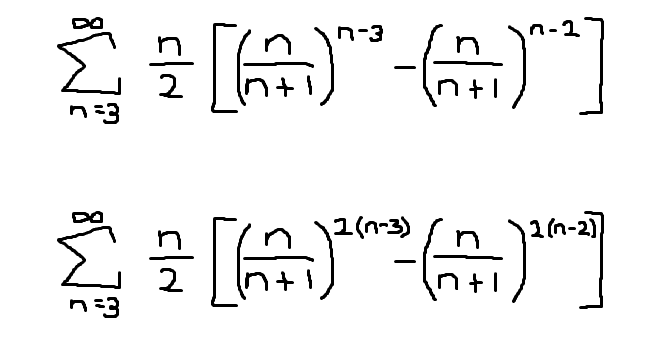
I've created two summations for my coursework, now I need to show whether or not the summations are finite or infinite.

The 2 summations are very similar:
2meqrl0.png


With the n/2 removed it was easy enough to show the sum was equal to 1 [edit: I now realize I may have this wrong], now with the n/2 term added I really have no idea where to start.

Any help appreciated, thanks.

Edit: I can see my writing may not be legible, 1's in the pic are straight vertical lines, some of the 2's may look like 1's, but they are 2's.
 
Last edited:
Physics news on Phys.org
Firepanda said:
I've created two summations for my coursework, now I need to show whether or not the summations are finite or infinite.

The 2 summations are very similar:

2meqrl0.png


With the n/2 removed it was easy enough to show the sum was equal to 1 [edit: I now realize I may have this wrong], now with the n/2 term added I really have no idea where to start.

Any help appreciated, thanks.

Edit: I can see my writing may not be legible, 1's in the pic are straight vertical lines, some of the 2's may look like 1's, but they are 2's.

For the first one, I found that the terms in the sequence approach a positive number. This is enough to convince me that the first series diverges.
 
Mark44 said:
For the first one, I found that the terms in the sequence approach a positive number. This is enough to convince me that the first series diverges.

Thanks for the reply!

Does this mean it sums to infinity?

What were your steps to find that it approaches a positive number?
 
Firepanda said:
Thanks for the reply!

Does this mean it sums to infinity?
Your textbook should have definitions for the terms converges and diverges.
Firepanda said:
What were your steps to find that it approaches a positive number?
I took the limit of the nth term in the sequence.
 

Similar threads

  • · Replies 7 ·
Replies
7
Views
2K
  • · Replies 1 ·
Replies
1
Views
2K
Replies
1
Views
2K
  • · Replies 5 ·
Replies
5
Views
2K
  • · Replies 4 ·
Replies
4
Views
2K
  • · Replies 4 ·
Replies
4
Views
2K
  • · Replies 2 ·
Replies
2
Views
1K
Replies
4
Views
2K
  • · Replies 1 ·
Replies
1
Views
1K
  • · Replies 2 ·
Replies
2
Views
2K