Fred404
- 2
- 3
Hi all!
I’m currently working on a project for which students will have to build a supercapacitor based dragster.
I saw here and there some videos on how it works but it’s too general to give me hints about components choice. So here I am with my questions, hoping that I’ll get enough answers to go forward with this project ;)
So, here it is:
I want students to build a small dragster (basically very light, made of wood sticks and such, not a big thing!) to organize a contest (drag race) on very small distance (let say about 3 meters max).
As for any school project, the amount of money is limited! No way to build a drag for 50$ each unfortunately.
Here are the components I was thinking about:
A small dc motor Gikfun DC 3V-6V Motor 2000 RPM
Here are specs:
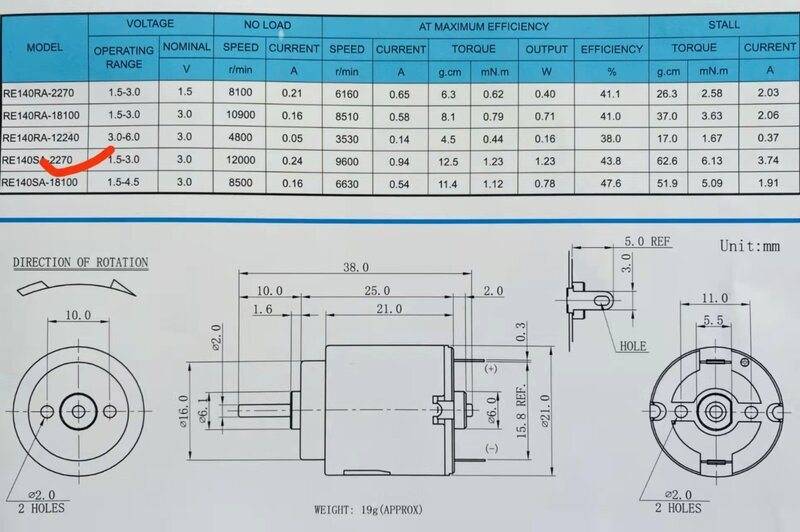
I was planning to feed it up with supercapacitors only. I was thinking of supercapacitor 2.7V, 10F to build a power pack in parallel if needed.
Here is what I’ve done so far (if I’m not wrong):
Energy stored in the supercapacitor 2.7V/10F
E=1/2.C.U2
E = (1/2)* 10F * 2.722V
E= 36.45 JoulesResistance of the DC motor:
R = U/I
At Maximum Efficiency – according to specs – we have 0.94A for 3V
R = 3V/0.9A = 3.34 ohm
Time of charge tho (sorry, don’t know the translation in English) for this setting:
Tho = R . C = 3.34 ohm x 10F = 33.4 s
So, this means that if tho = 33.4s, after 33.4s, there will only 37% energy left in capacitor.
After 5x tho, the capacitor will be empty.
Energy required for the race:
This is where I think, calculation may be inaccurate cause it depends on the weight of car (the heavier, the more energy needed)
Let say the car is about 150g (0.15 Kg)
F = m x g
F = 0.15 x 9.81 = 1.47 N
For a 3 meters race:
W = F x d
W = 1.47 x 3 = 4.41 J
For the motor, at Max Efficiency, we have 0.94A at 3V (even though the supercapacitor will only deliver 2.7V) for a 5 sec race
P = UI and E = Pt
P = 3 x 0.94 = 2.82W
E = 2.82 x 5 = 14.1 Joules
So, all "energy needed together", this represents an overall total of 4.41 + 14.1 = 18.51 J
According to that, this means that 1 supercapacitor would be enough
But just to have "backup", I can add an extra capacitor in parallel, which should give me twice energy...
So, am I totally out of field? Does it make sens?
Also, does someone knows if I can buy a device to charge supercapacitors? I've found a diy to build one but it may take too much time for students to build it! So I was wondering if I could find a device that would do the job so that would just have to go to a station to charge their drag!
Thanks for any inputs ;)
Fred
I’m currently working on a project for which students will have to build a supercapacitor based dragster.
I saw here and there some videos on how it works but it’s too general to give me hints about components choice. So here I am with my questions, hoping that I’ll get enough answers to go forward with this project ;)
So, here it is:
I want students to build a small dragster (basically very light, made of wood sticks and such, not a big thing!) to organize a contest (drag race) on very small distance (let say about 3 meters max).
As for any school project, the amount of money is limited! No way to build a drag for 50$ each unfortunately.
Here are the components I was thinking about:
A small dc motor Gikfun DC 3V-6V Motor 2000 RPM
Here are specs:
I was planning to feed it up with supercapacitors only. I was thinking of supercapacitor 2.7V, 10F to build a power pack in parallel if needed.
Here is what I’ve done so far (if I’m not wrong):
Energy stored in the supercapacitor 2.7V/10F
E=1/2.C.U2
E = (1/2)* 10F * 2.722V
E= 36.45 JoulesResistance of the DC motor:
R = U/I
At Maximum Efficiency – according to specs – we have 0.94A for 3V
R = 3V/0.9A = 3.34 ohm
Time of charge tho (sorry, don’t know the translation in English) for this setting:
Tho = R . C = 3.34 ohm x 10F = 33.4 s
So, this means that if tho = 33.4s, after 33.4s, there will only 37% energy left in capacitor.
After 5x tho, the capacitor will be empty.
Energy required for the race:
This is where I think, calculation may be inaccurate cause it depends on the weight of car (the heavier, the more energy needed)
Let say the car is about 150g (0.15 Kg)
F = m x g
F = 0.15 x 9.81 = 1.47 N
For a 3 meters race:
W = F x d
W = 1.47 x 3 = 4.41 J
For the motor, at Max Efficiency, we have 0.94A at 3V (even though the supercapacitor will only deliver 2.7V) for a 5 sec race
P = UI and E = Pt
P = 3 x 0.94 = 2.82W
E = 2.82 x 5 = 14.1 Joules
So, all "energy needed together", this represents an overall total of 4.41 + 14.1 = 18.51 J
According to that, this means that 1 supercapacitor would be enough
But just to have "backup", I can add an extra capacitor in parallel, which should give me twice energy...
So, am I totally out of field? Does it make sens?
Also, does someone knows if I can buy a device to charge supercapacitors? I've found a diy to build one but it may take too much time for students to build it! So I was wondering if I could find a device that would do the job so that would just have to go to a station to charge their drag!
Thanks for any inputs ;)
Fred