Superposition principle and information

Click For Summary
SUMMARY

The discussion centers on the concept of superposition in wave physics, specifically addressing the storage of information about individual waveforms during superposition. Participants clarify that while the individual waves may not be visually represented at the moment of superposition, they still exist mathematically as part of the overall wave function. The analogy of adding apples illustrates that, unlike distinct objects, waves are a continuous distribution of energy, complicating the retrieval of original waveforms after they combine.

PREREQUISITES
  • Understanding of wave mechanics and superposition principle
  • Familiarity with mathematical representation of waves
  • Basic knowledge of energy distribution in physical systems
  • Concept of wave functions in physics
NEXT STEPS
  • Explore the mathematical formulation of wave functions in quantum mechanics
  • Study the principles of wave interference and diffraction
  • Investigate the implications of superposition in quantum entanglement
  • Learn about the role of dimensions in wave behavior and information storage
USEFUL FOR

Students of physics, educators explaining wave phenomena, and anyone interested in the foundational concepts of wave mechanics and superposition.

Virous
Messages
68
Reaction score
0
I have a question about, perhaps, GCSE level physics, if not below, which, for some reason, is not explained anywhere I've looked up. Or, at least, I didn't find any explanation.
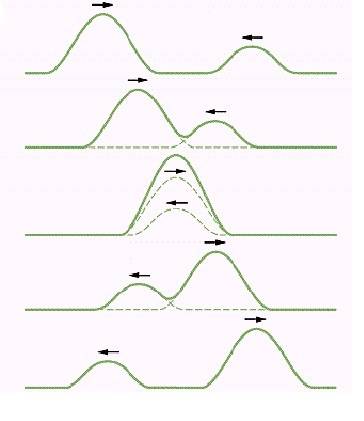
img003.jpg
The picture above is supposed to explain the concept of superposition. It depicts a pair of one-dimensional waves (wave pulses) at 5 different points in time. On the third picture (the exact moment of superposition), the initial individual waves do not exist. Instead we have a single large wave, composed of the energy of both. Where is the information about the shapes of the initial waves at this moment of time stored?

In other words, after the third picture, how does this large wave "know" how it should split in order to restore the initial pulses?

Thank you!
 
Science news on Phys.org
Virous said:
On the third picture (the exact moment of superposition), the initial individual waves do not exist.
I think that's where your problem lies. Both waveforms DO exist at that point exactly as they do exist at every other point on the graph, it's just that you are looking at the sum.

If you had a basket of 3 apples and you added 2 more apples, you wouldn't be thinking "damn, where did my 3 apples go? How can I get them out again?" but because the waveforms add in a smooth way, if you ONLY look at the waveform at that point in time, you can't tell what the individual waves look like, whereas with the apples you don't have that problem.
 
The apple example would make sense, since apples are composed of different matter (I mean, each apple has its own). The problem with waves, though, is that they are all made of the same matter (the same rope in this case, or whatever that is). So a wave is just a distribution of a particular property (in this case the displacement) in space/time.

When you add two numbers (e.g. 3 and 2) you get 5. If you give 5 to another person, he wouldn't be able to tell, if the original numbers were 4 and 1 or 3 and 2 or 2.5 and 2.5 and so on. This is exactly the same case :)

If you think of it in terms of particles, on the third picture one of the particles is "up" and it is ready to go down. How is that possible that when it goes down it gives unequal amounts of energy to absolutely identical particles on its left and right?

If I were to predict what's going to happen after, I would say that the resulting waves after the superposition would be equal. Yet, all the diagrams draw them in this way, so I'm confused.
 
phinds said:
Both waveforms DO exist at that point exactly
If the diagram depicts a real situation, they obviously do :) The question is, where? Particles definitely don't have this information, since they are just particles moving up and down and having a particular displacement function.

Suppose, I have managed to superimpose a million of waves with strange shapes (I guess I would need more dimensions, but anyway). Where will all this information go?
 

Similar threads

Replies
2
Views
2K
  • · Replies 19 ·
Replies
19
Views
2K
  • · Replies 29 ·
Replies
29
Views
4K
  • · Replies 21 ·
Replies
21
Views
2K
Replies
8
Views
7K
  • · Replies 10 ·
Replies
10
Views
2K
  • · Replies 10 ·
Replies
10
Views
2K
Replies
9
Views
2K
  • · Replies 2 ·
Replies
2
Views
2K
  • · Replies 5 ·
Replies
5
Views
2K