Supremum proof & relation to Universal quantifier

Click For Summary

Discussion Overview

The discussion revolves around the proof of the supremum and its relation to the universal quantifier in mathematical reasoning. Participants explore the manipulation of bounds and the appropriate use of epsilon in proofs, focusing on the conditions necessary to establish a supremum.

Discussion Character

  • Technical explanation
  • Mathematical reasoning
  • Debate/contested

Main Points Raised

  • One participant questions the necessity of proving that ## a > s_A - \epsilon > 0 ## and ## b > s_B - \epsilon > 0 ## in the context of establishing a supremum.
  • Another participant suggests that using ## \frac{\epsilon}{s_A + s_B} ## instead of ## \epsilon ## is valid since it is still an arbitrary positive number, but does not clarify the implications of this substitution.
  • There is a proposal to define ## m = a ## and to prove the inequality involving ## s_A ##, but uncertainty remains about the correctness of this approach.
  • One participant emphasizes that the proof should assume ## a ## is greater than a certain value rather than proving it, introducing a new variable ## \delta = \frac{\epsilon}{s_A + s_B} ## to facilitate the argument.
  • Another participant reiterates the importance of understanding that the supremum allows for choosing values of ## a ## that are arbitrarily close to it, suggesting that the expression used for closeness can vary.

Areas of Agreement / Disagreement

Participants express differing views on the manipulation of epsilon and the assumptions made in the proof. No consensus is reached regarding the correct approach to proving the supremum.

Contextual Notes

There are unresolved questions about the validity of substituting epsilon with a derived expression and the implications of introducing new variables in the proof process.

CGandC
Messages
326
Reaction score
34
TL;DR
x
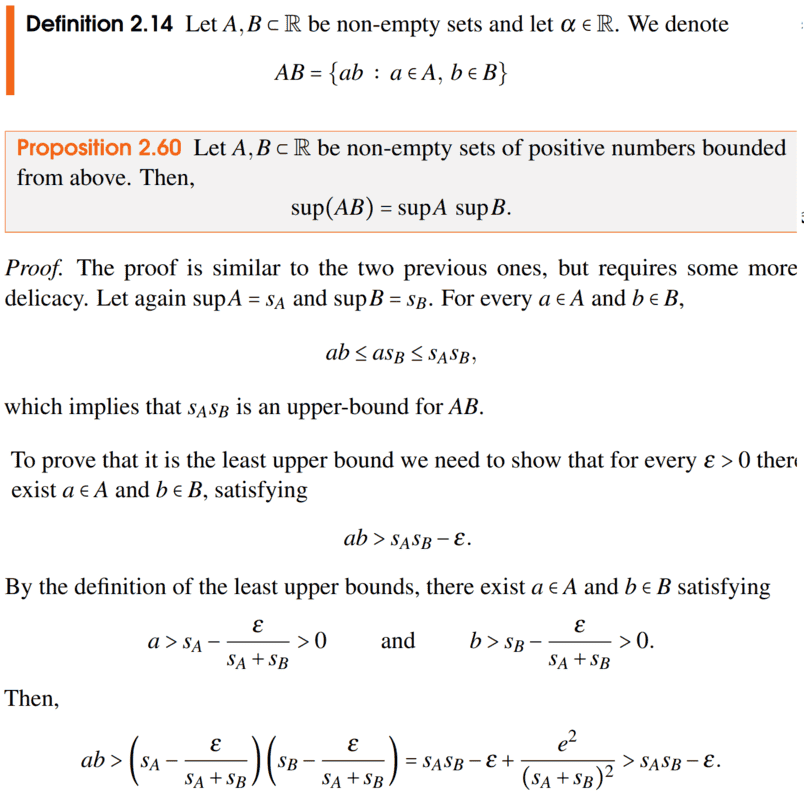
In the following proof:
1604086966233.png


I didn't understand the following part:

1604087047433.png


Isn't it supposed to be :
## a > s_A - \epsilon >0 ## and ## b > s_B - \epsilon >0 ##

Because to prove that ## s ## is a supremum, we need to prove the following:
For every ## \epsilon > 0 ## there exists ## m \in M ## such that ## m > s - \epsilon ## .

So In my proof, to represent the claim for ## a \in A ## I do the following:
Let ## \epsilon > 0 ## be arbitrary. Define ## m=a ## . Then we need to prove ## a > s_A - \epsilon ## . ( where ## s_A ## is my upper bound for ## A ## )

However, I didn't understand why they wrote ## \frac{\epsilon}{s_A + s_B} ## instead of ## \epsilon ## . They prove ## a > s_A - \frac{\epsilon}{s_A + s_B} ## but I don't understand how they replaced the ## \epsilon ## with ## \frac{\epsilon}{s_A + s_B} ## since the universal quantifier in the proof is on ## \epsilon ## and not on ## \frac{\epsilon}{s_A + s_B} ## . Can you please help me understand why they did this?

Note: I saw this kind of bound variable manipulation appearing also in the following:
## \forall n \in N ( n < s) ## is the same as ## \forall n \in N ( (n+1)<s ) ## ( 'N' is the natural numbers set , 's' is some free variable )
Why is this possible?
 
Physics news on Phys.org
It's just another ##\epsilon##, since it is supposed to hold for every ##\epsilon \gt 0##.
 
So in my proof I write as follows? :
Let ## \frac{\epsilon}{s_A + s_B} > 0 ## be arbitrary. Define ## m=a ## . Then we need to prove ## a > s_A - \frac{\epsilon}{s_A + s_B} ## . ( where ## s_A ## is my upper bound for ## A ## )

OR

Let ## \epsilon > 0 ## be arbitrary. Define ## m=a ## . Then we need to prove ## a > s_A - \frac{\epsilon}{s_A + s_B} ## . ( where ## s_A ## is my upper bound for ## A ## )

but these don't look correct. Can you please elaborate?
 
Why are you proving a is bigger than something? You're supposed to assume it. Let ##\delta = \frac{\epsilon}{s_a+s_b}##. Then since ##\delta>0##, there exists some ##a## such that ##s_a > a > s_a- \delta##.
 
Office_Shredder said:
Why are you proving a is bigger than something? You're supposed to assume it. Let ##\delta = \frac{\epsilon}{s_a+s_b}##. Then since ##\delta>0##, there exists some ##a## such that ##s_a > a > s_a- \delta##.

I was just giving an example of what I would write if I had to prove that given ## s_a ## is supremum given it is an upperbound. I'm trying to get used to math proofs.

So what you've done is you introduced 2 arbitrary variables, like so?:
Let ## \epsilon > 0 ## . Let ## \delta = \frac{\epsilon}{s_a+s_b} ##.
Then I write like you did:
Then since ## \delta > 0 ##, there exists some ## a ## such that ## s_a > a > s_a - \delta ##
 
Right. The idea is that you know ##s_a## is a supremum, so you can pick a as close as you want to it. In the definition of the supremum, "as close as you want" is defined to be ##\epsilon##, but in practice in proofs you typically have some other expression possibly involving a variable named ##\epsilon## that you use as your "as close as you want" number.
 

Similar threads

  • · Replies 2 ·
Replies
2
Views
896
Replies
3
Views
2K
  • · Replies 1 ·
Replies
1
Views
2K
  • · Replies 16 ·
Replies
16
Views
3K
  • · Replies 2 ·
Replies
2
Views
3K
Replies
6
Views
3K
  • · Replies 20 ·
Replies
20
Views
3K
  • · Replies 9 ·
Replies
9
Views
2K
Replies
4
Views
1K
  • · Replies 35 ·
2
Replies
35
Views
5K