Surface area of inner and outer halves of torus

Click For Summary

Discussion Overview

The discussion revolves around the surface area of the inner and outer halves of a torus, particularly focusing on the implications of curvature when the torus is sliced and visualized. Participants explore the geometric properties and relationships between the areas of the two halves, considering both theoretical and practical aspects of the problem.

Discussion Character

  • Exploratory
  • Technical explanation
  • Conceptual clarification
  • Debate/contested

Main Points Raised

  • One participant states that the total surface area of a torus is given by ##4\pi^2 Rr## and questions why the inner half has a smaller surface area than the outer half when visualizing a cut and stretch into a cylinder.
  • Another participant argues that one cannot simply cut and stretch the torus while preserving areas and geometry, highlighting a misunderstanding in the original visualization.
  • A further reply suggests that the areas are not preserved due to the curvature of the torus, asking for visualizations or equations to clarify this point.
  • Another participant proposes that when considering cuts perpendicular to the torus axis, the outer circle is longer than the inner circle, leading to the conclusion that the total area of the inner circles is smaller than that of the outer circles.
  • One participant mentions that if the torus is straightened into a cylinder, the lengths of the cut circles would become equal line segments, indicating a stretching or shrinking effect.
  • A later contribution introduces the concept of a four-dimensional torus where the two halves can have equal areas without stretching or shrinking, noting that this challenges the conventional understanding of inner and outer in three dimensions.

Areas of Agreement / Disagreement

Participants express differing views on the preservation of area when transforming the torus into a cylinder. There is no consensus on the implications of curvature or the validity of the proposed visualizations, indicating an ongoing debate regarding the geometric properties of the torus.

Contextual Notes

Participants highlight limitations in visualizing the torus and the assumptions made regarding area preservation during transformations. The discussion remains open to interpretations of geometric properties and their implications.

TheCanadian
Messages
361
Reaction score
13
A torus with major radius, ##R##, and minor radius, ##r##, has a total surface area given by ##4\pi^2 Rr##. If one slices the torus on its midline (i.e. at a line on a poloidal angle of ##-\pi/2## and ##\pi/2##), I was told the inner half of the torus has a smaller surface area than the outer half of the torus.

Although I am having some trouble visualizing this. If we were to simply cut the torus at one point and stretch it out, it would simply look like a cylinder, where the inner and outer halves have equal surface areas. But in this case, the curvature supposedly changes that. Any insight on why exactly the surface area changes for the inner and outer halves, and how one can quantify the change in surface area due to curvature in this case, would be greatly appreciated.
 
Physics news on Phys.org
TheCanadian said:
If we were to simply cut the torus at one point and stretch it out, it would simply look like a cylinder
You can't do that while preserving areas and the overall geometry (e. g. keeping the separation between the outer and inner half on opposite sides).
 
mfb said:
You can't do that while preserving areas and the overall geometry (e. g. keeping the separation between the outer and inner half on opposite sides).

It seems like this is where my misunderstanding lies. Would you happen to have a visualization or any equations describing why the areas are not preserved?

It seems fairly simply that: ## A = (2\pi r)(2\pi R) = 2\pi r L## which is the same equation as the area of a cylinder of length, ##L = 2\pi R##, which you would get if the cylinder was fully cut in one toroidal cross-section and made straight. What's the error in this interpretation?
 
Torus 2 v2.png
 

Attachments

  • Torus 2 v2.png
    Torus 2 v2.png
    12.9 KB · Views: 1,613
Last edited:
  • Like
Likes   Reactions: TheCanadian and mfb
Alternatively, consider the distance between the small circles on the inside and outside here:

Simple_Torus_svg.png


The total area corresponds to a cylinder with 2 pi R length, but the torus doesn't consist of many small cylinders.
 

Attachments

  • Simple_Torus_svg.png
    Simple_Torus_svg.png
    11.9 KB · Views: 1,495
To simplify the visualization, consider a cut by a plane perpendicular to the torus axis. You get two circles, one from the inner half and one from the outer half. The outer circle is longer than the inner circle. Integrate over all such plane cuts and the small circles total area is smaller than the large circles total area. These correspond to the cut you made.
 
The inner and outer circles are of different length. If you cut the torus and straightened it out into a cylinder, these two cut circles would become line segments of equal length. That means stretching/shrinking has happened.

- In four dimensions, one can make a torus where the two halves have equal area - although in four dimensions the idea of inner and outer goes away. In this case the cut torus can be straightened into a cylinder without stretching or shrinking. It is truly a geometric double cylinder. This torus has zero Gauss curvature.
 
Last edited:
lavinia said:
- In four dimensions, one can make a torus where the two halves have equal area - although in four dimensions the idea of inner and outer goes away. In this case the cut torus can be straightened into a cylinder without stretching or shrinking. It is truly a geometric double cylinder. This torus has zero Gauss curvature.
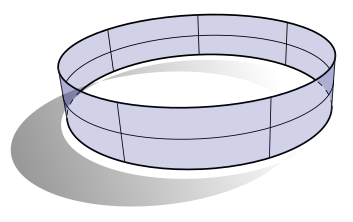
In case someone is wondering how that looks like: Imagine a long strip of paper flat on the ground. If you want to connect its ends in two dimensions, you have to stretch one side or shrink the other to make a shape like this:

Annulus_700.gif


In three dimensions, you can produce this without any stretching:

ddg_circular_band.svg


In 4 dimensions you can do the equivalent to the second thing with a cylinder instead of a strip of paper because the cylinder is "flat" in the fourth dimension.
 

Attachments

  • Annulus_700.gif
    Annulus_700.gif
    2.8 KB · Views: 1,447

Similar threads

  • · Replies 5 ·
Replies
5
Views
2K
  • · Replies 4 ·
Replies
4
Views
2K
Replies
1
Views
3K
  • · Replies 5 ·
Replies
5
Views
3K
Replies
11
Views
4K
  • · Replies 7 ·
Replies
7
Views
6K
  • · Replies 9 ·
Replies
9
Views
3K
  • · Replies 4 ·
Replies
4
Views
4K
  • · Replies 4 ·
Replies
4
Views
2K
  • · Replies 9 ·
Replies
9
Views
3K