How to Operate a Swamp Cooler in Phoenix in June

  • Context: Undergrad 
  • Thread starter Thread starter rude man
  • Start date Start date
  • Tags Tags
    Cooler
Click For Summary
SUMMARY

This discussion focuses on the operation of swamp coolers in Phoenix during June, emphasizing the need for precise control of effluent flow rates and impurity densities. The conversation highlights the mathematical modeling of water volume and impurity concentration in a tank system, specifically the equations governing the dynamics of water flow and solute concentration. Participants discuss the implications of using reverse osmosis (RO) systems to maintain water quality and the importance of understanding evaporation rates for optimal performance. The final goal is to derive the expression for impurity density, ## \rho(t) ##, to achieve equilibrium in the swamp cooler system.

PREREQUISITES
  • Understanding of basic swamp cooler operation and evaporative cooling principles.
  • Familiarity with differential equations, particularly in the context of mixing and dilution.
  • Knowledge of reverse osmosis (RO) systems and their impact on water quality.
  • Ability to analyze flow rates and impurity concentrations in fluid dynamics.
NEXT STEPS
  • Research the mathematical modeling of fluid dynamics in evaporative cooling systems.
  • Learn about the principles of reverse osmosis and its application in maintaining water purity.
  • Study the effects of evaporation rates on swamp cooler efficiency and performance.
  • Explore the design and operation of feedback control systems in fluid management.
USEFUL FOR

Engineers, HVAC professionals, and anyone involved in the design and operation of evaporative cooling systems, particularly in arid climates like Phoenix.

rude man
Science Advisor
Insights Author
Messages
8,032
Reaction score
869
Guys, this is a real-life problem, especially now in Phoenix in June!
Wolfram Alpha gave me this:
Must be easier than that??
 

Attachments

  • Slide1.JPG
    Slide1.JPG
    33.7 KB · Views: 159
Last edited:
Science news on Phys.org
rude man said:
Guys, this is a real-life problem, especially now in Phoenix in June!
Wolfram Alpha gave me this:
Must be easier than that??
Not clear what you are asking here?
 
  • Like
Likes   Reactions: russ_watters
The problem statement makes sense to me. Is there more to it than that?
 
...and while it says "evaporative cooler", the diagram and process description in the OP doesn't look anything like an evaporative cooler to me.
 
  • Like
Likes   Reactions: Lnewqban
russ_watters said:
...and while it says "evaporative cooler", the diagram and process description in the OP doesn't look anything like an evaporative cooler to me.
I am looking for the expression for ## \rho(t) ## so I can optimally adjust the effluent flow rate.

Basic swamp cooler operation:
Water runs over pads; evaporates; that cools the pads, then air is blown past the pads into the house. If the air is very dry a swamp cooler can produce air almost as cold as an air conditioner.

Details:
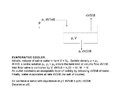
You have a tank of impure water of volume V(t) and impurity (solute) density ## \rho(t) ##. Water at flow rate dV1/dt, controlled by V, and impurity density ## \rho_1 ## flows into it. Tank water effluent flows out at ## dV2/dt ## and ## \rho ##. Water at ## dV3/dt ## and zero impurity density gets evaporated away out of the tank. A float valve controls ## dV1/dt ## via tank volume V. Tank water continuously flows over the pads via a pump.

We have a servo controlling ##\rho_{~final} ## and ## V_{final} ##.

The math as I see it is

## dV/dt = dV1/dt - dV2/dt - dV3/dt ## ... (1)
; water rises in tank.

## dV1/dt = k_1(V_r - V) ## ... (2)
; feedback action of an adjustable inlet valve. ## k_1 ## forms the servo loop gain.

## d/dt~ (\rho V) = \rho_1 ~dV1/dt - \rho ~dV2/dt ## ... (3)
; buid-up of solute in tank

V and ## \rho ## are functions of time. V and ## \rho ## adjust automatically until equilibrium is reached at ## dV/dt = d\rho/dt = 0 ##.

dV2/dt, dV3/dt and ## \rho_1 ## are constants.
## V_r ## is a constant reference volume. If the tank is empty (V=0), dV1/dt flow is max. at ## k_1V_r ##.

The tank fills until dV/dt = 0 set by the servo action, at which point dV1/dt = dV2/dt + dV3/dt.

For that I need an expression for ## \rho(t) ##.

So just look at it as a math problem with what I've given you, or dispute any of it.. And refer to the attached jpeg.
 
bob012345 said:
Not clear what you are asking here?
cf. post 6.
 
Chestermiller said:
The problem statement makes sense to me. Is there more to it than that?
Nope, just give me ## \rho(t) ##.
cf. post 6 and scrutinize the jpeg.
 
russ_watters said:
...and while it says "evaporative cooler", the diagram and process description in the OP doesn't look anything like an evaporative cooler to me.
Well I tried ... o:)
 
  • #10
I should add that deriving ## \rho_{~final} ## does not require solving for the time function but I also wanted an idea of the time required to reach (close to) equilibrium. Besides, it looked like a good physics challenge.
 
  • #12
rude man said:
Well I tried ... o:)
I wasn't criticizing your art skills, I was saying you didn't describe an evaporative cooling process. But I think I see it now...
rude man said:
I am looking for the expression for ## \rho(t) ## so I can optimally adjust the effluent flow rate.

Basic swamp cooler operation:
Water runs over pads; evaporates; that cools the pads, then air is blown past the pads into the house. If the air is very dry a swamp cooler can produce air almost as cold as an air conditioner.
Why ## \rho(t) ## ? If you want a specific effluent impurity density, why not just do a single-point(in time)/steady-state mixing calculation to find the required flow rate for it? ##V1/V2 = \rho2/\rho1 ##
Where ## V1 - V3 = V2 ##

What are your knowns? Do you know or need to calculate the evaporation rate? I don't see how you can calculate the supply water rate without it.

Also, what is the point of the tank? For systems I've seen they just run the water over the pad and what's left goes straight to drain without a tank...or pump. If you are circulating the tank water over the pad and filling/emptying from the tank, then you have high impurity water going over the pad. This isn't critical to your question though...
 
  • #13
rude man said:
I should add that deriving ## \rho_{~final} ## does not require solving for the time function but I also wanted an idea of the time required to reach (close to) equilibrium. Besides, it looked like a good physics challenge.
Ah... ok, so it's a side question that you are asking about in addition to or instead of the main question...

For that you can use the differential equation for concentration in mixing/dilution vs time:
https://en.wikipedia.org/wiki/Dilution_(equation)#Dilution_ventilation_equation

As described it's for ventilation, but should work the same for your scenario.
 
  • #14
russ_watters said:
Ah... ok, so it's a side question that you are asking about in addition to or instead of the main question...

For that you can use the differential equation for concentration in mixing/dilution vs time:
https://en.wikipedia.org/wiki/Dilution_(equation)#Dilution_ventilation_equation

As described it's for ventilation, but should work the same for your scenario.
My question was 'what is ## \rho(t) ##.'

The link I don't think applies to my situation: "The equation can only be applied when the purged volume of vapor or gas is replaced with "clean" air or gas."
In my case the impure solvent (water) is replaced by less impure solvent. (Of course I could possibly introduce distilled water into the tank but that would be expensive & have to be pumped. I use an RO setup for my influent.)
Thx anyway.
 
  • #15
russ_watters said:
Why ## \rho(t) ## ? If you want a specific effluent impurity density, why not just do a single-point(in time)/steady-state mixing calculation to find the required flow rate for it? ##V1/V2 = \rho2/\rho1 ##
Where ## V1 - V3 = V2 ##
I wanted the time to reach equilibrium, not just the final values.

russ_watters said:
What are your knowns? Do you know or need to calculate the evaporation rate? I don't see how you can calculate the supply water rate without it.
Knowns:
effluent rate dV2/dt
loop gain component ## k_1 ##
influent purity ## \rho_1 ##
Reference volume ## V_r ##
The fly in the ointment is admittedly the evap rate which I have to estimate. I do have empirical data of sorts.

I never claimed that tank impurity density is independent of evap rate. It's part of the physics prolem I was led to investigate, partly from curiosity.
russ_watters said:
Also, what is the point of the tank? For systems I've seen they just run the water over the pad and what's left goes straight to drain without a tank...or pump. If you are circulating the tank water over the pad and filling/emptying from the tank, then you have high impurity water going over the pad. This isn't critical to your question though...\quote
Well since you're interested: for the system you describe (1) the water is not cool as it is in a tank (summer water here runs around 90F!); (2) our city water would soon deposit salts on the pads to the extent that they have to be replaced quite frequently. Lots of fun climbing onto the roof when it's 115F+ ! Also, pad replacement is a bear to do.

Operating an R/O (reverse osmosis) system introduces almost pure water to the pads. My pads last for years and years in consequence.

(3) Your system is wasteful of water since the intake flow has to be set well above what is needed for very dry conditions (high evap rate), then as our "monsoon" season starts the humidity goes up, evaporation goes down, more water is wasted. To be fair, an R/O system also typically dumps waste water (to preserve the membrane). My water bill is not significantly impacted in summer though.

(4) Using a pump system allows use of a thermostat in the home just as in air conditioning. Most swamp coolers come with pumps. I use one in my garage, works great.

Etc.
 

Similar threads

  • · Replies 32 ·
2
Replies
32
Views
4K
  • · Replies 46 ·
2
Replies
46
Views
14K
  • · Replies 2 ·
Replies
2
Views
3K
Replies
8
Views
4K
  • · Replies 9 ·
Replies
9
Views
15K
  • · Replies 5 ·
Replies
5
Views
2K
  • · Replies 14 ·
Replies
14
Views
6K
  • · Replies 1 ·
Replies
1
Views
922
  • · Replies 9 ·
Replies
9
Views
3K
Replies
17
Views
4K