Symbolic integration of a Bessel function with a complex argument

Click For Summary
SUMMARY

The discussion centers on solving a symbolic integral involving the Bessel function of the first kind and order 0 using Mathematica. The user encounters difficulties due to the complex argument of the Bessel function and seeks to express the integral as a function of r for plotting purposes. A key insight provided is the use of the "Assumptions" option in Mathematica to specify that the coefficient delta is real, which may simplify the integration process. The conversation highlights the challenges of integrating complex functions and the importance of setting proper assumptions in computational tools.

PREREQUISITES
  • Familiarity with Bessel functions, specifically the Bessel function of the first kind and order 0.
  • Understanding of symbolic integration techniques in Mathematica.
  • Knowledge of complex numbers and their implications in mathematical functions.
  • Experience with plotting functions in Mathematica, particularly using 3D plots.
NEXT STEPS
  • Learn how to use the "Assumptions" option in Mathematica for symbolic computations.
  • Explore techniques for integrating complex functions in Mathematica.
  • Study the properties and applications of Bessel functions in mathematical analysis.
  • Investigate methods for visualizing complex functions using Plot3D in Mathematica.
USEFUL FOR

Mathematicians, physicists, and engineers working with complex integrals, as well as users of Mathematica seeking to enhance their skills in symbolic computation and visualization of mathematical functions.

ocmaxwell
Messages
8
Reaction score
1
Hello all

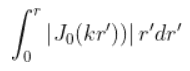
I am trying to solve the following integral with Mathematica and I'm having some issues with it.
1676210485824.png

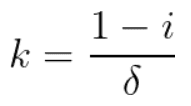
where Jo is a Bessel Function of first kind and order 0. Notice that k is a complex number given by
1676210684948.png


Where delta is a coefficient.

Due to the complex arguments I'm integrating the absolute value of the Bessel function.

I would like to solve the integral symbolically to get the result as a function or r, and not a number, so I can plot f(r) later on. See below what I did

1676211023657.png
notice that r1 is r' in the integral above
and the result

1676211136130.png


I am totally sure there should be a way in which it can be done.

Any help would be greatly appreciated

Thank you in advance
 
Physics news on Phys.org
ocmaxwell said:
I am totally sure there should be a way in which it can be done
Usually if Mathematica doesn’t know a way then there is no known way.
 
  • Like
Likes   Reactions: FactChecker
This is certainly not a proof, but if you Plot3D the Re and the Im of either your Bessel or the Abs of your Bessel, say for {delta,-5,5} and {r1,-5,5} then that blowing up to infinity in lots of odd ways strongly hints to me that finding that integral might be really challenging. If you could restrict delta to being an integer, or even a specific integer, then the graphs hint that might possibly be a simpler problem. Without giving Mathematica any information about delta it will proceed imagining that delta might even be complex
 
You are very right Mr. Simpson
For this case delta is real, how could I enforce this condition so mathematica undertands it and still gives me the result of the integral in terms of delta and r?

Thank you for your response
 
You can use the option “Assumptions” to tell it to assume that it is real.
 
Thank you Sir, I will try that out.
Thank you for taking the time to respond.
 

Similar threads

  • · Replies 13 ·
Replies
13
Views
2K
  • · Replies 3 ·
Replies
3
Views
2K
  • · Replies 2 ·
Replies
2
Views
3K
  • · Replies 2 ·
Replies
2
Views
2K
  • · Replies 2 ·
Replies
2
Views
2K
  • · Replies 13 ·
Replies
13
Views
3K
  • · Replies 1 ·
Replies
1
Views
3K
  • · Replies 4 ·
Replies
4
Views
2K
Replies
2
Views
2K
  • · Replies 4 ·
Replies
4
Views
2K