Synthesis of aspirin, confused noob

Click For Summary

Discussion Overview

The discussion revolves around the synthesis of aspirin, specifically focusing on the protonation of acetic anhydride and salicylic acid during the reaction. Participants explore the underlying reasons for the behavior of the H plus ion in this context, including aspects of resonance structures and basicity.

Discussion Character

  • Exploratory
  • Technical explanation
  • Debate/contested
  • Mathematical reasoning

Main Points Raised

  • One participant expresses confusion about why the H plus ion bonds to the oxygen of acetic anhydride rather than the oxygen of salicylic acid, noting the lack of charge and electronegativity differences.
  • Another participant suggests drawing resonance structures for the anhydride to identify which oxygen carries a negative or positive charge, implying this may provide insight into the protonation process.
  • A participant questions the necessity of negative charges for proton acceptance, arguing that carbonyl oxygen should be able to accept an H plus ion regardless of charge.
  • One response clarifies that while any oxygen with a lone pair can accept a proton, the likelihood of protonation varies, which can influence the reactivity of the functional groups involved.
  • It is noted that typically only catalytic amounts of phosphoric acid are used, which affects the protonation dynamics of the involved species.

Areas of Agreement / Disagreement

Participants do not reach a consensus on the reasons behind the protonation preferences of the oxygen atoms. Multiple competing views are presented regarding the roles of resonance structures and basicity in the reaction.

Contextual Notes

Participants mention the importance of considering basicity rankings and the conditions under which protonation occurs, but these aspects remain unresolved and are dependent on further exploration.

Who May Find This Useful

This discussion may be useful for individuals interested in organic chemistry, particularly those studying reaction mechanisms and protonation processes in synthesis reactions.

gangsterlover
Messages
31
Reaction score
0
Hi,

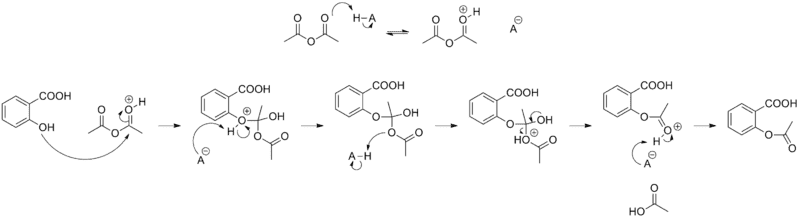
Take a look at this synthesis of aspirin. Because I am noob, please bare with me.
800px-Acetylation_of_salicylic_acid%2C_mechanism.png


On the top there you can see how the acetic anhydride gets attacked by the H plus ion.
I can't understand why the h plus ion gets bonded there.
I`ve been trying to find the answer to this question for quite some time now, and this is what I have come up to.

1. There is no charge on none of the oxygen atoms. So not explanation there.
2. There is no difference in electronegativity between the oxygen as far as I can see, but please tell me different. I would actually not mind, because I am totally stuck.
3. There was this one step on(http://www.masterorganicchemistry.com/2012/06/18/what-makes-a-good-nucleophile/) which said something about solvent, but I didn`t understand it too well, so I`ll just move on to steric hindrance.
4. Steric hindrance could explain why the h plus ion doesn`t bond at the bottom oxygen on the acetic anhydride, but not why the h plus ion doesn`t want to bond on the salicylic acid oxygen in the top left corner.

Omg...
yelp!
 
Chemistry news on Phys.org
Draw the resonance structures of the anhydride. Which oxygen carries a negative charge in the resonance structure and which carries a positive charge?
 
I don`t see how drawing the resonance structure for the acetic anhydride could show me the answer to my question. I am pretty much only curious in why the h plus ion gets bonded on the acetic anhydride oxygen and not on the salicylic acid oxygen.
 
Ah ok, I misunderstood your question. I thought you were asking why the carbonyl oxygen of the anhydride got protonated while the bridging oxygen of the anhydride did not.

Still, when considering whether the phenolic -OH of salicilic acid is more basic than the carbonyl oxygen of the anhydride, it is still good to write out the resonance structures for the anhydride and salicylic acid. Which oxygens carry a negative charge in the resonance structures, and which structures carry positive charges in the resonance structures?
 
But they don`t need to be negatively charged to accept a proton, do they? What?! I don't see any reason why the carbonyl oxygen couldn`t accept an h plus ion. I just can't see it with my eyes.
 
Sure, any oxygen with a lone pair can accept a proton. But some are more likely to do so than others, and the relative amount of time they spend protonated vs unprotonated can affect the reactivity of the groups in the various reactions. For example, if the phenolic -OH of salicylic acid were more likely to be protonated than the carbonyl oxygen of the anhydride, the proposed reaction scheme would not work.

added in edit: note that usually only catalytic amounts of phosphoric acid are added to the reaction, so there won't be enough acid around to protonate everything. Therefore, you must consider which atoms are the most basic and the most likely to be protonated under these conditions.
 
I`ll have to read up on the ranking of basicity?
 

Similar threads

  • · Replies 8 ·
Replies
8
Views
4K
  • · Replies 1 ·
Replies
1
Views
4K
  • · Replies 1 ·
Replies
1
Views
5K
  • · Replies 3 ·
Replies
3
Views
8K
  • · Replies 1 ·
Replies
1
Views
21K