High School Temperature based on colour index using Planck's law

Click For Summary
The discussion focuses on determining the temperature of stars using their B-V magnitude through Planck's law. The user seeks guidance on solving for temperature (T) numerically, expressing difficulty in integrating over the filter's bandpass. Suggestions include using numerical methods and programming languages like Mathematica, Matlab, or Python for integration. The user expresses a lack of familiarity with coding but considers using graphical methods instead. Overall, the conversation emphasizes the importance of numerical integration in applying Planck's law for temperature calculations.
heavystray
Messages
71
Reaction score
0
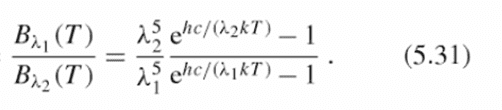
Hi, I'm trying to find temperature of stars using the stars' B-V magnitude by using the Planck law. However i do not know how to solve for T (assume other quantities are all given and determined first). Any idea how to do so? I already tried to do it but reach a dead end. Here I attached the Planck equation. h is Planck's constant, k is boltzman's constant, c is the speed of light,
upload_2018-1-23_0-13-28.png
 

Attachments

  • upload_2018-1-23_0-13-28.png
    upload_2018-1-23_0-13-28.png
    7.4 KB · Views: 555
Astronomy news on Phys.org
It should be a simple matter to solve for T numerically. To do it right, you really should integrate λ over the bandpass of the filter.
 
phyzguy said:
It should be a simple matter to solve for T numerically. To do it right, you really should integrate λ over the bandpass of the filter.
How do you integrate it tho? It'd be great if you can show step by step on how to do it, thanks for answering.
 
heavystray said:
How do you integrate it tho? It'd be great if you can show step by step on how to do it, thanks for answering.

I would do that numerically as well. You can write some simple code in Mathematica, Matlab, or Python to do it. Do you know how to use any of those?
 
phyzguy said:
I would do that numerically as well. You can write some simple code in Mathematica, Matlab, or Python to do it. Do you know how to use any of those?
hmmm no..but i think it's ok for now...i'll just solve it using graph, thanks!
 
UC Berkely, December 16, 2025 https://news.berkeley.edu/2025/12/16/whats-powering-these-mysterious-bright-blue-cosmic-flashes-astronomers-find-a-clue/ AT 2024wpp, a luminous fast blue optical transient, or LFBOT, is the bright blue spot at the upper right edge of its host galaxy, which is 1.1 billion light-years from Earth in (or near) a galaxy far, far away. Such objects are very bright (obiously) and very energetic. The article indicates that AT 2024wpp had a peak luminosity of 2-4 x...

Similar threads

  • · Replies 5 ·
Replies
5
Views
2K
  • · Replies 1 ·
Replies
1
Views
1K
  • · Replies 12 ·
Replies
12
Views
14K
  • · Replies 26 ·
Replies
26
Views
3K
  • · Replies 5 ·
Replies
5
Views
9K
Replies
1
Views
2K
  • · Replies 5 ·
Replies
5
Views
2K
Replies
11
Views
2K
Replies
7
Views
2K
Replies
1
Views
2K