Temperature based on colour index using Planck's law

Click For Summary
SUMMARY

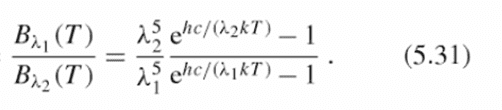
The discussion focuses on determining the temperature of stars using their B-V magnitude through Planck's law. Participants emphasize the necessity of integrating the wavelength over the filter's bandpass to accurately solve for temperature (T). Numerical methods are recommended, with specific mention of using programming tools such as Mathematica, Matlab, or Python for implementation. The conversation highlights the importance of numerical integration in astrophysical calculations.

PREREQUISITES
  • Understanding of Planck's law and its application in astrophysics
  • Familiarity with B-V magnitude and its significance in stellar temperature estimation
  • Basic knowledge of numerical integration techniques
  • Proficiency in programming with Mathematica, Matlab, or Python
NEXT STEPS
  • Learn numerical integration techniques in Python using libraries like NumPy and SciPy
  • Study the implementation of Planck's law in astrophysical calculations
  • Explore the use of Mathematica for solving complex integrals
  • Investigate the relationship between B-V magnitude and stellar temperature
USEFUL FOR

Astronomy students, astrophysicists, and programmers interested in numerical methods for calculating stellar temperatures using Planck's law.

heavystray
Messages
71
Reaction score
0
Hi, I'm trying to find temperature of stars using the stars' B-V magnitude by using the Planck law. However i do not know how to solve for T (assume other quantities are all given and determined first). Any idea how to do so? I already tried to do it but reach a dead end. Here I attached the Planck equation. h is Planck's constant, k is Boltzmann's constant, c is the speed of light,
upload_2018-1-23_0-13-28.png
 

Attachments

  • upload_2018-1-23_0-13-28.png
    upload_2018-1-23_0-13-28.png
    7.4 KB · Views: 559
Astronomy news on Phys.org
It should be a simple matter to solve for T numerically. To do it right, you really should integrate λ over the bandpass of the filter.
 
phyzguy said:
It should be a simple matter to solve for T numerically. To do it right, you really should integrate λ over the bandpass of the filter.
How do you integrate it tho? It'd be great if you can show step by step on how to do it, thanks for answering.
 
heavystray said:
How do you integrate it tho? It'd be great if you can show step by step on how to do it, thanks for answering.

I would do that numerically as well. You can write some simple code in Mathematica, Matlab, or Python to do it. Do you know how to use any of those?
 
phyzguy said:
I would do that numerically as well. You can write some simple code in Mathematica, Matlab, or Python to do it. Do you know how to use any of those?
hmmm no..but i think it's ok for now...i'll just solve it using graph, thanks!
 

Similar threads

  • · Replies 5 ·
Replies
5
Views
2K
  • · Replies 6 ·
Replies
6
Views
2K
  • · Replies 3 ·
Replies
3
Views
2K
  • · Replies 1 ·
Replies
1
Views
1K
  • · Replies 6 ·
Replies
6
Views
2K
  • · Replies 12 ·
Replies
12
Views
14K
  • · Replies 1 ·
Replies
1
Views
1K
Replies
0
Views
1K
  • · Replies 26 ·
Replies
26
Views
4K
Replies
11
Views
2K