Temperature inside a weather station enclosure

Click For Summary

Discussion Overview

The discussion revolves around the temperature measurements inside a wooden enclosure designed for a digital thermometer. Participants explore the effects of the enclosure's design, including the use of a PVC pipe around the sensor, on temperature readings, particularly in relation to sunlight exposure and ambient air temperature.

Discussion Character

  • Exploratory
  • Technical explanation
  • Debate/contested
  • Experimental/applied

Main Points Raised

  • One participant observes that the temperature readings are higher (0.3 to 0.5 degrees) with a PVC pipe around the sensor compared to without it, prompting questions about the reasons behind this increase.
  • Another participant suggests that the design of the enclosure, similar to a Stevenson screen, may influence temperature readings due to how it interacts with sunlight and ambient conditions.
  • A later reply mentions the possibility of "auto-heating" from the digital thermometer's power dissipation affecting the temperature readings when confined in the enclosure.
  • Some participants discuss the implications of using louvers versus holes in the enclosure design, speculating on how these features might affect temperature accuracy.
  • One participant proposes the idea of using a solar-powered fan to improve air circulation within the enclosure, potentially enhancing measurement accuracy.
  • Another participant shares their experience with a weather station that uses a fan to mitigate temperature measurement issues, suggesting it as a viable solution.

Areas of Agreement / Disagreement

Participants express various hypotheses regarding the temperature readings, with no consensus reached on the exact mechanisms at play. Multiple competing views remain about the effects of the enclosure design and the potential for auto-heating.

Contextual Notes

Participants note the complexities of non-equilibrium temperature measurement and the influence of surrounding environmental factors on the thermometer's readings. There are references to the need for unobstructed station locations for certification by weather authorities, highlighting potential limitations in the experimental setup.

Who May Find This Useful

Individuals interested in weather station design, temperature measurement techniques, and the effects of enclosure materials on sensor accuracy may find this discussion relevant.

GhostLoveScore
Messages
149
Reaction score
9
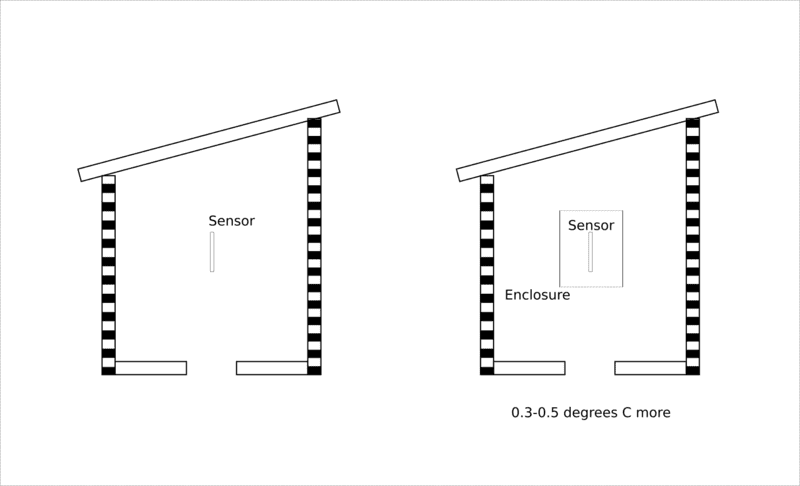
Hello I have a digital thermometer that I put into a wooden enclosure. It has horizontal holes drilled into its sides all around to let air in. On the bottom there is an opening around 1/3 of the width, like in attached photo.
weather1.png


And I was thinking about certain thing. When I put a bare thermometer circuit board in the middle of the enclosure, like on the left side of the attached image, I get certain values. But sometimes sunlight can get through the holes (at sunset) so I decided to put a PVC square pipe around the sensor.
Sensor is attached inside the pipe with two plastic spacers and it's exactly in the middle of the pipe. It doesn't have top and bottom sides. It hangs from the wire in both cases (with or without PVC pipe) from the top of the wooden enclosure.

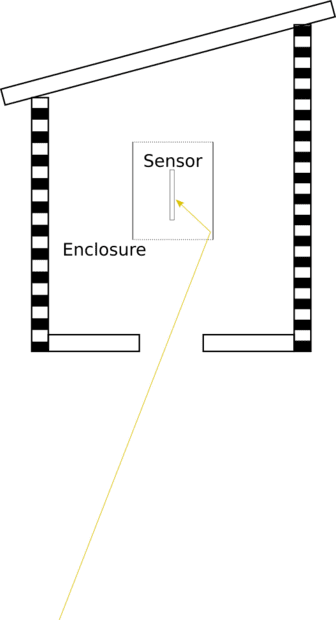
I noticed that my temperatures are about 0.3 to 0.5 degrees higher with PVC pipe around the sensor than without it. At first I thought that maybe light is getting reflected like in second attached photo,
weather2.png


so I taped the inside with black tape. Still same thing.

Then I though that maybe PVC pipe is warmed up with my hands and with sunlight before I put it inside, but that seemed to be wrong when I stored the PVC pipe inside the wooden weather enclosure, so it should be the same temperature as the enclosure.

So now I'm thinking that maybe ambient air is colder than either wooden enclosure or the PVC pipe, but because PVC pipe is a lot closer to the sensor than wooden enclosure, it could be heating it up those 0.3-0.5 degrees. Any ideas on what's happening here?

Maybe I'm naive, but I thought when something is in (not total) shade and you put it in additional shade it should only get colder, closer to being at ambient air temperature, not hotter.
 
Physics news on Phys.org
See "Stevenson Screen," and get back to "us." (Not a "Royal We.")
 
Bystander said:
See "Stevenson Screen," and get back to "us." (Not a "Royal We.")
This is pretty much Stevenson screen, just simlified version of it. With holes instead of angled pieces of wood. I've built real Stevenson screens before, but it's a lot of work.
But that's not important. I am wondering what's going on here, when I have an object in the shade that apparently gets warmer when I put another shade around it.
 
GhostLoveScore said:
just simlified version of it.
Welcome to the "wonderful world" of attempts at non-equilibrium temperature measurement; frosted windshields at "above freezing" ambient/air temperature are quite common, as are "opposite" effects such as you've noticed.

You might check for radiation/radiant heat sources in the immediate vicinity; anything within one to two hundred yards/meters is "integrated" into the thermal background. Station locations are "required" to be "unobstructed" to be certified by the NWS; very few actually are.
 
Hmm... Maybe that's why 'official' weather station enclosure have louvers instead of drilled holes. Put a light bulb in place of the thermometer and notice how much of the surroundings are illuminated; that's what the thermometer sees.

Cheers,
Tom
 
  • Like
Likes   Reactions: russ_watters
Tom.G said:
Hmm... Maybe that's why 'official' weather station enclosure have louvers instead of drilled holes. Put a light bulb in place of the thermometer and notice how much of the surroundings are illuminated; that's what the thermometer sees.

Cheers,
Tom

yes, of course. But in that case, what is that additional pvc enclosure doing to raise the temperature? From physics point of view? Is it, in some, way higher in temperature than ambient air so that it heats up the sensor?

I would imagine that if thermometer "sees" through the holes, it would be even better now with something that blocks the way.
 
https://www.physicsforums.com/threads/selective-surfaces.893834/#post-5624354

Ever burn/blister your arm on your car's chrome trim? Wait a minute...that's "highly" reflective...or, is it? Optical properties are very much functions of temperature, surface type, color, history... Find/borrow/beg/steal a copy of R&H, and remember what temperatures you are dealing with; there are hundreds of white paints out there, and they'll all reach different steady-state temperatures when exposed to "earth surface" ambient.
 
  • Like
Likes   Reactions: dlgoff and GhostLoveScore
Bystander said:
https://www.physicsforums.com/threads/selective-surfaces.893834/#post-5624354

Ever burn/blister your arm on your car's chrome trim? Wait a minute...that's "highly" reflective...or, is it? Optical properties are very much functions of temperature, surface type, color, history... Find/borrow/beg/steal a copy of R&H, and remember what temperatures you are dealing with; there are hundreds of white paints out there, and they'll all reach different steady-state temperatures when exposed to "earth surface" ambient.
Yes, but the car chrome trim was exposed to the direct sunlight.
 
'Digital Thermometer' covers a lot of ground. I'm still trying to figure out how you read it (inside a pipe inside a box).
 
  • #10
Dullard said:
'Digital Thermometer' covers a lot of ground. I'm still trying to figure out how you read it (inside a pipe inside a box).

It's MPC9808 IC on a circuit board and I'm communicating via I2C protocol with it to a microcontroller outside the enclosure.
 
  • #11
I looked at the data sheet. It seems possible that you are 'auto-heating' - power dissipated by the device (And pull-ups, etc.) are warming the temp sensor/PCB when you place it in a 'confined' space.
 
  • Informative
Likes   Reactions: berkeman
  • #12
Dullard said:
I looked at the data sheet. It seems possible that you are 'auto-heating' - power dissipated by the device (And pull-ups, etc.) are warming the temp sensor/PCB when you place it in a 'confined' space.

It's possible. The thermometer is placed on an "island" on the board with only thin bridges that carry power and data, so the heating should be minimal, but I guess it's possible.
 
  • #13
I have a (non-functioning) acurite home weather station. It has a small PV panel which drives a small fan when there's sunshine. That is an easy solution to measuring the surrounding air temperature rather than the temperature of static / warmed up air inside the enclosure. Technology beyond Stevenson.
 
  • #14
sophiecentaur said:
I have a (non-functioning) acurite home weather station. It has a small PV panel which drives a small fan when there's sunshine. That is an easy solution to measuring the surrounding air temperature rather than the temperature of static / warmed up air inside the enclosure. Technology beyond Stevenson.
I might try that, thanks!
 
  • #15
GhostLoveScore said:
I might try that, thanks!
So easy to do with an eBay fan and a battery. T without fan and T with fan. I like that kind of experiment.
 
  • #16
sophiecentaur said:
So easy to do with an eBay fan and a battery. T without fan and T with fan. I like that kind of experiment.
Even better. I'm making 2 more sensors and I will place them inside at the same time, one bare pcb for reference and put the other one in various situations to see what affects the temperature in which way.
 
  • #17
You are clearly doing the delux job.
Collect a brownie point!
 
  • Like
  • Love
Likes   Reactions: jim mcnamara, GhostLoveScore and Tom.G
  • #18
How about a solar powered fan at the top of the box. Since the temp variations seem to be most severe in daylight hours, the fan should draw enough ambient air to improve accuracy. The solar powered fan would not add to the heat load inside the enclosure.
 
  • Like
Likes   Reactions: sophiecentaur
  • #19
Tommy T said:
How about a solar powered fan at the top of the box. Since the temp variations seem to be most severe in daylight hours, the fan should draw enough ambient air to improve accuracy. The solar powered fan would not add to the heat load inside the enclosure.
That's exactly what I had in my previous home weather station. I would have thought that a non-mechanical compensation for insolation would be better than a fan, though. I remember, when I first bought the unit, hearing the fan working and re-read the booklet. "Ahh! that's what it is." The fan broke down but not before the rain gauge tipping bucket needed de-spidering.
 
  • #20
That would be a good choice, I think.
Stevenson screen is great, when it's large enough. Unfortunately, large ones are harder to make, take up space or they are expensive if you buy them.
Smaller ones are easy to carry and can be placed anywhere. A small fan at the top of the small enclosure should make measurements more accurate.

The down side is that if your weather station is solar powered like mine, there's an issue of power consumption. But i think spinning the fan for a 5-10 seconds every couple minutes should be good enough. I'll let you know the results, I'm printing out a 15cm diameter round stevenson screen and I'll compare it to my nice, large, wooden Stevenson screen.
 
  • #21
GhostLoveScore said:
But i think spinning the fan for a 5-10 seconds every couple minutes should be good enough.
The fan only needs to be running during full sun. Let the Sun tell it when to run by using a tiny separate cell to power the fan.
 
  • Like
Likes   Reactions: GhostLoveScore
  • #22
GhostLoveScore said:
Stevenson screen is great, when it's large enough.
It all depends on what accuracy you're after. I use Wunderground which is a network of amateur weather stations and looney enthusiasts. Temperature measurements from contributors near where I live (a few miles) seem to agree with me a with each other, certainly within one C. There is a range of equipment, I think, so I can't grumble for my level of use.
Frankly, it mainly useful for rain measurements so I know whether the garden needs watering when I'm away. My neighbour will give it a splosh if I ring him in an emergency.
But, if you take it seriously, I guess you need the right gear.
 
  • #23
sophiecentaur said:
It all depends on what accuracy you're after. I use Wunderground which is a network of amateur weather stations and looney enthusiasts. Temperature measurements from contributors near where I live (a few miles) seem to agree with me a with each other, certainly within one C. There is a range of equipment, I think, so I can't grumble for my level of use.
Frankly, it mainly useful for rain measurements so I know whether the garden needs watering when I'm away. My neighbour will give it a splosh if I ring him in an emergency.
But, if you take it seriously, I guess you need the right gear.
Ideally I want to be within 0.1 degrees from real value. But way too many things affect the temperature reading so I'm not sure how realistic is that goal of being within 0.1 degrees.
 
  • #24
GhostLoveScore said:
Ideally I want to be within 0.1 degrees from real value.
I guess that "real value" is defined as what you'd measure in a Stevenson screen because reality implies a definition of how you measure it. But far be it from me to question the motivation of an enthusiast. I'm full of nerdiness in other directions. Plus, if we're following climate change then precision is important.
 
  • #25
sophiecentaur said:
I guess that "real value" is defined as what you'd measure in a Stevenson screen because reality implies a definition of how you measure it.

Yes, current definition of taking an air temperature is at 2 meters above grass ground, in Stevenson screen.
Like I said, I'm sure that many variables can cause different temperature readings. For example, if I moved my enclosure 5 meters to the right, the temperature would be slightly different. Or if I moved my thermometer 20cm lower or higher the temperature would also differ from the last example. So, I'm not sure how high I can go in accuracy before it starts being meaningless, but 0.1C seems to be the norm.
 
  • #26
GhostLoveScore said:
Ideally I want to be within 0.1 degrees from real value. But way too many things affect the temperature reading so I'm not sure how realistic is that goal of being within 0.1 degrees.
SInce the chip itself is specified as ±0.5°C (±0.9°F), I'm wondering how you will calibrate to ±0.1°C (±0.18°F).

https://www.google.com/url?q=https://ww1.microchip.com/downloads/en/DeviceDoc/25095A.pdf
•Accuracy:
- ±0.25 (typical) from -40°C to +125°C
- ±0.5°C (maximum) from -20°C to 100°C
- ±1°C (maximum) from -40°C to +125°C
 

Similar threads

Replies
14
Views
4K
  • · Replies 21 ·
Replies
21
Views
3K
  • · Replies 26 ·
Replies
26
Views
3K
  • · Replies 4 ·
Replies
4
Views
3K
  • · Replies 1 ·
Replies
1
Views
935
  • · Replies 4 ·
Replies
4
Views
7K
  • · Replies 13 ·
Replies
13
Views
7K
Replies
4
Views
3K
  • · Replies 2 ·
Replies
2
Views
3K
  • · Replies 35 ·
2
Replies
35
Views
8K