Tensile and compressive forces

Click For Summary
SUMMARY

The discussion centers on the concepts of tensile and compressive forces as they relate to a tightrope walker. It establishes that the weight of the walker creates tensile forces (TL and TR) acting away from the point of weight application, while compressive forces do not exist in this scenario since a rope cannot be pushed. The key takeaway is that for static equilibrium to occur, the sum of all forces—both horizontal and vertical—must equal zero, confirming the walker’s stability on the tightrope.

PREREQUISITES
  • Understanding of static equilibrium principles
  • Familiarity with tensile and compressive forces
  • Basic knowledge of force resolution into components
  • Concept of net force in physics
NEXT STEPS
  • Study the principles of static equilibrium in physics
  • Learn about force resolution techniques in mechanics
  • Explore real-world applications of tensile and compressive forces
  • Investigate the physics of tightrope walking and similar activities
USEFUL FOR

Physics students, engineering professionals, and anyone interested in understanding the mechanics of forces in static systems.

MBBphys
Gold Member
Messages
55
Reaction score
0
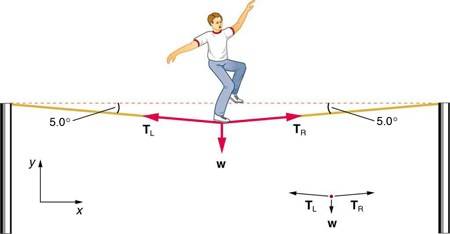
Example of a tightrope walker:
Figure_04_05_06.jpg

Now, the weight force acts at a point. The rope is stretched. Compressive forces act inwards towards that point (opposite to TL and TR, the tensile forces). The resultant of the compressive forces equals the weight and is in the same direction – the weight force CAUSES the compressive forces.

If the man is stable on the tightrope and not moving, then resultant force is zero.

As string is stretched, tension forces act away from the point where weight acts (see image above). These are labelled TL and TR. The resultant of the tensile forces equals the weight in magnitude, but acts in the opposite direction, producing zero net force.

Is my understanding correct? Thanks in advance for your reply :)
 
Physics news on Phys.org
MBBphys said:
Example of a tightrope walker:
Figure_04_05_06.jpg

Now, the weight force acts at a point. The rope is stretched. Compressive forces act inwards towards that point (opposite to TL and TR, the tensile forces). The resultant of the compressive forces equals the weight and is in the same direction – the weight force CAUSES the compressive forces.

What compressive forces? The wire is placed in tension by the weight of the walker.

You should know from experience that you can't push on a rope. Since you can't push on a rope, there is no compressive force.
If the man is stable on the tightrope and not moving, then resultant force is zero.
That is why it's called static equilibrium.
As string is stretched, tension forces act away from the point where weight acts (see image above). These are labelled TL and TR. The resultant of the tensile forces equals the weight in magnitude, but acts in the opposite direction, producing zero net force.

The weight of the walker causes the line to deflect downward. The tensile force in each half of the rope can be resolved into a horizontal and a vertical component.

For static equilibrium to occur, the sum of all these forces must equal zero.

The two horizontal components are of equal magnitude acting in opposite directions, so their net force is zero.
The sum of the vertical components of the tensile forces in the rope must equal the weight of the walker, and these components act in the opposite direction to the weight of the walker, so the net force in the vertical direction is zero.

The sum of the forces in the horizontal and vertical directions is zero, therefore, the walker is in static equilibrium.
 
  • Like
Likes   Reactions: billy_joule and Chestermiller
SteamKing said:
What compressive forces? The wire is placed in tension by the weight of the walker.

You should know from experience that you can't push on a rope. Since you can't push on a rope, there is no compressive force.

That is why it's called static equilibrium.The weight of the walker causes the line to deflect downward. The tensile force in each half of the rope can be resolved into a horizontal and a vertical component.

For static equilibrium to occur, the sum of all these forces must equal zero.

The two horizontal components are of equal magnitude acting in opposite directions, so their net force is zero.
The sum of the vertical components of the tensile forces in the rope must equal the weight of the walker, and these components act in the opposite direction to the weight of the walker, so the net force in the vertical direction is zero.

The sum of the forces in the horizontal and vertical directions is zero, therefore, the walker is in static equilibrium.
Ah yes I get why I was wrong; thanks so much for your help :)
 

Similar threads

  • · Replies 2 ·
Replies
2
Views
2K
  • · Replies 4 ·
Replies
4
Views
3K
  • · Replies 2 ·
Replies
2
Views
3K
  • · Replies 5 ·
Replies
5
Views
2K
  • · Replies 14 ·
Replies
14
Views
2K
  • · Replies 27 ·
Replies
27
Views
3K
  • · Replies 6 ·
Replies
6
Views
3K
  • · Replies 49 ·
2
Replies
49
Views
5K
  • · Replies 9 ·
Replies
9
Views
3K
  • · Replies 5 ·
Replies
5
Views
2K