Tensor Product - Knapp - Theorem 6.10 .... Further Question

Click For Summary

Discussion Overview

The discussion revolves around the proof of Theorem 6.10 from Anthony W. Knapp's book on Basic Algebra, specifically focusing on tensor products and the implications of bilinearity in the context of multilinear algebra. Participants seek clarification on specific aspects of the theorem, including the mapping properties of certain linear maps and the relationship between propositions within the text.

Discussion Character

  • Exploratory
  • Technical explanation
  • Debate/contested

Main Points Raised

  • One participant requests a detailed demonstration of how the bilinearity of a function \( b \) implies that \( B_1 \) maps \( V_0 \) to 0.
  • Another participant seeks clarification on the meaning of "B_1 descends to a linear map \( B: V_1/V_0 \longrightarrow U \)" and the reasoning behind \( Bi = b \).
  • Some participants suggest that the answers to these questions may relate to Proposition 2.25, indicating a potential connection between the theorem and the proposition.
  • One participant reflects on their difficulty in applying Proposition 2.25 to Theorem 6.10, indicating ongoing confusion regarding the proof.
  • A different participant introduces a conceptual framework for understanding tensor products, discussing the properties of multiplication and addition in relation to vector spaces.
  • Another participant mentions the definition of inner products on free abelian groups and poses a challenge related to the uniqueness of inner products on integers.

Areas of Agreement / Disagreement

Participants express varying degrees of understanding regarding the implications of bilinearity and the application of Proposition 2.25, indicating that the discussion remains unresolved with multiple competing views on how to interpret the theorem and its proof.

Contextual Notes

Participants note the dependence on specific definitions and the potential for missing assumptions in the application of the propositions to the theorem. There is also an indication of unresolved mathematical steps in the discussion.

Math Amateur
Gold Member
MHB
Messages
3,920
Reaction score
48
I am reading Anthony W. Knapp's book: Basic Algebra in order to understand tensor products ... ...

I need some help with a further aspect of the proof of Theorem 6.10 in Section 6 of Chapter VI: Multilinear Algebra ...

The text of Theorem 6.10 reads as follows:
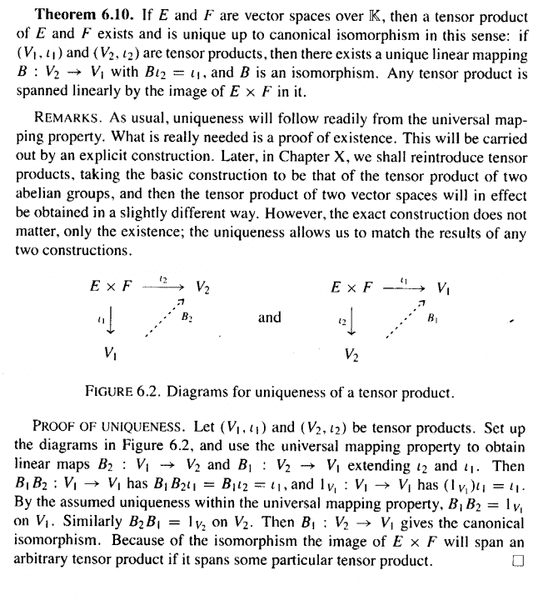
?temp_hash=20761c54b5f7418b2421d2c6e83f9f89.png

?temp_hash=20761c54b5f7418b2421d2c6e83f9f89.png
The above proof mentions Figure 6.1 which is provided below ... as follows:
?temp_hash=20761c54b5f7418b2421d2c6e83f9f89.png

In the above text, in the proof of Theorem 6.10 under "PROOF OF EXISTENCE" we read:

" ... ... The bilinearity of [itex]b[/itex] shows that [itex]B_1[/itex] maps [itex]V_0[/itex] to [itex]0[/itex]. By Proposition 2.25, [itex]B_1[/itex] descends to a linear map [itex]B \ : \ V_1/V_0 \longrightarrow U[/itex], and we have [itex]Bi = b[/itex]. "
My questions are as follows:Question 1

Can someone please give a detailed demonstration of how the bilinearity of [itex]b[/itex] shows that [itex]B_1[/itex] maps [itex]V_0[/itex] to [itex]0[/itex]?Question 2

Can someone please explain what is meant by "[itex]B_1[/itex] descends to a linear map [itex]B \ : \ V_1/V_0 \longrightarrow U[/itex]" and show why this is the case ... also showing why/how [itex]Bi = b[/itex] ... ... ?

Hope someone can help ...

Peter===========================================================*** EDIT ***

The above post mentions Proposition 2.25 so I am providing the text ... as follows:
?temp_hash=0056dc594d9ea4604db6b3d726d39a45.png


============================================================*** EDIT 2 ***

After a little reflection it appears that the answer to my Question 2 above should "fall out" or result from matching the situation in Theorem 6.10 to that in Proposition 2.25 ... also I have noticed a remark of Knapp's following the statement of Proposition 2.25 which reads as follows:
?temp_hash=369f867dba02ccfff528d343805d5e2e.png
So that explains the language: "[itex]B_1[/itex] descends to a linear map [itex]B \ : \ V_1/V_0 \longrightarrow U[/itex]" ... ...

BUT ... I remain perplexed over question 1 ...

Peter
 

Attachments

  • Knap - 1 - Theorem 6.10 - Part 1       ... ....png
    Knap - 1 - Theorem 6.10 - Part 1 ... ....png
    47 KB · Views: 642
  • Knap - 2 - Theorem 6.10 - Part 2       ... ....png
    Knap - 2 - Theorem 6.10 - Part 2 ... ....png
    40.2 KB · Views: 610
  • Knapp - Figure 6.1     ....png
    Knapp - Figure 6.1 ....png
    11.7 KB · Views: 610
  • Knapp - Proposition 2.25 ....png
    Knapp - Proposition 2.25 ....png
    68.5 KB · Views: 604
  • Knapp - 2 - Proposition 2.25 - PART 2 ....png
    Knapp - 2 - Proposition 2.25 - PART 2 ....png
    4.1 KB · Views: 580
Last edited:
Physics news on Phys.org
Math Amateur said:
I am reading Anthony W. Knapp's book: Basic Algebra in order to understand tensor products ... ...

I need some help with a further aspect of the proof of Theorem 6.10 in Section 6 of Chapter VI: Multilinear Algebra ...

The text of Theorem 6.10 reads as follows:
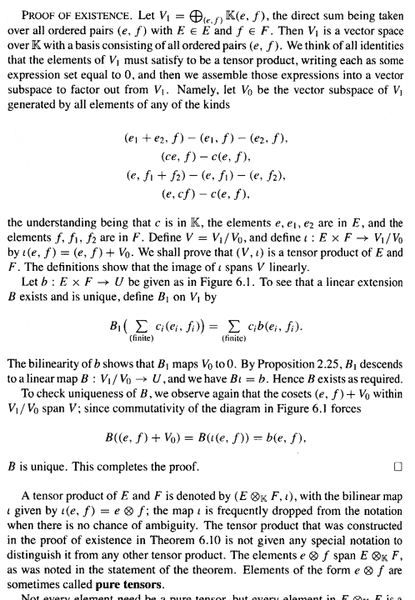
?temp_hash=20761c54b5f7418b2421d2c6e83f9f89.png

?temp_hash=20761c54b5f7418b2421d2c6e83f9f89.png
The above proof mentions Figure 6.1 which is provided below ... as follows:
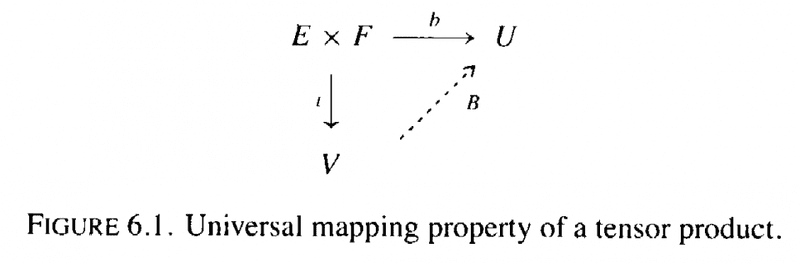
?temp_hash=20761c54b5f7418b2421d2c6e83f9f89.png

In the above text, in the proof of Theorem 6.10 under "PROOF OF EXISTENCE" we read:

" ... ... The bilinearity of [itex]b[/itex] shows that [itex]B_1[/itex] maps [itex]V_0[/itex] to [itex]0[/itex]. By Proposition 2.25, [itex]B_1[/itex] descends to a linear map [itex]B \ : \ V_1/V_0 \longrightarrow U[/itex], and we have [itex]Bi = b[/itex]. "
My questions are as follows:Question 1

Can someone please give a detailed demonstration of how the bilinearity of [itex]b[/itex] shows that [itex]B_1[/itex] maps [itex]V_0[/itex] to [itex]0[/itex]?Question 2

Can someone please explain what is meant by "[itex]B_1[/itex] descends to a linear map [itex]B \ : \ V_1/V_0 \longrightarrow U[/itex]" and show why this is the case ... also showing why/how [itex]Bi = b[/itex] ... ... ?

Hope someone can help ...

Peter===========================================================*** EDIT ***

The above post mentions Proposition 2.25 so I am providing the text ... as follows:
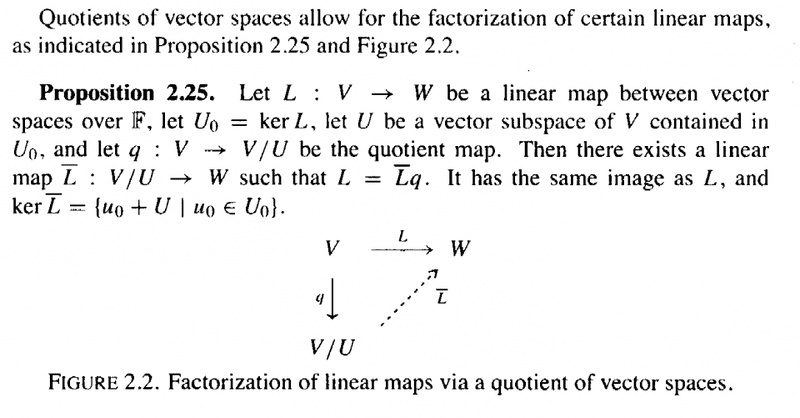
?temp_hash=0056dc594d9ea4604db6b3d726d39a45.png


============================================================*** EDIT 2 ***

After a little reflection it appears that the answer to my Question 2 above should "fall out" or result from matching the situation in Theorem 6.10 to that in Proposition 2.25 ... also I have noticed a remark of Knapp's following the statement of Proposition 2.25 which reads as follows:

?temp_hash=369f867dba02ccfff528d343805d5e2e.png
So that explains the language: "[itex]B_1[/itex] descends to a linear map [itex]B \ : \ V_1/V_0 \longrightarrow U[/itex]" ... ...

BUT ... I remain perplexed over question 1 ...

Peter
... ... BUT NOTE ... after further reflection and work ...

I am having trouble applying Proposition 2.25 to Theorem 6.10 ... SO ... Question 2 remains a problem ... hope someone can help ...AND ... I remain perplexed over question 1 ...

Peter
 
Here is a way of thinking that may help with tensor products.

When one multiplies two numbers ##xy## ,for instance real or complex numbers, then the rules of ordinary multiplication and addition say that

##(ax)y = a(xy) = x(ay)##, ##(x_1 + x_2)y = x_1y + x_2y## and ##x(y_1 + y_2) = xy_1 + xy_2##

One would like to have exactly the same rules apply when ##x## and ##y## are vectors in two(usually different) vector spaces and ##a## is a scalar. Since it makes no sense to multiply vectors one needs to decide what a multiplication would mean. Your book defines the tensor product as the solution to a universal mapping problem. andrewkirk defines it in another way.

Whatever the construction one gets "products" ##x⊗y## in a new vector space, ##V⊗W##, that satisfy the rules of multiplication and addition. That is:

* ##a(x⊗y) = (ax)⊗y = x⊗(ay)##, ##(x_1+x_2)⊗y = x_1⊗y + x_2⊗y## and ##x⊗(y_1+y_2) = x⊗y_1+x⊗y_2##

This new vector space will be all linear combinations ##Σ_{i}a_{i}x_{i}⊗y_{i}## subject to the required rules of multiplication and addition. That is: the tensor product is just the vectors space of all symbols ##Σ_{i}a_{i}x_{i}⊗y_{i}## subject to the equivalence relations *

One can think of the tensor product of two vector spaces completely formally in this way. You tell yourself, " However it was constructed, this is what is must look like."

It is easy to check that a linear map from ##V⊗W## into another vector space,##U##, determines a bilinear map from ##V##x##W## into ##U## and visa versa.

Here is an exercise: Let ##V## be a vector space over the real numbers and view the complex numbers ##C## as a vectors space over the real numbers as well. What is the space ##V⊗C##? Is it a complex vector space?
 
Last edited:
  • Like
Likes   Reactions: Math Amateur
Inner products can also be defined on free abelian groups. ##g(x,y)## is a symmetric positive definite bilinear form that takes values in the integers. There is the additional condition that for every linear map ##L## of ##V## into the integers there is a unique ##v_0## such that
##L(w) = g(w,v_0)## for all ##w## in ##L##.

- Show that there is only one inner product on the integers.
 
Last edited:

Similar threads

Replies
5
Views
2K
  • · Replies 5 ·
Replies
5
Views
2K
  • · Replies 3 ·
Replies
3
Views
2K
  • · Replies 10 ·
Replies
10
Views
3K
  • · Replies 14 ·
Replies
14
Views
2K
  • · Replies 2 ·
Replies
2
Views
2K
  • · Replies 5 ·
Replies
5
Views
3K
  • · Replies 2 ·
Replies
2
Views
2K
  • · Replies 4 ·
Replies
4
Views
3K
  • · Replies 2 ·
Replies
2
Views
2K