brotherbobby
- 796
- 176
- TL;DR
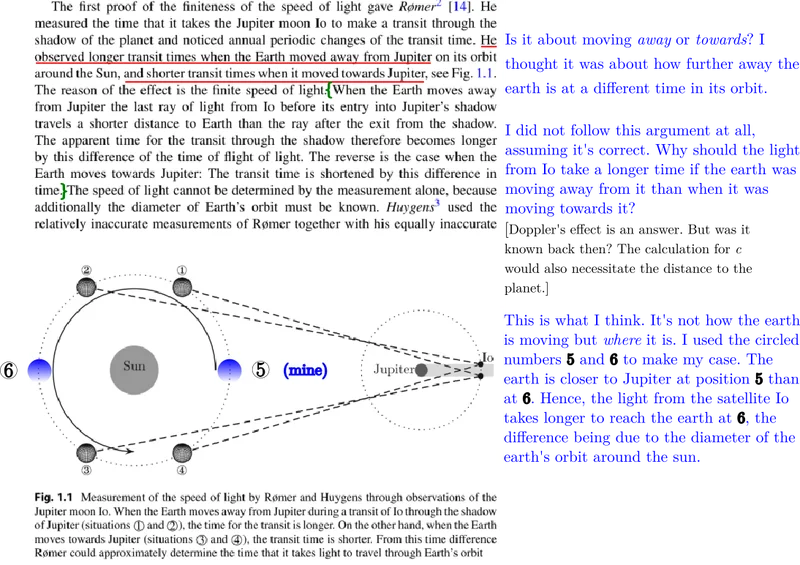
- A recent textbook (see below) has described the dutch astronomer R##\ddot{\text o}##mer's calculation of the velocity of light by alluding to the differences in the sighting of Jupiter's moon when the earth was ##\textit{moving away}## from the planet as against the earth ##\textit{moving towards}## the planet. I don't understand it. Why should light take longer or shorter times depending how the earth moved? I thought it was due to ##\textit{where}## the earth is, not how it was moving.
Statement of the problem : I copy and paste the clip from the text, underling in red the sentences where, in my opinion, the author(s) have gone wrong. I annonate to the right of the text in blue, assuming they are both readable. The text in question is titled Special and General Relativity (2026, Springer) by Boblest, Muller and Wunner.
I don't explain further, except for one point.
It is reported that R##\ddot{\text o}##mer found a time lag ##\Delta t = 22\;\text{minutes}\,## between the two sightings of the moon at different times of the year. Also, that he found the light's speed to measure to about ##\boxed{c = 220,000\;\text{km/s}}##.
I can use my reasoning as in the image to see if it fits. If indeed the time discrepancy takes place due to where the earth is relative to Jupiter, then the "culprit" should be the diameter of the earth's orbit. It is this extra distance that light has to travel that explains why it appears that the moon Io's stays a longer time eclipsed "behind" Jupiter.
This should help me calculate. We know the radius of the earth's orbit around the sun ##R_{\bigodot} = 1.5\times 10^8\;\text{km}##. The reported time lag ##\Delta t = 22\; \text{minutes}\, = 22\times 60\; \text{seconds}\, ##. Hence the speed of light ##c = \dfrac{2R_{\bigodot}}{\Delta t}= \dfrac{2\times 1.5 \times 10^8\;\text{km}}{22\times 60\;\text{s}} = \boxed{227272\;\text{km/s}}##, which is close to what was obtained.
Thanks for your time. If indeed I am mistaken and the authors are correct, I'd like to know of their reasoning and the calculation. The only way out I can see is if light is assumed to move through ether. Indeed, according to Doppler's effect, the speed of light (or sound) will change if the observer moved towards or away from the source. Is this the author's reasoning? Even if it was, I don't see how it leads to the result of light speed.
I don't explain further, except for one point.
It is reported that R##\ddot{\text o}##mer found a time lag ##\Delta t = 22\;\text{minutes}\,## between the two sightings of the moon at different times of the year. Also, that he found the light's speed to measure to about ##\boxed{c = 220,000\;\text{km/s}}##.
I can use my reasoning as in the image to see if it fits. If indeed the time discrepancy takes place due to where the earth is relative to Jupiter, then the "culprit" should be the diameter of the earth's orbit. It is this extra distance that light has to travel that explains why it appears that the moon Io's stays a longer time eclipsed "behind" Jupiter.
This should help me calculate. We know the radius of the earth's orbit around the sun ##R_{\bigodot} = 1.5\times 10^8\;\text{km}##. The reported time lag ##\Delta t = 22\; \text{minutes}\, = 22\times 60\; \text{seconds}\, ##. Hence the speed of light ##c = \dfrac{2R_{\bigodot}}{\Delta t}= \dfrac{2\times 1.5 \times 10^8\;\text{km}}{22\times 60\;\text{s}} = \boxed{227272\;\text{km/s}}##, which is close to what was obtained.
Thanks for your time. If indeed I am mistaken and the authors are correct, I'd like to know of their reasoning and the calculation. The only way out I can see is if light is assumed to move through ether. Indeed, according to Doppler's effect, the speed of light (or sound) will change if the observer moved towards or away from the source. Is this the author's reasoning? Even if it was, I don't see how it leads to the result of light speed.
Last edited: