The concept of rotational equilibrium

Click For Summary
SUMMARY

The discussion centers on the concept of rotational equilibrium, specifically addressing the conditions under which an object can be in torque equilibrium without being in force equilibrium. Participants reference the textbook "Physics for Scientists & Engineers" by Serway, which presents a quiz question that confuses the distinction between these two states. Key points include the necessity of considering the center of mass when evaluating torque and the implications of using an accelerating pivot point. The consensus is that while an object can be in torque equilibrium, it may still experience translational acceleration, leading to confusion regarding the textbook's assertions.

PREREQUISITES
  • Understanding of torque and its calculation in physics
  • Familiarity with the concepts of force equilibrium and torque equilibrium
  • Knowledge of center of mass and its significance in mechanics
  • Basic principles of rotational dynamics and acceleration
NEXT STEPS
  • Study the concept of torque equilibrium in detail, focusing on examples from "Physics for Scientists & Engineers" by Serway
  • Learn about the implications of using an accelerating pivot point in rotational dynamics
  • Explore advanced topics in Classical Mechanics, particularly the relationship between translational and rotational motion
  • Review the principles of inertial forces and their role in analyzing systems in motion
USEFUL FOR

Students of physics, particularly those studying mechanics, educators seeking to clarify concepts of equilibrium, and anyone interested in the nuances of rotational dynamics.

hms.tech
Messages
246
Reaction score
0
Here is a text from my Physics Book :

The net external torque on the object about any axis must be zero for it to be in rotational equilibrium.

I divide the torques into two categories, anticlockwise and clockwise. (This approach works fine for 2-D objects but will it work for 3-D objects as well ?)

I think i found an error in my book or it might be possible that there is something wrong with my judgment. There was this quick quiz question and it asked whether the object is in rotational equilibrium.
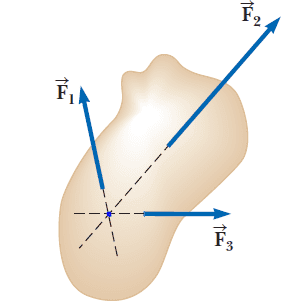
Capture.PNG


I say no, it shouldn't and i can prove it :
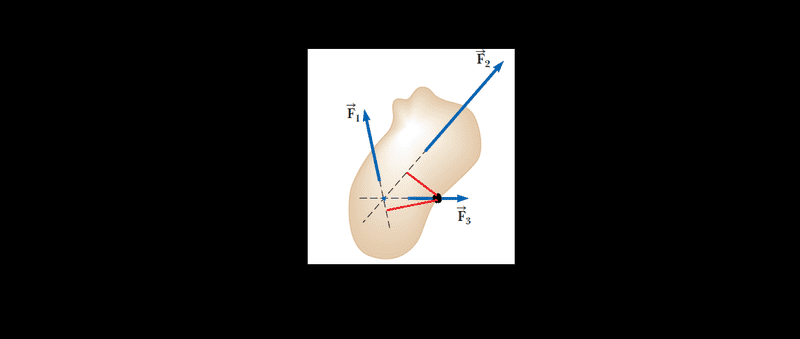
Untitled.png

Consider the black spot as the pivot and if i were to take moments about this point of the two forces, i would find that F_{1} and F_{2} each provide a clockwise torque !

Yes i agree that the net torque about their point of intersection will be zero but not about the black spot(which also lies in the object)
 
Physics news on Phys.org
Hi hms.tech, did the question specify whether or not the point of intersection of the three force vectors was also the center of mass?
 
cactusCookies said:
Hi hms.tech, did the question specify whether or not the point of intersection of the three force vectors was also the center of mass?

Not at all
 
hms.tech said:
Not at all

Then I'm inclined to agree with you!

If it was the center of mass, the object would be in rotational equilibrium. If you take your pivot axis at the black dot as you suggested, don't forget to add in the inertia force to produce a torque that counters the torque from the applied force and all is right in the world again :)
 
What book are you using? Are you saying that the text claimed that the pictured object was in rotational equilibrium?
 
Doc Al said:
What book are you using? Are you saying that the text claimed that the pictured object was in rotational equilibrium?

This book was recommended as a great book for introductory physics by ppl here on PF
Physics for Scientists & Engineers by Serway.

As mentioned in the first post, there was this quiz on page 349~350 which asked whether the given object is in equilibrium, i stumbled across it while reading the text.

The answer given at the back of the book says this :
The object is in torque equilibrium but not force equilibrium.

I am seriously confused, is that possible ?
 
"The object is in torque equilibrium but not force equilibrium.

I am seriously confused, is that possible?"

Sure. Consider an object in free fall. It experiences no torque, but definitely a force.
 
hms.tech said:
The answer given at the back of the book says this :
The object is in torque equilibrium but not force equilibrium.

I am seriously confused, is that possible ?
Is it possible for an object to be in torque equilibrium but not force equilibrium? Only if the torque about the center of mass is zero. In which case the object will have a translational acceleration, but not a rotational acceleration about its center of mass. (Usually these issues are addressed in your next mechanics course. I doubt Serway covers these cases.)

I would say that the book is wrong about that question. (Unless they are talking about the line of action intersecting at the center of mass. But I don't think the book is covering such issues.)
 
Doc Al said:
Is it possible for an object to be in torque equilibrium but not force equilibrium? Only if the torque about the center of mass is zero. In which case the object will have a translational acceleration, but not a rotational acceleration about its center of mass. (Usually these issues are addressed in your next mechanics course. I doubt Serway covers these cases.)

I would say that the book is wrong about that question. (Unless they are talking about the line of action intersecting at the center of mass. But I don't think the book is covering such issues.)

I can't see the logic in your answer .
I think that even if all three forces were passing through the Center of mass, there MIGHT still be a net torque !
Let me prove it : https://www.physicsforums.com/attachment.php?attachmentid=57701

Consider this diagram in which the three forces are passing through the Center of mass (I am assuming this to prove my point). A point (black) is taken to be the pivot. Will there not be a net torque about this black spot ? (i think there will. )

Both F_{1} and F_{2} exert a clockwise torque ! ( i really can't see the possibility of an inertia force on the center of mass as suggested by cactusCookies; it does not make sense)
 
  • #10
hms.tech said:
I can't see the logic in your answer .
I think that even if all three forces were passing through the Center of mass, there MIGHT still be a net torque !
Let me prove it : https://www.physicsforums.com/attachment.php?attachmentid=57701

Consider this diagram in which the three forces are passing through the Center of mass (I am assuming this to prove my point). A point (black) is taken to be the pivot. Will there not be a net torque about this black spot ? (i think there will. )
Is there a torque about the black spot? Sure. But be careful about what conclusions you draw from that, since the black spot is accelerating. It still turns out that there will be no rotational acceleration of the object.

Both F_{1} and F_{2} exert a clockwise torque ! ( i really can't see the possibility of an inertia force on the center of mass as suggested by cactusCookies; it does not make sense)
One way of dealing with the fact that you are using an accelerating point as your pivot is by introducing inertial forces as cactusCookies stated. (The center of mass is a special point--it doesn't matter if it is accelerating or not.)

As I hinted, these more advanced issues are dealt with in your next mechanics course (e.g., Classical Mechanics).
 
Last edited:

Similar threads

  • · Replies 14 ·
Replies
14
Views
1K
  • · Replies 17 ·
Replies
17
Views
2K
  • · Replies 14 ·
Replies
14
Views
1K
  • · Replies 4 ·
Replies
4
Views
607
  • · Replies 7 ·
Replies
7
Views
3K
  • · Replies 4 ·
Replies
4
Views
2K
Replies
2
Views
1K
  • · Replies 47 ·
2
Replies
47
Views
5K
  • · Replies 8 ·
Replies
8
Views
753
  • · Replies 5 ·
Replies
5
Views
3K