The Curious Case of The Impotent Magnets

  • Context: Undergrad 
  • Thread starter Thread starter theycallmevirgo
  • Start date Start date
  • Tags Tags
    Curious Magnets
Click For Summary

Discussion Overview

The discussion revolves around the issues encountered when using magnets to create a battery pack, specifically focusing on the loss of magnetic force and the reliability of electrical connections. Participants explore the implications of soldering techniques, the physical arrangement of components, and the properties of magnets in relation to temperature and electrical contact.

Discussion Character

  • Exploratory
  • Technical explanation
  • Debate/contested
  • Mathematical reasoning

Main Points Raised

  • One participant reports a significant loss of magnetic force in magnets used in a battery pack, questioning whether this is due to soldering technique or the arrangement of components.
  • Another participant suggests that exposure to high temperatures could lead to demagnetization, referencing the Curie temperature of magnets.
  • Some participants express confusion about the initial choice of using magnets for battery connections, questioning the practicality of the approach.
  • Concerns are raised about the reliability of electrical contacts made with magnets, citing three criteria for effective long-term connections: low electronegativity difference, high contact pressure, and multiple contact points.
  • A participant mentions that while magnetic contacts may work for short-term applications like chargers, they could lead to increased resistance and inefficiency in longer-term use.
  • There is a discussion about the availability of standard battery holders and the potential for reusing materials instead of purchasing new components.
  • Questions arise regarding the specifics of contact pressure and the design of multiple contact points in electrical connections.

Areas of Agreement / Disagreement

Participants express a mix of agreement and disagreement regarding the effectiveness of using magnets for battery connections. While some acknowledge the potential for short-term use, others emphasize the challenges and limitations of this approach, indicating that the discussion remains unresolved.

Contextual Notes

Participants note the importance of understanding the physical properties of magnets and the implications of soldering techniques, as well as the need for reliable electrical connections in battery applications. There are references to specific temperatures and material properties that may affect magnetism and electrical contact, but these aspects remain complex and not fully resolved.

Who May Find This Useful

This discussion may be useful for hobbyists and engineers interested in battery design, electrical connections, and the practical applications of magnets in electronic projects.
theycallmevirgo
Messages
108
Reaction score
25
TL;DR
Why did my magnets lose much of their force when I soldered wires to to them?
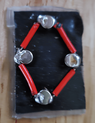
I connected some magnets with (single strand) wire and solder in a parallelogram pattern, in the process of making a battery pack. After I was through, it seems they lost a great deal of their force, Identical magnets still attract to them, but unpolarized ferromagnetic objects (like the batteries) are no longer attracted.

Any ideas what happened? If it's simply my soldering technique or the physical arrangement I could try to come up with another one, but if it's the solder or the wires I'll have to come up with a workaround.

Picture is attached. Magnets are 5mm in diameter, wire is 22AWG, solder is leaded rosin core.
 

Attachments

  • Screenshot 2022-07-20 181836.png
    Screenshot 2022-07-20 181836.png
    79.5 KB · Views: 134
Physics news on Phys.org
  • Like
Likes   Reactions: vanhees71 and theycallmevirgo
theycallmevirgo said:
I connected some magnets with (single strand) wire and solder in a parallelogram pattern
Um, why?
 
berkeman said:
Um, why?
I'm trying to make a (parallel) battery pack for cylindrical cells. The technique with magnets and adhesive tape was the fastest way I could come up with of correctly positioning the terminals.
 
theycallmevirgo said:
I'm trying to make a (parallel) battery pack for cylindrical cells. The technique with magnets and adhesive tape was the fastest way I could come up with of correctly positioning the terminals.
There aren't existing plastic holders with standard spring clips for the configuration you want to make? That's probably your best bet, especially for reliable long-term connections to the battery terminals (without worrying about dissimilar metal corrosion, etc.).

What is the exact battery configuration you want to achieve? If you want to use AA batteries (or similar standard sizes), there are lots of standard holder options. The image below show a series connection of 4xAA batteries, but you can get single holders as well, allowing you to do a parallel connection. Please do keep in mind that parallel connection of batteries should only be done with batteries that have the same history (purchased together, charged together if they are rechargeable, etc.).

1658360889877.png


https://www.pololu.com/product/1153
 
The cells are larger than standard size. Although, you're correct in that I didn't check the market first. Frankly I have so much crap lying around that my first move is to try and reuse :).
 
Are you familiar with the three very important criteria for making reliable long-term electrical contact between two metal objects? Your magnet idea would seem to violate all 3 of them at first glance... :wink:

(Full disclosure update -- I worked at Bell Labs for a few years, so reliability was a big deal) :smile:
 
  • Like
Likes   Reactions: theycallmevirgo
berkeman said:
Are you familiar with the three very important criteria for making reliable long-term electrical contact between two metal objects? Your magnet idea would seem to violate all 3 of them at first glance... :wink:

(Full disclosure update -- I worked at Bell Labs for a few years, so reliability was a big deal) :smile:
My original idea was to add more solder later.

I know you have extensive industry experience. That's why I always value your input.

To follow up on your original point, looking at what's available on Amazon there are many good options but most of them come in packs of four. I have no idea where I'd even put the other 3 for storage :).
 
  • #10
Thanks for the kind words.

theycallmevirgo said:
My original idea was to add more solder later.
More solder won't help the connection issue. Here are the 3 requirements for good, reliable long-term electrical connections between two metallic things (whether batteries to contacts, or wires to connectors, or EMI spring finger contacts on shielded room closures, etc.):

-1- The contacting metals should have a low difference in electronegetivity -- that is, they should be the same material or have inherently low electronegetivity values:
https://en.wikipedia.org/wiki/Galvanic_corrosion
https://www.corrosionpedia.com/definition/6767/electronegative

-2- The contacting metals should have a high contact pressure to hold them together, to exclude air from the contact area(s). This helps to reduce the possibility of corrosion forming in that contact area.

-3- The contacting metals should have multiple contact points at the interface, so that if one contact point develops a corrosion issue, the others will still be good.

So I think you can see how using magnets as the contact interfaces to the battery terminals will not be reliable. Instead, look to use strong spring contacts using standard spring contact materials. You can certainly fabricate your own holders (especially if you or your friends have a small 3-D printer available), but getting the metal-to-metal contacts right is very important to ensure long-term reliable power delivery. :smile:
 
  • Like
Likes   Reactions: theycallmevirgo
  • #11
berkeman said:
Thanks for the kind words.More solder won't help the connection issue. Here are the 3 requirements for good, reliable long-term electrical connections between two metallic things (whether batteries to contacts, or wires to connectors, or EMI spring finger contacts on shielded room closures, etc.):

-1- The contacting metals should have a low difference in electronegetivity -- that is, they should be the same material or have inherently low electronegetivity values:
https://en.wikipedia.org/wiki/Galvanic_corrosion
https://www.corrosionpedia.com/definition/6767/electronegative

-2- The contacting metals should have a high contact pressure to hold them together, to exclude air from the contact area(s). This helps to reduce the possibility of corrosion forming in that contact area.

-3- The contacting metals should have multiple contact points at the interface, so that if one contact point develops a corrosion issue, the others will still be good.

So I think you can see how using magnets as the contact interfaces to the battery terminals will not be reliable. Instead, look to use strong spring contacts using standard spring contact materials. You can certainly fabricate your own holders (especially if you or your friends have a small 3-D printer available), but getting the metal-to-metal contacts right is very important to ensure long-term reliable power delivery. :smile:
Thanks so much for this. My google fu was not up to the task. Having said that,

A) I didn't come up with the magnetic contacts idea myself. There are a few chargers like that on the market.

B) Do you have a numerical value for "high contact pressure"? Certainly I don't have any equipment capable of such a measurement but some of my simulation software might be able to evaluate a design.

C) Could you perhaps provide a graphical example of "multiple contact points"? Most of the things I see on Amazon seem to have only one, unless a flat surface is in and of itself "multiple contacts".
 
  • #12
theycallmevirgo said:
A) I didn't come up with the magnetic contacts idea myself. There are a few chargers like that on the market.
I guess for just a charger (which is only in contact with the battery contacts for a short time), the requirements that I listed probably could be eased. The contacts will be cleaned by the wiping action of pulling out and pushing in each battery cell to be recharged, which is a good thing. Still, the low contact pressure would seem to increase the Ohmic resistance of the contact with the battery, which reduces the charging efficiency and could confuse some charging circuits, IMO.

Where are these batteries being used after they are charged? If those battery holders and contacts are of a more standard design, then the charger may have more flexibility in its design.

theycallmevirgo said:
B) Do you have a numerical value for "high contact pressure"? Certainly I don't have any equipment capable of such a measurement but some of my simulation software might be able to evaluate a design.
It should require some effort to put the batteries into the holders. I know that's pretty nebulous, but it will take me a while to search the old BTL docs for expected contact pressures. "Soft" electrical connections are prone to corrosion.

theycallmevirgo said:
C) Could you perhaps provide a graphical example of "multiple contact points"? Most of the things I see on Amazon seem to have only one, unless a flat surface is in and of itself "multiple contacts".

Cheap battery holders may only have one contact point for the + terminal, like in the 4xAA holder pic that I posted above. But better designed connections will use multiple contact points...

1658365412495.png

https://sc04.alicdn.com/kf/HTB1lQKCaYH1gK0jSZFwq6A7aXXac.jpg

1658365497761.png

https://encrypted-tbn0.gstatic.com/images?q=tbn:ANd9GcTpQIGWU9b7Ldo-zhtsBpIWWqK6e8_83bf-7g&usqp=CAU

1658365599530.png

https://hollandshielding.com/content/2800/2800-door-fingers-header.png
 
  • Informative
Likes   Reactions: dlgoff
  • #13
I don't think the magnet is losing its magnetization because the Curie temperature is exceeded. Solder is not all that hot.

How are the poles arranged? I suspect much of the flux is contained inside the magnets.
 
  • Informative
Likes   Reactions: dlgoff
  • #14
Vanadium 50 said:
I don't think the magnet is losing its magnetization because the Curie temperature is exceeded. Solder is not all that hot.

How are the poles arranged? I suspect much of the flux is contained inside the magnets.
Solder is certainly not that hot. The iron, OTOH, hits 320c according to the onboard sensor :).
 
  • #15
berkeman said:
I guess for just a charger (which is only in contact with the battery contacts for a short time), the requirements that I listed probably could be eased. The contacts will be cleaned by the wiping action of pulling out and pushing in each battery cell to be recharged, which is a good thing. Still, the low contact pressure would seem to increase the Ohmic resistance of the contact with the battery, which reduces the charging efficiency and could confuse some charging circuits, IMO.

Where are these batteries being used after they are charged? If those battery holders and contacts are of a more standard design, then the charger may have more flexibility in its design.It should require some effort to put the batteries into the holders. I know that's pretty nebulous, but it will take me a while to search the old BTL docs for expected contact pressures. "Soft" electrical connections are prone to corrosion.
Cheap battery holders may only have one contact point for the + terminal, like in the 4xAA holder pic that I posted above. But better designed connections will use multiple contact points...

View attachment 304532
https://sc04.alicdn.com/kf/HTB1lQKCaYH1gK0jSZFwq6A7aXXac.jpg

View attachment 304534
https://encrypted-tbn0.gstatic.com/images?q=tbn:ANd9GcTpQIGWU9b7Ldo-zhtsBpIWWqK6e8_83bf-7g&usqp=CAU

View attachment 304535
https://hollandshielding.com/content/2800/2800-door-fingers-header.png
Actually I got involved trying to kitbash something because the original enclosure had a crappy i/o board (dropped output voltage when input was connected). I just realized I could simply pull the terminals from the old enclosure and desolder them. Lingering effects of some health garbage make me a little slow :).

I'll definitely use your suggestions at the next stage.
 
  • Like
Likes   Reactions: berkeman

Similar threads

  • · Replies 42 ·
2
Replies
42
Views
3K
  • · Replies 22 ·
Replies
22
Views
4K
  • · Replies 1 ·
Replies
1
Views
13K
  • · Replies 3 ·
Replies
3
Views
2K
  • · Replies 8 ·
Replies
8
Views
4K