The Electrical energy of a conducting cylinder

Click For Summary

Homework Help Overview

The problem involves a cylindrical conductor with a dielectric material, where the task is to calculate the change in electrical energy when the dielectric is removed. The setup includes variables such as the length of the cylinder, inner and outer radii, and a constant voltage from a battery.

Discussion Character

  • Mixed

Approaches and Questions Raised

  • Participants discuss the relationship between charge, capacitance, and voltage in the context of the problem. There are attempts to express energy differences using capacitance equations, and some participants raise questions about the conservation of charge and the role of electric fields.

Discussion Status

There is ongoing exploration of the relevant equations and concepts, with some participants suggesting methods to compute capacitance and energy differences. Multiple interpretations of the problem are being discussed, particularly regarding the conservation of charge and the effects of the dielectric.

Contextual Notes

Participants note the importance of understanding the geometry of the system and the definitions of capacitance in relation to the problem. There is mention of the dielectric's effect on charge distribution, but no consensus has been reached on the implications for the calculations.

doktorwho
Messages
181
Reaction score
6
1. The problem stsatemesnt, all variables and given/known data
A cylinder conductor of length ##l##, inner radius ##a## and outer radius ##b## is half-filled with a liquid dielectric as shown in the picture. The cylinder is attached to a battery of constant voltage ##U## and then separated from it. Imagine that the dielectric is leaking and calculate the change of electrical energy when there is no dielectric present. ( meaning the difference between the beginning state and the one were there is no dielectric)
There is a picture below.
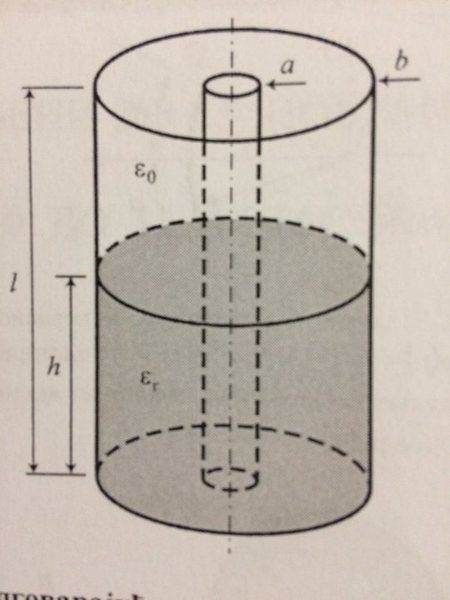
IMG_2019.JPG

Homework Equations


3. The Attempt at a Solution
I'm going to guide you through my work and thinking so you can correct me and help me finish the problem.[/B]
##ΔW_e=W_{e2}-W_{e1}## ( The state 2 is when its empty)
##W_{e1}=\frac{1}{2}\frac{Q_1^2}{C_1}## ( ##C_1,Q_1## are the total charge and capacitance of the system 1)
Because there is a dielectric in the first system i have two electric fields, the one above the ##h## and the one below going radial.
##E_1=\frac{Q'_1}{2 \pi ε_0 r}##
##U_1=\frac{Q'_1}{2 \pi ε_0}\ln (b/a)##
##E_2=\frac{Q'_2}{2 \pi ε_0 ε_r r}##
##U_2=\frac{Q'_2}{2 \pi ε_0 ε_r} \ln (b/a)##
Then i express the linear charge densities ##Q'_1,Q'_2##
##Q'_1=\frac{2 \pi ε_0 U_1}{\ln (b/a)}##
##Q'_2=\frac{2 \pi ε_0 ε_r U_2}{\ln (b/a)}##
##Q_{total}=Q'_1*(l/2) + Q'_2*(l/2)##
Something does not seem right here, can you help me with what i got wrong?
 
Last edited:
Physics news on Phys.org
Hi,

I'm missing the relevant equations in section 2 :smile: like ##Q_{\rm total}\ ## conserved, ##U_1 = U_2 ## and such...
And what about ##\ C_1, C_2\ ## ?
 
BvU said:
Hi,

I'm missing the relevant equations in section 2 :smile: like ##Q_{\rm total}\ ## conserved, ##U_1 = U_2 ## and such...
And what about ##\ C_1, C_2\ ## ?
It's not stated but I am guessing that ##Q## must be conserved and ##C## and ##U## are changing. :) The whole work is my guess so i don't know the answer if anything is conserved xD I was thinking someone can provide an insight.
 
I would forget about E fields. Just compute C1 and C2, then take the difference in 1/2 CV^2. Yes, Q is conserved; removing the dielectric does not remove any charge. So you know that V1 and V2 will be different also.
 
  • Like
Likes   Reactions: BvU
rude man said:
I would forget about E fields. Just compute C1 and C2, then take the difference in 1/2 CV^2. Yes, Q is conserved; removing the dielectric does not remove any charge. So you know that V1 and V2 will be different also.
But to compute C i need to have V and to have V i need E
 
doktorwho said:
But to compute C i need to have V and to have V i need E
No you don't. C is a property of the geometry etc etc and is independent of V, E or Q. (We are not yet dealing with nonlinear capacitors at your stage of the game).
 
rude man said:
No you don't. C is a property of the geometry etc etc and is independent of V, E or Q. (We are not yet dealing with nonlinear capacitors at your stage of the game).
##C=\frac{Q}{V}## by definition. What do you mean its not dependent on ##Q## or ##V##?
 
doktorwho said:
##C=\frac{Q}{V}## by definition. What do you mean its not dependent on ##Q## or ##V##?
doktorwho said:
##C=\frac{Q}{V}## by definition. What do you mean its not dependent on ##Q## or ##V##?
OK take two large parallel plates. Area = A, separation = d. What's the capacitance?
 
rude man said:
OK take two large parallel plates. Area = A, separation = d. What's the capacitance?
##C=\epsilon_0\frac{A}{d}##
I see your point, it is the conductors geometric property.
For the cylindrical system i then have two capacitances ##C_1=\frac{2\pi\epsilon_0L/2}{ln(b/a)}##, ##C_2=\frac{2\pi\epsilon_0\epsilon_rL/2}{ln(b/a)}## Now i need to know the ##V_1,V_2## for the system in case it's half filled and for that i need ##E##. When i find that what is my ##C## for the case where its half filled? I have two C's?
 
  • #10
doktorwho said:
##C=\epsilon_0\frac{A}{d}##
I see your point, it is the conductors geometric property.
For the cylindrical system i then have two capacitances ##C_1=\frac{2\pi\epsilon_0L/2}{ln(b/a)}##, ##C_2=\frac{2\pi\epsilon_0\epsilon_rL/2}{ln(b/a)}## Now i need to know the ##V_1,V_2## for the system in case it's half filled and for that i need ##E##. When i find that what is my ##C## for the case where its half filled? I have two C's?
You don't need E.
You have two capacitors in "parallel", do you see that? Call them CA and CB. So C = CA + CB. Say CA has the dielectric, initially. You can compute CA1; also CB1 = CA2 = CB2.
You know V1, = same for CA and CB. You then can find Q = V1(CA1 + CB1).
For V2 you invoke the fact that Q does not change. This enables you to compute V2.
Finally, as I said, energy = 1/2 Δ{CV2}, or = 1/2 Q ΔV.
I can say no more.
 
  • Like
Likes   Reactions: doktorwho
  • #11
All a matter of writing down the relevant equations, including the conservation relationships ...
BvU said:
I'm missing the relevant equations in section 2 :smile: like ##Q_{\rm total}\ ##conserved, ##U_1 = U_2## and such...
(not to rub it in, but to make clear the ingredients of a solid problem solving approach ... )
doktorwho said:
It's not stated but I'm guessing that ##Q## must be conserved and ##C## and ##U## are changing.
No guessing. Physics. Where would Q go ?
 
  • Like
Likes   Reactions: doktorwho and rude man
  • #12
Dielectric polarization can make Q change at conductor surfaces. The net change in Q is 0 globally.
 
  • #13
EricGetta said:
Dielectric polarization can make Q change at conductor surfaces. The net change in Q is 0 globally.
Don't think so. The dielectric does not assume net charge. All charge stays on the metal surfaces.
 

Similar threads

  • · Replies 4 ·
Replies
4
Views
2K
  • · Replies 23 ·
Replies
23
Views
2K
Replies
4
Views
2K
  • · Replies 3 ·
Replies
3
Views
2K
Replies
1
Views
3K
  • · Replies 6 ·
Replies
6
Views
2K
  • · Replies 4 ·
Replies
4
Views
2K
Replies
2
Views
2K
Replies
2
Views
2K
  • · Replies 14 ·
Replies
14
Views
2K