The Method of Images (Electromagnetism)

Click For Summary
SUMMARY

The discussion centers on the Method of Images in electromagnetism, specifically addressing the concept of grounding and its relation to electric potential. Grounding a conducting plane establishes it at zero electric potential, allowing it to accept charge without altering its potential. While the method typically assumes an infinite conducting plane for simplicity, finite planes can be used with more complex calculations. The grounding process is a mathematical convenience, as only potential differences are physically significant.

PREREQUISITES
  • Understanding of electric potential and grounding concepts
  • Familiarity with the Method of Images in electromagnetism
  • Basic knowledge of electrostatics and conductors
  • Mathematical skills for solving potential problems in physics
NEXT STEPS
  • Study the implications of grounding in electrostatics
  • Explore the Method of Images with finite conducting planes
  • Learn about electric potential differences and their physical significance
  • Investigate advanced applications of the Method of Images in complex geometries
USEFUL FOR

Students and professionals in physics, electrical engineering, and anyone interested in understanding the principles of electromagnetism and electric potential management.

sinus
Messages
17
Reaction score
1
TL;DR
What is the effect of the plane that being grounded make its electric potential become zero?
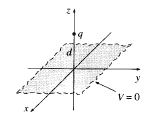
Can anyone explain to me why grounded means zero electric potential. I confuse what's the relation between infinite ground conducting plane and its electric potential (the method of images).
1675585195620.png

I have a several question:
1. Why the conductor plane must be infinite, while in reality there's no such one.
2. Why the electric potential must be zero to using this method?
2. If the plane isn't be grounded, does its electric potential not zero? What's exactly that making the potential in the plane zero when we grounded it? How ?
As far as I know that the electron easily run into the ground, does it mean the plane become positive charge?
 
Physics news on Phys.org
It's arbitrary what you define to be zero because only potential differences matter. If there is a ground connection then that's usually defined to be zero.

There is too much context missing to answer your individual questions.
1. Conducting plates don't have to be infinite in general.
2. Which method?
 
  • Like
Likes   Reactions: sinus and Dale
sinus said:
1. Why the conductor plane must be infinite, while in reality there's no such one.
Because it makes the calculation easier. A large but finite plane would give approximately the same answer, but with more mathematical effort required.

sinus said:
2. Why the electric potential must be zero to using this method?
Because it makes the calculation easier. You can set it to any potential you like, but setting it to zero is convenient.

sinus said:
2. If the plane isn't be grounded, does its electric potential not zero?
Grounding allows the plane to accept charge without changing potential. So grounding produces a structure with a fixed potential. It is merely a mathematical convenience to set that fixed potential to zero.

sinus said:
What's exactly that making the potential in the plane zero when we grounded it? How ?
It is just an arbitrary choice. The value of potential is not physical. Only potential differences are physically meaningful.

sinus said:
As far as I know that the electron easily run into the ground, does it mean the plane become positive charge?
No. As I said above, grounding makes it so that the plane has a fixed potential which does not change as charges are added or removed.
 
  • Like
  • Informative
Likes   Reactions: sinus and hutchphd
mfb said:
It's arbitrary what you define to be zero because only potential differences matter. If there is a ground connection then that's usually defined to be zero.

There is too much context missing to answer your individual questions.
1. Conducting plates don't have to be infinite in general.
2. Which method?
Thank you for your reply sir, I finally understand the method of images. Sorry for long tome didn't respond. For your feedback,number 2: the method that I meant is the method of images, like why using that solutions method (thank god, now I know the reason)
For number 1, I don't follow. So for a finite conducting planes the method of images is still apply?
 
Dale said:
Because it makes the calculation easier. A large but finite plane would give approximately the same answer, but with more mathematical effort required.

Because it makes the calculation easier. You can set it to any potential you like, but setting it to zero is convenient.

Grounding allows the plane to accept charge without changing potential. So grounding produces a structure with a fixed potential. It is merely a mathematical convenience to set that fixed potential to zero.

It is just an arbitrary choice. The value of potential is not physical. Only potential differences are physically meaningful.

No. As I said above, grounding makes it so that the plane has a fixed potential which does not change as charges are added or removed.
Thank you so much for your explanation sir, it really helpful for me :)
 

Similar threads

  • · Replies 7 ·
Replies
7
Views
3K
  • · Replies 11 ·
Replies
11
Views
2K
  • · Replies 4 ·
Replies
4
Views
2K
  • · Replies 2 ·
Replies
2
Views
2K
  • · Replies 2 ·
Replies
2
Views
2K
  • · Replies 4 ·
Replies
4
Views
2K
  • · Replies 3 ·
Replies
3
Views
2K
  • · Replies 4 ·
Replies
4
Views
2K
  • · Replies 14 ·
Replies
14
Views
3K
  • · Replies 4 ·
Replies
4
Views
3K