Deriving a Formula for Velocity of Ball 2 Based on Mass and Angle of Inclination

  • Thread starter Thread starter designroad
  • Start date Start date
  • Tags Tags
    Energy Practical
Click For Summary

Homework Help Overview

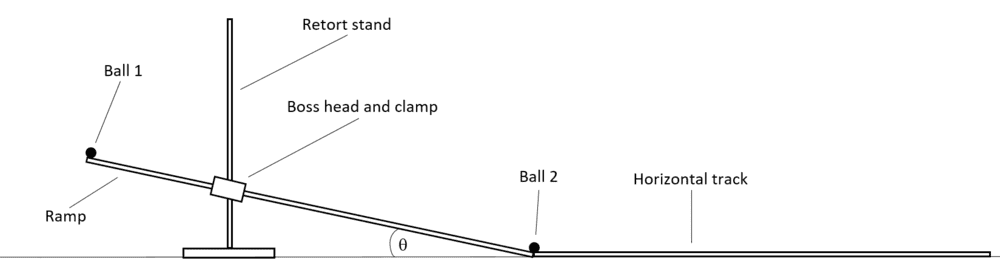
The discussion revolves around deriving a formula that relates the mass of ball 1 and the angle of inclination of a ramp to the velocity of ball 2. The original poster describes an experimental setup involving two balls and seeks assistance in formulating a relationship based on their observed velocities.

Discussion Character

  • Exploratory, Assumption checking, Problem interpretation

Approaches and Questions Raised

  • Participants discuss the need for clarity in the equations used and the principles behind them. There are questions regarding the roles of rotational kinetic energy and friction in the collision, as well as the implications of the mass and size of the balls on the results.

Discussion Status

The conversation is ongoing, with participants providing feedback on the original poster's attempts and suggesting that a more thorough explanation of the equations is necessary. There is a focus on conservation of momentum and kinetic energy, with some participants questioning the assumptions made in the calculations.

Contextual Notes

The original poster indicates that certain concepts, such as rotational kinetic energy, are beyond the scope of their current coursework. There is also mention of the need for an approximate equation that aligns with theoretical expectations despite the experimental inaccuracies.

designroad
Messages
7
Reaction score
0
Summary: I set it up my investigation as in the image with two independent variables: the mass of ball 1 and the angle of ramp inclination. I released ball 1 and started a timer when it stuck ball 2 then stopped it at the end of the track. I then took the average velocity of ball 2 over the 1 metre horizontal track.

I need some help in deriving a formula which links mass of ball 1 and angle of inclination, to the velocity of ball 2. Any help/guidance would be much appreciated. Thank you :-)
1568712733462.png
1568713065719.png
 
Physics news on Phys.org
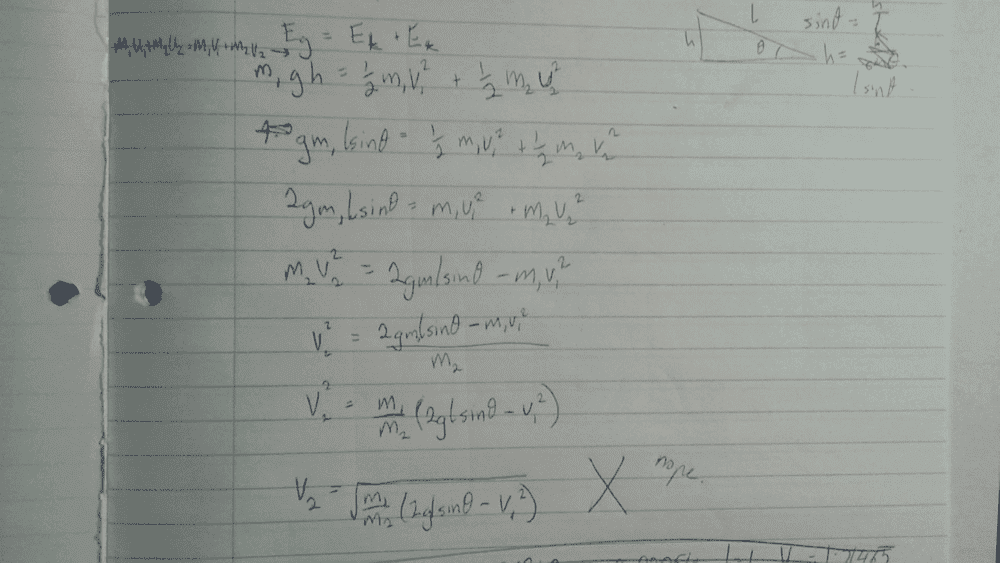
My failed attempt is shown in the picture. I put in my angle of inclination and mass of ball 1 values into this equation but the result was no where near close to the actual velocities i found.
 
You have jumped directly from a drawing to a set of hand-drawn equations. What is missing is an explanation of what principles you are invoking and what the variables denote. It would also be nice to have the equations typed in (or, better yet, type-set using LaTeX).

However, I also see that you have neglected the rotational kinetic energy of both balls and the dissipation of rotational kinetic energy into frictional losses when the balls skid after (and during) their collision.
 
Thanks for your response ill type equations next time.
I don't have to go into details about 'rotational kinetic energy' because that beyond the course so we haven't learned it. Would you be able to help me get an equation that works please?
Thanks again
 
what happens on the horizontal track? do ball1 and ball2 have the same velocity there? or does ball1 just stop on impact with ball2?
 
designroad said:
I don't have to go into details about 'rotational kinetic energy' because that beyond the course
The balls do not know that. If you do not allow for rotational KE of each ball you will not get close to the actual result.
Ignoring friction between the balls and the degree of elasticity of the collision might also lead to significant errors. Can you answer @gmax137's question?
 
  • Like
Likes   Reactions: jbriggs444
designroad said:
Thanks for your response ill type equations next time.
Typing the equations would be a good start. But also important is explaining why the equations are used.

For instance, in addition to writing ##m_1gh = m_1v_1^2 + m_2v_2^2##, you could write that "this equation follows from conservation of kinetic energy".

That would put us in a good position to discuss whether kinetic energy is conserved. It would also be good to clarify that the ##v_1## and ##v_2## are the velocities of the two masses shortly after the collision.
 
Since the mass of ball1 was greater than the mass of ball2 for all tested values, both balls had a forwards velocity down the track (in the same direction), but with different velocities.
In testing the angle of ramp inclination, mass of both balls was kept constant and they each ended with different velocities in the same direction down the track
Thanks for you responses
 
designroad said:
Since the mass of ball1 was greater than the mass of ball2 for all tested values, both balls had a forwards velocity down the track (in the same direction), but with different velocities.
In testing the angle of ramp inclination, mass of both balls was kept constant and they each ended with different velocities in the same direction down the track
Thanks for you responses
Did you measure both velocities?
What were the balls made of?
 
  • #10
designroad said:
Since the mass of ball1 was greater than the mass of ball2 for all tested values, both balls had a forwards velocity down the track (in the same direction), but with different velocities.
When changing the mass ratio of the two balls, did the ratio of radii change as well? An otherwise-elastic collision at a non-horizontal angle would result in some vertical impulse. Energy in the vertical motion of either ball would be quickly dumped into the track.
 
  • #11
the ratio of radii did not Change since all the balls used for ball1 were of the same size but different mass. They were all glass or metal. I just need to derive a very approximate equation linking the two independent variables to the velocity of the second ball to give to my teacher. Is the calculation above reasonable in terms of theory (ignoring rotational kinetic energy and vertical impulse.)

This equation just needs to be correct according to the theory because my results were not accurate due to a number of factors. So it can’t really apply to them anyway.
 
  • #12
designroad said:
the ratio of radii did not Change since all the balls used for ball1 were of the same size but different mass. They were all glass or metal. I just need to derive a very approximate equation linking the two independent variables to the velocity of the second ball to give to my teacher. Is the calculation above reasonable in terms of theory (ignoring rotational kinetic energy and vertical impulse.)

This equation just needs to be correct according to the theory because my results were not accurate due to a number of factors. So it can’t really apply to them anyway.
Looking at your hand drawn equations, I do not see a prediction. The final equation you arrived at depends on an unknown, ##v_1##. Conservation of momentum is mentioned in the thread title but not actually used anywhere that I can see.
 
  • #13
So do you have an equation which would make more sense? Thanks
 
  • #14
designroad said:
So do you have an equation which would make more sense? Thanks
For the purpose you specify, all you need to do is include the equation for conservation of linear momentum.
 
  • #15
How would I include that?
 
  • #16
designroad said:
How would I include that?
Write out the equation and use it to eliminate v1, which, as @jbriggs444 pointed out, should not appear in your answer.
 

Similar threads

  • · Replies 14 ·
Replies
14
Views
3K
  • · Replies 60 ·
3
Replies
60
Views
5K
Replies
8
Views
6K
  • · Replies 32 ·
2
Replies
32
Views
3K
Replies
11
Views
2K
  • · Replies 6 ·
Replies
6
Views
12K
Replies
7
Views
2K
  • · Replies 7 ·
Replies
7
Views
4K
  • · Replies 6 ·
Replies
6
Views
3K