The Mystery of Center of Gravity (CoG) and Center of Mass (CoM)

  • Context: Undergrad 
  • Thread starter Thread starter Lisciu
  • Start date Start date
  • Tags Tags
    Cog Confused
Click For Summary

Discussion Overview

The discussion revolves around the concepts of Center of Gravity (CoG) and Center of Mass (CoM), specifically focusing on their implications for stability in static systems. Participants explore the relationship between the height of the CoG and the stability of objects, questioning how this relationship can be understood mathematically and conceptually.

Discussion Character

  • Exploratory
  • Technical explanation
  • Conceptual clarification
  • Debate/contested

Main Points Raised

  • One participant expresses confusion about why a lower CoG is associated with greater stability, seeking a mathematical explanation involving moments of equilibrium.
  • Another participant suggests considering the distance the force must act to tip the block over, depending on the height of the CoG.
  • Concerns are raised about the relevance of the height of the CoG in calculations of moments, with some participants noting that the height of the box seems more significant than the CoG height.
  • There is a discussion about the conditions under which a block will tip over, with emphasis on the relationship between the CoG and the tilt axis.
  • Some participants propose re-drawing diagrams to clarify the relationship between CoG and pivot points when the block is tilted.
  • One participant notes that the stability of the block decreases as the CoG moves further from the tilt axis, questioning the analytical reasoning behind this observation.
  • Another participant emphasizes that dynamics may be necessary to fully understand the stability issues, despite some wanting to limit the discussion to statics.

Areas of Agreement / Disagreement

Participants express varying levels of understanding and agreement regarding the relationship between CoG height and stability. There is no consensus on the mathematical treatment of the problem, and multiple competing views remain regarding the significance of CoG in stability analysis.

Contextual Notes

Participants highlight limitations in their diagrams and calculations, particularly regarding the angles and positions of CoG relative to the tilt axis. There is an ongoing exploration of how these factors influence stability, but no definitive conclusions are reached.

Lisciu
Messages
38
Reaction score
0
Hello everyone,

Since yesterday I'm struggling with concept of CoG and of course in CoM.

The problem is that I don't understand why lower to the ground CoG is more stable then CoG more off the ground. On the internet there is batch of information about that but nobody explained it by momentum equlibrium. And that's what I need to understand that because of course i feel that but when i trying to do moments of equilibrium then i don't see this dependence.

For example two drawings:
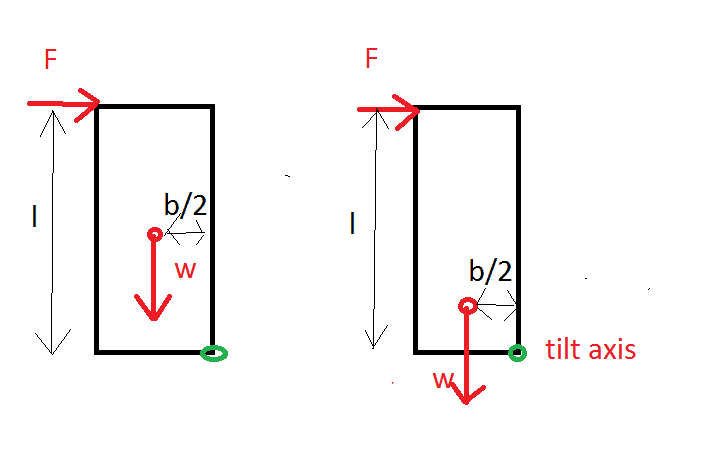
hGqQhC5.png


From the Moments around the point called "Tilt axis" I compute the equation:

Fl = Wb/2 in both case and I see the depend on the base rather then position of CoG. Can someone explain my what I do wrong? Should I point the force that i attached as a pulling one to the CoG? But it will make no sense from my point because it's like open a door lever task. If i will need to move the force to CoG i will generate less moment and door shouldn't open.

It's make my head blow up. Could someone help me to understand where is mistake?

I also trying to understand why we put sometimes force (not only the weight of itself) in CoG and when we should?
 
Physics news on Phys.org
Um... What is it you are trying to calculate? You have a force. Is that the only thing you need to know in order to know stability?

Consider how far the force must act to get the block to tip over. Consider this as a function of the height above the floor the CoG is located.

Consider giving the block a smack. That is, impart an impulse. How much impulse would you need to impart to get the block to tip over with the CoG at different heights above the floor?
 
Dear Mr DEvens,

Honestly I trying only to find why stability of something depends on height of CoG. I know about leverage, opening doors etc. and i totally get it. But thing i don't know is how it works in math way in case of this box. Because when I take the moment force around the tip point, then i don't have in moment arm the height for Weight of the block. So it's hard to understand why it actually depends on the position of CoG.
 
Lisciu said:
Dear Mr DEvens,

Honestly I trying only to find why stability of something depends on height of CoG. I know about leverage, opening doors etc. and i totally get it. But thing i don't know is how it works in math way in case of this box. Because when I take the moment force around the tip point, then i don't have in moment arm the height for Weight of the block. So it's hard to understand why it actually depends on the position of CoG.

So, you answered my questions? What were the answers?
 
1. I don't think I need something more. If you mean the friction i want to neglected this case and keep it simple. Even with friction there will be no arm as a height of force from CoG. In my example the height of the box is important not the height of CoG and that is the problem.

2. I don't want to go to dynamics with this. Just simple statics.

I am not a physics guy so apologize if I don't understand you.
 
Sigh. Ok, under what circumstances will the block tip over? What exactly has to happen for the block to tip over? And how does that change when the height of the CoG above ground changes?

To be as blunt as I am going to be, where will the CoG be relative to the corner you have called "tilt axis" when the block starts to fall over?
 
Try re-drawing the diagrams with the two blocks tilted so that their centres of gravity are vertically above the pivot points .

Update : D.Evans is saying same thing - I missed by a button press !
 
  • Like
Likes   Reactions: CWatters
The force of pulling need to be larger then moment from the weight. And it will going to fall when the CoG will be further then tilt axis. But still I don't understand this...
 
Lisciu said:
The force of pulling need to be larger then moment from the weight. And it will going to fall when the CoG will be further then tilt axis. But still I don't understand this...

So how far does the CoG have to move to be over the tilt axis? And does this depend on how far it is from the floor? And how does it affect motion of the block?

Draw the picture with different height CoG. How far does the block rotate with a high CoG compared to a low CoG?
 
  • #10
yt0jyIs.png


It's travel more where the CoG is lower and of course I knew that. But i don't now why from vector and analytical way. But why it will fell down when the CoG get further then axis of tilt?
 
  • #11
Your diagrams are not very good. You have the same angle for both. And you have the CoG past the corner in both cases. It will be a different angle with a different height above the floor.

How much must the CoG move *UPWARDS* in each case? And what does that mean about *ENERGY*? Stability is a dynamic thing.
 
  • #12
Lisciu said:
yt0jyIs.png


It's travel more where the CoG is lower and of course I knew that. But i don't now why from vector and analytical way. But why it will fell down when the CoG get further then axis of tilt?

Once the CoG moves to the right of the green circle as the box is tilted, the box will fall over clockwise unless restrained by another force acting to the left.

The higher the location of the CoG is above the base of the box, the less tilting you need to topple the box over. This is why we say that a high CoG makes things less stable. (This works with botes, too, not just boxes.)
 
  • #13
Lisciu said:
2. I don't want to go to dynamics with this. Just simple statics.
.
But simple statics won't give you the answer, because regardless of the height of the CoG, as long as it is the same distance horizontally from the tilt axis, it takes the same force to cause the object to be on the verge of tilting about the lower corner. So for any force F up to a limiting value, the object is at rest, that is , the sum of forces (including the weight, force F, and the normal force) and sum of torques about the pivot(including torque from the normal force, which shifts from center to corner as the load increases ) is 0.
Now when the applied force exceeds the static limit, that is, when it exceeds Wb/2l, now the box is unstable and starts to tilt and rotate and angularly accelerate. The previous responses explain why then the height of the cg becomes important in keeping the cg left of the tilt axis until release of the applied force.
 

Similar threads

  • · Replies 1 ·
Replies
1
Views
1K
  • · Replies 10 ·
Replies
10
Views
4K
  • · Replies 13 ·
Replies
13
Views
6K
  • · Replies 3 ·
Replies
3
Views
2K
  • · Replies 24 ·
Replies
24
Views
2K
  • · Replies 8 ·
Replies
8
Views
11K
  • · Replies 1 ·
Replies
1
Views
1K
  • · Replies 6 ·
Replies
6
Views
4K
  • · Replies 5 ·
Replies
5
Views
2K
Replies
7
Views
3K