The period between two successive cell divisions is called?

  • Thread starter Thread starter gracy
  • Start date Start date
  • Tags Tags
    Cell Period
Click For Summary
SUMMARY

The period between two successive cell divisions is definitively called the generation time, which corresponds to the length of the cell cycle. The cell cycle includes all phases of cell division, specifically the interphase, which consists of G1, S, and G2 phases, followed by the mitotic phase. Interphase is the collective term for the phases occurring between mitotic divisions, while generation time refers to the elapsed time between two cytokinesis events. Both terms are essential for understanding cellular processes in biology.

PREREQUISITES
  • Understanding of cell biology terminology, including "cell cycle" and "interphase."
  • Familiarity with the phases of the cell cycle: G1, S, G2, and mitosis.
  • Knowledge of cytokinesis and its role in cell division.
  • Basic comprehension of molecular biology concepts as outlined in "Molecular Biology of the Cell" by Alberts et al.
NEXT STEPS
  • Research the detailed phases of the cell cycle, focusing on G1, S, and G2 phases.
  • Study the differences between mitosis and cytokinesis in various cell types.
  • Explore the implications of generation time on cell growth and division rates.
  • Review authoritative sources on cell biology, such as "Molecular Biology of the Cell" by Alberts et al.
USEFUL FOR

This discussion is beneficial for biology students, educators, and researchers interested in cellular processes, particularly those studying cell division and the cell cycle.

gracy
Messages
2,486
Reaction score
83
the period between two successive cell divisions is called ?
according to the site below
http://www.geekmcq.com/biology/cellcycle/discussion-7116
it's interphase
and as per below site
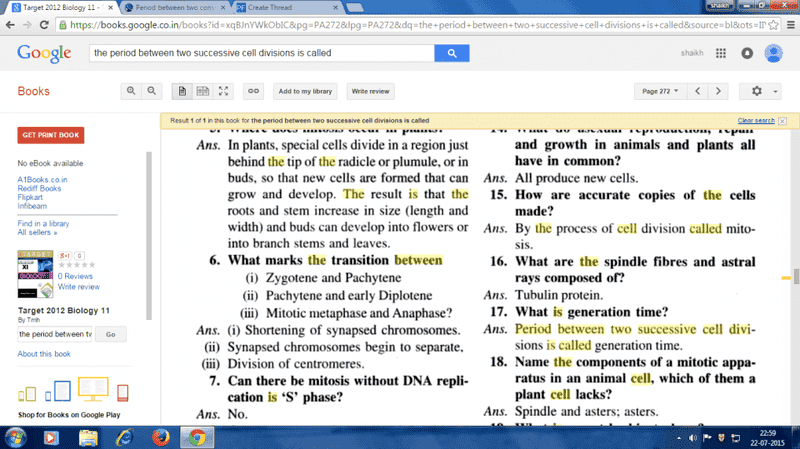
upload_2015-7-22_22-59-16.png


in question no 17 as we can see it is called generation time.And my teacher says generation time is same as cell cycle.Now I am confused what actually the period between two successive cell divisions is called ?Interphase or cell cycle i.e generation time.
 

Attachments

  • upload_2015-7-22_22-57-21.png
    upload_2015-7-22_22-57-21.png
    100.8 KB · Views: 999
Biology news on Phys.org
The amount of time elapsed between two successive cell divisions is called the generation time. The name of the collective phases of the cell cycle between mitotic phases is interphase.
 
  • Like
Likes   Reactions: gracy
The period between two successive cell divisions is called Interphase or the resting phase. This is the time during which the cell decides to either divide or stop dividing (Note: it is in the case of animal cells because plant cells have special cells called the meristematic cells which are meant to divide). If it chooses to divide there is this G1(first growth), Synthetic and G2 phases after which the actual division(Pro,meta,telo-phases) happen. And the Cell Cycle is all the above processes taking place in a cyclic manner! i.e., the cell divides the divided cells again go through all the processes and they divide again, it goes on until the cell divides to stop dividing.
 
Ygggdrasil said:
The amount of time elapsed between two successive cell divisions is called the generation time. The name of the collective phases of the cell cycle between mitotic phases is interphase.
Is there any difference between mitotic phase and cell division?
 
gracy said:
And my teacher says generation time is same as cell cycle.
What you think about this?
 
Generation time is the time taken for a cell cycle which includes all the phases I had told you before.
 
gracy said:
Is there any difference between mitotic phase and cell division?

Cell division is a fairly general and imprecise term that encompasses the entire process of how one cell gives rise to two daughter cells. If you want a more precise definition, I'd call the generation time the elapsed time between two successive cytokinesis events. You could also say that the generation time is the length of the cell cycle.
 
  • Like
Likes   Reactions: gracy
So generation time is
Does cell cycle include cytokinesis?I think yes..
 
gracy said:
Does cell cycle include cytokinesis?I think yes.

In almost all cases, yes. There are some rare types of cells that undergo mitosis without cytokinesis to make multinucleated cells.
 
  • Like
Likes   Reactions: gracy
  • #10
Ygggdrasil said:
The name of the collective phases of the cell cycle between mitotic phases is interphase.
interphase definition is easily available .It includes G1 phase,S phase and G2 phase, right?
 
  • #11
gracy said:
interphase definition is easily available .It includes G1 phase,S phase and G2 phase, right?

Yup, that is correct.
 
  • Like
Likes   Reactions: gracy
  • #12
And the last question does the cell cycle include interphase?
according to http://www.apelslice.com/books/9780618843175NIMAS/HTMLOUT/HTML/c_id4613060.html answer is yes.But still want to verify as on internet everything seems to be fishy.
 
  • #13
gracy said:
And the last question does the cell cycle include interphase?
according to http://www.apelslice.com/books/9780618843175NIMAS/HTMLOUT/HTML/c_id4613060.html answer is yes.But still want to verify as on internet everything seems to be fishy.

Yes, the cell cycle includes interphase. One of the most widely used cell biology textbooks is Molecular Biology of the Cell by Alberts et al., and it defines the cell cycle as including interphase.
 
  • Like
Likes   Reactions: gracy
  • #14
If you are saying , I can certify this !:smile:Thanks thanks thanks a lot.
 
  • #15
Ygggdrasil said:
Molecular Biology of the Cell by Alberts
Happy :smile: !
I have found something trustworthy !You are my favorite @Ygggdrasil
 

Similar threads

  • · Replies 2 ·
Replies
2
Views
3K
  • · Replies 1 ·
Replies
1
Views
2K
Replies
12
Views
5K
  • · Replies 5 ·
Replies
5
Views
5K
  • · Replies 2 ·
Replies
2
Views
4K
  • · Replies 1 ·
Replies
1
Views
3K
  • · Replies 4 ·
Replies
4
Views
2K
  • · Replies 3 ·
Replies
3
Views
6K
Replies
4
Views
3K
  • · Replies 14 ·
Replies
14
Views
5K