The slope of the tangent of the voltage curve.

Click For Summary
SUMMARY

The discussion focuses on the relationship between current and voltage in an AC circuit with a capacitor, specifically addressing the slope of the voltage curve represented by the derivative (dV/dt). Participants clarify that the slope of the tangent to the voltage curve indicates how voltage changes over time, which is crucial for understanding capacitor behavior. The conversation also touches on the implications of feeding a capacitor with constant current versus direct current, emphasizing the distinction between the two concepts. Ultimately, the discussion reinforces the importance of calculus in analyzing electrical circuits.

PREREQUISITES
  • Understanding of AC circuits and capacitors
  • Basic knowledge of calculus, specifically derivatives
  • Familiarity with the concepts of current and voltage
  • Knowledge of the relationship between charge, capacitance, and voltage (Q = C * V)
NEXT STEPS
  • Study the concept of derivatives in calculus, focusing on how they apply to electrical functions
  • Learn about the behavior of capacitors in AC circuits versus DC circuits
  • Explore the implications of constant current sources in electrical engineering
  • Investigate the formation of triangle wave generators using capacitors
USEFUL FOR

Electrical engineering students, educators, and professionals seeking to deepen their understanding of capacitor behavior in AC circuits and the application of calculus in electrical analysis.

Samar A
Messages
10
Reaction score
0
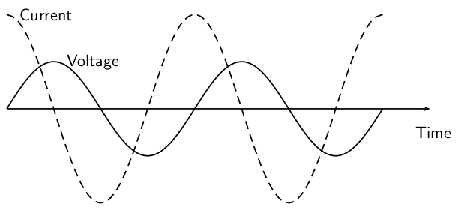
In an AC circuit with only a capacitor this diagram represents the relation between the current and the voltage in it (the current leads the voltage by 90 degrees).
pg12c9-002.png

and because: (I= dQ/dt) and ( Q=C*V)
where: Q is the amount of charge, C is the capacitance and V is the potential difference between the plates of the capacitor.
Then: I=C (dV/dt).
In the diagram above my textbook refers to the slope of the tangent of the voltage curve to be (dV/dt), and I don't understand it, could you please explain this for me? Regarding that I don't actually know how to determine the slope of a tangent of a curve.
 
Engineering news on Phys.org
Slope of the tangent at a point on the function is the derivative of the function at that point. It is a very big topic in calculus, called differential calculus.

Could you be more specific about what you don't understand in that graph?
 
Try: My textbook refers to the slope of the voltage versus time curve to be (dV/dt). To find this slope you draw a straight line that is tangential to the voltage curve, and the slope of this straight line is the slope of the curve at that point.
 
NascentOxygen said:
Try: my textbook refers to the slope (of or the tangent) of the voltage curve to be (dV/dt)
It says: (dV/dt) represents the slope of the tangent drawn to the curve.
cnh1995 said:
Slope of the tangent at a point on the function is the derivative of the function at that point. It is a very big topic in calculus, called differential calculus.

Could you be more specific about what you don't understand in that graph?
chh1995, I actually don't study calculus I know only a small amount of information about it. What I want to know is how the value (dV/dt) determines the slope?
 
NascentOxygen said:
Try: My textbook refers to the slope of the voltage versus time curve to be (dV/dt). To find this slope you draw a straight line that is tangential to the voltage curve, and the slope of this straight line is the slope of the curve at that point.
Ok, why the value of (dV/dt) particularly represents the value of the slope?
 
Samar A said:
chh1995, What I want to know is how the dV/dt determines the slope?
You'll need to study calculus for that..:-p
It is the definition of derivative.
If y=f(x), dy/dx is the slope of the tangent to the curve. Here, voltage V is a function of time t. So, dV/dt represents the slope of the curve (which is same as slope of the tangent to the curve at a point).

As you can see, slope of the voltage curve at its peak point is zero (the tangent is parallel to the time axis). This means, the capacitor current is zero, which is shown in the current waveform.
 
  • Like
Likes   Reactions: Samar A
Samar A said:
Ok, why the value of (dV/dt) particularly represents the value of the slope?
Think of it as ∆V/∆t
where ∆V is the small change in V that occurs during a small change in time, ∆t
and you can measure ∆V and ∆t off the graph, choosing ∆t to be any measurable small change in time, i.e., of your own choosing
 
  • Like
Likes   Reactions: CWatters and Samar A
cnh1995 said:
You'll need to study calculus for that..:-p
It is the definition of derivative.
If y=f(x), dy/dx is the slope of the tangent to the curve. Here, voltage V is a function of time t. So, dV/dt represents the slope of the curve (which is same as slope of the tangent to the curve at a point).

As you can see, slope of the voltage curve at its peak point is zero (the tangent is parallel to the time axis). This means, the capacitor current is zero, which is shown in the current waveform.
Referring to #7, where Δt is a small (infinitesimal) change in time, the derivative is given by,
dV/dt=lim Δt→0 (ΔV/Δt).
 
  • Like
Likes   Reactions: CWatters and Samar A
+1

You might also like to think about what happens if you feed a capacitor with a constant current.
 
  • #10
CWatters said:
+1

You might also like to think about what happens if you feed a capacitor with a constant current.
when feeding the capacitor with a DC source the current of the source flows to charge the capacitor and then it stops when the voltage across the capacitor is equal to the voltage across the terminals of the source. Then, nothing will happen there will be no sinusoidal curve as in the case of the AC source, so I don't know how to think of it as if we fed it with a constant current?!
 
  • #11
Samar A said:
when feeding the capacitor with a DC source the current of the source flows to charge the capacitor and then it stops when the voltage across the capacitor is equal to the voltage across the terminals of the source. Then, nothing will happen
Right. But that's the case with "direct" current. Constant current is different. It is a source of constant current (just like a voltage source is a source of constant voltage). I think you haven't studied current sources yet in college.
Samar A said:
so I don't know how to think of it as if we fed it with a constant current?!
No. I don't think he is asking you to think about ac in terms of constant current. I believe it is meant to be a small exercise in order to understand how a capacitor responds to different inputs.
 
  • #12
cnh1995 said:
Right. But that's the case with "direct" current. Constant current is different. It is a source of constant current (just like a voltage source is a source of constant voltage). I think you haven't studied current sources yet in college.

No. I don't think he is asking you to think about ac in terms of constant current. I believe it is meant to be a small exercise in order to understand how a capacitor responds to different inputs.
Oh, sorry. You are right I didn't study current sources, I am only a high school student. I thought a constant current is a direct current. Anyways, it is okay, I got it and understood the curve of an AC source.
 
  • #13
A constant current source delivers a constant current to the load. So given your equation...

I=C(dV/dt)

...if I is constant then dV/dt is constant. The result is that the voltage on the capacitor increases at a constant rate/constant slope. In the real world this can't happen indefinitely as the voltage would get too high, however such a circuit could form the basis of a triangle wave generator.
 
  • Like
Likes   Reactions: Samar A

Similar threads

  • · Replies 4 ·
Replies
4
Views
2K
  • · Replies 15 ·
Replies
15
Views
3K
Replies
6
Views
3K
  • · Replies 6 ·
Replies
6
Views
2K
Replies
1
Views
2K
  • · Replies 10 ·
Replies
10
Views
4K
  • · Replies 7 ·
Replies
7
Views
2K
Replies
1
Views
2K
Replies
8
Views
2K
  • · Replies 63 ·
3
Replies
63
Views
8K