The Tensor Algebra - Cooperstein, Defn 10.5

Click For Summary

Discussion Overview

The discussion revolves around understanding Definition 10.5 from Bruce N. Cooperstein's book "Advanced Linear Algebra," specifically focusing on the concept of homogeneous elements in the tensor algebra. Participants explore the implications of the definition and its mathematical structure, raising questions about the nature of elements in the tensor algebra and their degrees.

Discussion Character

  • Exploratory
  • Technical explanation
  • Debate/contested
  • Mathematical reasoning

Main Points Raised

  • Peter questions how an element ##x \in \mathcal{T}(V)## can also be in ##\mathcal{T}_d(V)##, suggesting a misunderstanding of the definition.
  • Some participants assert that the tensor algebra is a disjoint union of the sets ##\mathcal{T}_k##, while others challenge this claim.
  • There is a discussion about the nature of the operation ##\oplus## and its implications for the structure of the tensor algebra.
  • One participant mentions that the set of pairs and triples in the tensor algebra are related to Cartesian products and equivalence classes, indicating a complex structure.
  • Another participant points out that the tensor algebra can be viewed as a "free algebra" over a vector space, emphasizing the inclusion of zero across all tensor spaces.
  • Several participants express differing opinions on the usability of the tensor algebra for calculations, with some finding it cumbersome compared to polynomial rings.
  • A later reply suggests that the notation used in the definition may be an abuse, proposing a more precise interpretation of the relationship between elements of the tensor algebra and their degrees.

Areas of Agreement / Disagreement

Participants express multiple competing views regarding the interpretation of the definition and the structure of the tensor algebra. There is no consensus on the nature of the elements or the validity of certain claims made about the tensor algebra.

Contextual Notes

Some participants highlight potential ambiguities in the definitions and notation used by Cooperstein, suggesting that the author may have oversimplified complex concepts. The discussion remains open regarding the implications of these interpretations.

Math Amateur
Gold Member
MHB
Messages
3,920
Reaction score
48
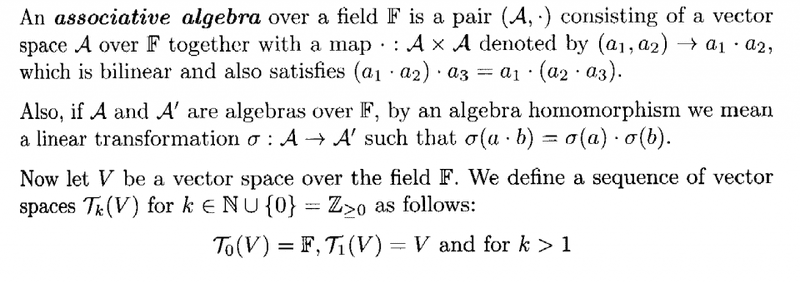
I am reading Bruce N. Coopersteins book: Advanced Linear Algebra (Second Edition) ... ...

I am focused on Section 10.3 The Tensor Algebra ... ...

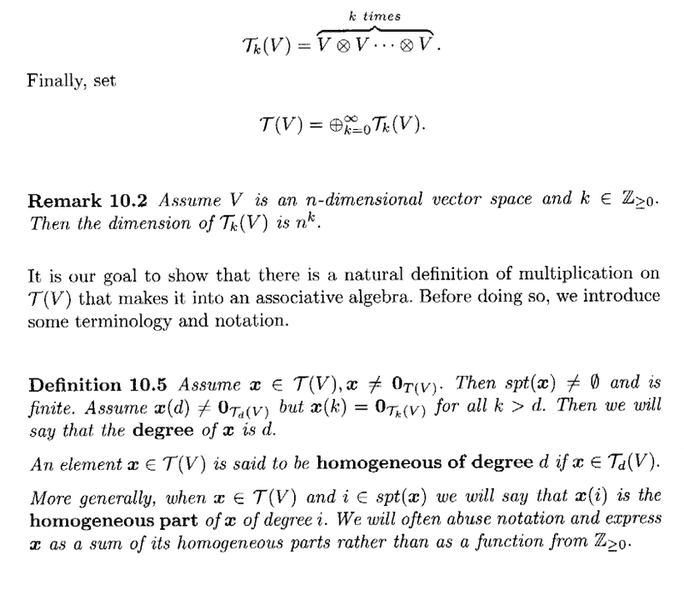
I need help in order to get a basic understanding of Definition 10.5 in Section 10.3 ...Definition 10.5 plus some preliminary definitions reads as follows:
?temp_hash=87acaf42109612625b53ef38dabca122.png

?temp_hash=87acaf42109612625b53ef38dabca122.png

In the above text from Cooperstein, in Definition 10.5, we read the following:

" ... ... An element ##x \in \mathcal{T}(V)## is said to be homogeneous of degree ##d## if ##x \in \mathcal{T}_d (V)## ... ..."My question is as follows:

How can x be such that ##x \in \mathcal{T}(V)## and ##x \in \mathcal{T}_d (V)## ... does not seem possible to me ... ...

... ... because ... ...

... if ##x \in \mathcal{T}(V)## then ##x## will have the form of an infinite sequence as in the following:##x = (x_0, x_1, x_2, \ ... \ ... \ , x_{d-1}, x_d, x_{d+1}, \ ... \ ... \ ... \ ... ) ##where ##x_i \in \mathcal{T}_i (V)##... ... clearly ##x_d## is the ##d##-th coordinate of ##x## and so cannot be equal to ##x## ... ..

Can someone please clarify this issue ... clearly I am not understanding this definition ...

Peter
 

Attachments

  • Cooperstein - 1 -   Tensor Algebra page 365-6    - PART 1     ....png
    Cooperstein - 1 - Tensor Algebra page 365-6 - PART 1 ....png
    37.5 KB · Views: 597
  • Cooperstein - 2  -   Tensor Algebra page 365-6    - PART 2     ....png
    Cooperstein - 2 - Tensor Algebra page 365-6 - PART 2 ....png
    38.3 KB · Views: 633
Physics news on Phys.org
stevendaryl said:
It is the disjoint union of all the \mathcal{T}_k

Not true.

\mathcal{T}_2 = the set of pairs of vectors, which we can represent as \langle x_1, x_2 \rangle
\mathcal{T}_3 = the set of triples of vectors: \langle x_1, x_2, x_3 \rangle

Both very much not true.
 
micromass said:
Not true.

It would have been helpful if you had said what you consider to be true, instead just saying that something is not true. Why do you think it's not true? What do you think the operation \oplus means?
 
  • Like
Likes   Reactions: Math Amateur
I'm letting micromass answer your question. But my original point is correct, which is that for every n, there is a "copy" of \mathcal{T}_n within \mathcal{T}.
 
  • Like
Likes   Reactions: Math Amateur
stevendaryl said:
It would have been helpful if you had said what you consider to be true, instead just saying that something is not true. Why do you think it's not true? What do you think the operation \otimes means?
The set of pairs, triples and so on are cartesian products. \otimes denotes equivalence classes of them. E.g. ##(2v,w), (v,2w) \in V \times V## are different elements but the same in ##V \otimes V##. Similar for the addition. This structure transports into ##\mathcal T##. And ##0## is an element of all ##\mathcal T_k## and ##\mathcal T##. It is considered the same ##0## in all of them so the union cannot be disjoint.
 
  • Like
Likes   Reactions: Math Amateur
One definition of \mathcal{T} is that it is the "free algebra" over V.
fresh_42 said:
The set of pairs, triples and so on are cartesian products. \otimes denotes equivalence classes of them. E.g. ##(2v,w), (v,2w) \in V \times V## are different elements but the same in ##V \otimes V##. Similar for the addition. This structure transports into ##\mathcal T##. And ##0## is an element of all ##\mathcal T_k## and ##\mathcal T##. It is considered the same ##0## in all of them so the union cannot be disjoint.

Thanks. But in any case, \mathcal{T} contains a copy of \mathcal{T}_n for each n, so you can think of any element of \mathcal{T}_n as also being an element of \mathcal{T}.
 
  • Like
Likes   Reactions: Math Amateur
stevendaryl said:
But in any case, \mathcal{T} contains a copy of \mathcal{T}_n for each n, so you can think of any element of \mathcal{T}_n as also being an element of \mathcal{T}.
As far as I'm concerned I always think of stuff going on in one \mathcal{T}_n as long as I'm not bothering with the overall properties. IMO \mathcal{T} isn't a nice place to really do calculations in but calculations on.
 
  • Like
Likes   Reactions: Math Amateur
fresh_42 said:
As far as I'm concerned I always think of stuff going on in one \mathcal{T}_n as long as I'm not bothering with the overall properties. IMO \mathcal{T} isn't a nice place to really do calculations in but calculations on.

The only use I've ever seen for mixed expressions (linear combinations of terms from different \mathcal{T}_n) is Clifford algebra.
 
  • Like
Likes   Reactions: Math Amateur and fresh_42
fresh_42 said:
As far as I'm concerned I always think of stuff going on in one \mathcal{T}_n as long as I'm not bothering with the overall properties. IMO \mathcal{T} isn't a nice place to really do calculations in but calculations on.

You don't think polynomial rings are a nice place to do calculations in? Because those are the kind of objects you get for ##\mathcal{T}##.
If ##V = \mathbb{F}##, then ##\mathcal{T}_n \sim \mathbb{F}## and ##\mathcal{T} = \mathbb{F}[X]##.
If ##V = \mathbb{F}^2##, then ##\mathcal{T} = \mathbb{F}<X,Y>##, the polynomials with variables ##X## and ##Y## that do not commute.
In general, if the dimension of ##V## is ##n##, then ##\mathcal{T} \sim \mathbb{F}<X_1,...,X_n>##.
 
  • Like
Likes   Reactions: Math Amateur
  • #10
micromass said:
You don't think polynomial rings are a nice place to do calculations in? Because those are the kind of objects you get for ##\mathcal{T}##.
If ##V = \mathbb{F}##, then ##\mathcal{T}_n \sim \mathbb{F}## and ##\mathcal{T} = \mathbb{F}[X]##.
If ##V = \mathbb{F}^2##, then ##\mathcal{T} = \mathbb{F}<X,Y>##, the polynomials with variables ##X## and ##Y## that do not commute.
In general, if the dimension of ##V## is ##n##, then ##\mathcal{T} \sim \mathbb{F}<X_1,...,X_n>##.
Touché. I just won't write them as tensors. They are just a bit too universal. Maybe it is about getting used to. I've met tensors in complexity theory as a way to describe n-linear algorithms, as universal algebraic objects or as part of cohomology theory where it is often about calculating between the filtration.
 
  • Like
Likes   Reactions: micromass
  • #11
When the author writes
Cooperstein said:
An element ##\boldsymbol{x}\in\mathcal{T}(V)## is said to be of homogeneous of degree ##d## if ##\boldsymbol{x}\in\mathcal{T}_d(V)##
I'm pretty sure that's an abuse of notation. ##\boldsymbol{x}## is a function from the index set ##\mathbb{N}## to ##\bigcup_{d\in\mathbb{N}}\mathcal T_d(V)## so it cannot also be an element of ##\mathcal T_d(V)##, which is part of its range. I think he must mean
$$Image(\boldsymbol x)\subset\left(\mathcal T_d(V)-\{0_{\mathcal T_d(V)}\}\right)\cup\bigcup_{k\in\mathbb N-\{d\}}\{0_{\mathcal T_k(V)}\}$$
Or, more succinctly:
##\pi_k(\boldsymbol x)## is zero for all ##k\in\mathbb N## except ##k=d##, for which it is nonzero.

So your (@Math Amateur 's) concern is entirely correct. However, the abuse of notation in question was foreshadowed by the author in the excerpt you posted in your other recent thread on this topic. Personally, I think it best in teaching texts to defer such abuses at least until the reader has had time to get comfortable with the new concepts - eg 'by now you should be familiar enough with the concepts of direct sums that we will henceforth, where it streamlines the notation, identify homogeneous elements of such direct sums with their isomorphic images in the component spaces'. But at least Cooperstein foreshadows the abuse.
@stevendaryl in post #6 has put his finger on the identification Cooperstein is making. The sense in which there is a 'copy' is that the set of all homogeneous elements of degree ##d## form a vector subspace of ##\mathcal T## (but not a subalgebra, as the set is not closed under tensor multiplication), which is vector-space-isomorphic to ##\mathcal T_d##.
 
Last edited:
  • #12
Thanks to all who have helped ...

Thanks Andrew for a complete and thorough answer to the question that was bothering me ...

Peter
 

Similar threads

  • · Replies 1 ·
Replies
1
Views
2K
  • · Replies 4 ·
Replies
4
Views
2K
Replies
2
Views
2K
  • · Replies 2 ·
Replies
2
Views
2K
  • · Replies 1 ·
Replies
1
Views
1K
  • · Replies 10 ·
Replies
10
Views
3K
  • · Replies 5 ·
Replies
5
Views
3K
  • · Replies 2 ·
Replies
2
Views
2K
  • · Replies 1 ·
Replies
1
Views
1K
  • · Replies 10 ·
Replies
10
Views
2K