The torque (and stalling torque) of a servo motor

Click For Summary

Discussion Overview

The discussion revolves around the torque specifications of a servo motor used for lifting a pen mechanism weighing 35g. Participants explore the implications of the servo's rated torque, mechanical setup, and alternative approaches to improve performance and reliability.

Discussion Character

  • Exploratory
  • Technical explanation
  • Debate/contested
  • Experimental/applied

Main Points Raised

  • One participant questions the interpretation of the servo's torque rating of 1.5 kg/cm, suggesting it may not directly correlate with the ability to lift the pen weight.
  • Another participant points out that the mechanical setup may be flawed, indicating that the lever-like configuration could be amplifying the required force.
  • Some participants suggest that small geared servos may struggle with high radial loads and recommend switching to larger, non-geared servos or stepper motors.
  • There is a mention of alternative pen-lifting mechanisms, such as using an electromagnet with gravity for downward force, which is common in commercial pen plotters.
  • Concerns are raised about the durability of the servos, with one participant noting that even more expensive options did not perform significantly better.
  • Another participant suggests using specific types of pens designed for plotters to mitigate issues with pen damage during operation.
  • One participant expresses intent to modify the mechanism to reduce torque requirements by shortening the arm length.

Areas of Agreement / Disagreement

Participants express differing views on the adequacy of the servo's torque rating and the effectiveness of the current mechanical setup. There is no consensus on the best approach to resolve the issues faced with the servo motor.

Contextual Notes

Participants note that the torque specifications are often given in kg/cm, which may not align with practical performance in their specific applications. The discussion highlights the complexity of mechanical setups and the influence of design choices on servo performance.

Owen Ransen
Messages
7
Reaction score
1
TL;DR
How to interpret torque claims for servo motors which seem to me to be ridiculous.
I'm using a servo to lift a pen. The pen and a bit of mechanism weights 35g.
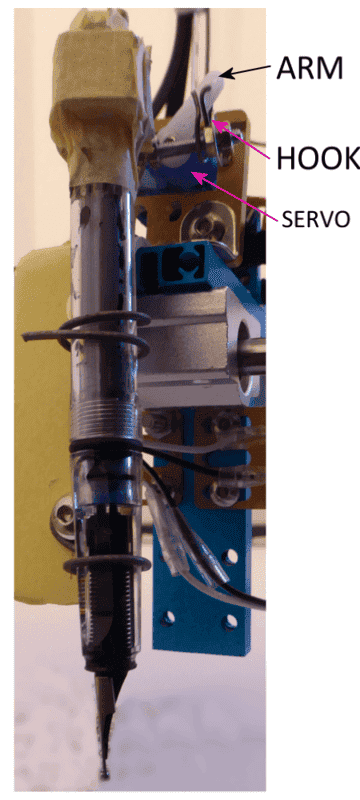
arm-hook-servo.png


The servo I use to bring the pen up and down claims to have a torsional moment of 1.5kg/cm. Sometimes they call it torque in the specs. But surely that does not mean they are claiming that if I hung a 1.5kg weight a 1 centimeter arm then the servo would be able to move?

The tiny 9g servo is shown here:

https://www.amazon.com/dp/B01MXPTCHO/?tag=pfamazon01-20

My servos fail a lot (die) and I'm asking because I've been told that the pen is too heavy for the servo. But if the servo can do 1.5kg.cm sure it can do 0.035*2 kg.cm? What am I missing?

(I realize it should be in Newtons per meter, but servos seem to always be specified in kg.cm (or oz.in even!).)
 
Engineering news on Phys.org
Typical stepper motors capable of 0.15 N*m (1.5 kgf*cm) are typically in form factor NEMA42, weighing about 200g.
Servos are lighter, but it still should be realistically about 30g.

Your Kuman SG-90 is geared servo, giving it higher torque for small weight. Your main mistake is in mechanical setup. Your lever-like setup multiply required force by approximately (length of pen/(1.5*length of arm). Not sure if your balancing load works properly. Also, small geared servos are weak against high radial loads as in your setup. I would recommend to switch to larger, non-geared servo or stepper and have a flexible coupling at output shaft like below:
https://www.amazon.com/dp/B00SMO7B8A/?tag=pfamazon01-20
 
  • Like
Likes   Reactions: Owen Ransen
trurle said:
Typical stepper motors capable of 0.15 N*m (1.5 kgf*cm) are typically in form factor NEMA42, weighing about 200g.
Servos are lighter, but it still should be realistically about 30g.

Your Kuman SG-90 is geared servo, giving it higher torque for small weight. Your main mistake is in mechanical setup. Your lever-like setup multiply required force by approximately (length of pen/(1.5*length of arm). Not sure if your balancing load works properly. Also, small geared servos are weak against high radial loads as in your setup. I would recommend to switch to larger, non-geared servo or stepper and have a flexible coupling at output shaft like below:
https://www.amazon.com/dp/B00SMO7B8A/?tag=pfamazon01-20

Thanks, you've given me something to think about.

However, does that mean that the specs of the servo on amazon I posted are completely wrong?
 
The photo does not show well the arrangement, I don't think the length of the pen comes into, here's a clearer image:
pen-servo.jpg
 
Something to consider:
On commercially available Pen Plotters, the pen lift is generally a simple electromagnet, with gravity supplying the downward force.
 
  • Like
Likes   Reactions: Owen Ransen
Thanks for the idea, but I moved to this system because simply dropping the pen splatters the ink and damages the nib (on this home made system).
 
Did you read the reviews in the Amazon link? I don't think that your problem is Physics.
 
I did read the reviews but took a chance. Some worked well, but not for very long. Then I got one which cost 10x the price and it did not last much longer than the best cheap one.
 
The comment about pens being destroyed when using gravity for pen-down, along with your sketch, makes me suspect you are using a fountain pen or a straight pen. If a fountain pen or similar is required for some reason, try adding a small dashpot (essentially an air piston shock absorber) to control the downward speed.

Alternative approaches would be use a felt tip-style pen (actually nylon fiber), or a drafting pen. Drafting Pen nibs (also called Technical Pens) are a hollow tube with a thin wire protruding from the end. When they contact the writing surface, the wire is pushed in and opens a valve to allow ink flow. They can be found in drafting supply stores, or sometimes in art supply stores.

Since it seems you are using the pen on a plotter, you may need to use a pen specifically designe for plotter use Plotter pens have a stronger nib to resist bending from the higher lateral force encountered. See if you can find a style of plotter replacement pen that can be adapted to your pen holder.

Cheers,
Tom
 
  • #10
Thanks Tom for the suggestions.

The actual system works very very well, and is very flexible about speed, angle etc. It is just the motors which break. What I'm going to do now is rejig mechanism to reduce the torque by 50% by using a shorter arm...
 
  • Like
Likes   Reactions: Tom.G

Similar threads

  • · Replies 4 ·
Replies
4
Views
4K
  • · Replies 8 ·
Replies
8
Views
5K
  • · Replies 5 ·
Replies
5
Views
2K
  • · Replies 7 ·
Replies
7
Views
2K
  • · Replies 17 ·
Replies
17
Views
3K
  • · Replies 31 ·
2
Replies
31
Views
4K
  • · Replies 4 ·
Replies
4
Views
4K