The unwinding coil (teaching experience sharing)

  • Context: Graduate 
  • Thread starter Thread starter wrobel
  • Start date Start date
  • Tags Tags
    Coil Experience
Click For Summary

Discussion Overview

The discussion revolves around the dynamics of a uniform disk with a wire wound around it, focusing on the behavior of the unwound part of the wire as the disk falls and rotates. Participants explore the conditions under which the wire remains vertical and the implications of different initial conditions and wire properties. The conversation includes theoretical considerations and potential teaching applications.

Discussion Character

  • Exploratory
  • Technical explanation
  • Conceptual clarification
  • Debate/contested
  • Mathematical reasoning

Main Points Raised

  • Some participants assert that the unwound part of the wire remains vertical due to the absence of horizontal forces acting on the system.
  • Others raise concerns about stability, questioning whether initial conditions could lead to sideways motion.
  • A participant suggests that if the coil has an elliptic shape, horizontal forces could emerge, complicating the situation.
  • There is a discussion about the nature of oscillations, with some expecting them to decrease over time.
  • Participants consider the potential for the center of mass of the disk to align vertically with the anchorage point after oscillations.
  • Some express skepticism about relying solely on intuition without mathematical backing, emphasizing the difference between intuitive understanding and formal proof.
  • An alternative scenario is proposed regarding the effects of a non-massless wire, with uncertainty about how it would behave.
  • There is a suggestion that the stiffness of the wire may play a significant role in the dynamics, especially if the wire has mass.

Areas of Agreement / Disagreement

Participants do not reach a consensus on several key points, including the stability of the system under various initial conditions and the effects of wire mass and stiffness. Multiple competing views remain regarding the behavior of the unwound wire and the dynamics of the disk.

Contextual Notes

Limitations include uncertainties about the initial conditions, the effects of wire mass and stiffness, and the applicability of intuitive reasoning versus formal mathematical models.

wrobel
Science Advisor
Insights Author
Messages
1,281
Reaction score
1,089
It is just for teaching experience sharing. Consider a uniform disk. A stretchless and massless wire has been wound on the disk. The end of the wire is attached to the ceiling. Initially the system is at rest as it is shown at the picture. Then the disk is released. It falls down and rotates and the wire unwinds.
Prove that the unwound part of the wire keeps being vertical for all the time.
This fact is evident (I do not know why), nevertheless to provide a correct proof one must write the Lagrange equations for the system with two degrees of freedom and make sure that the corresponding motion satisfies the equations.
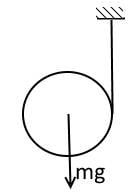
pic.jpg
 
Last edited:
  • Like
Likes   Reactions: Delta2, Adesh, etotheipi and 3 others
Physics news on Phys.org
wrobel said:
This fact is evident (I do not know why), ...
Intuitively, because there are no horizontal forces.
 
  • Like
Likes   Reactions: Delta2, Adesh and Leo Liu
Aren't there stability issues? What if the initial conditions provide just a little sideways nudge?
 
A.T. said:
Intuitively, because there are no horizontal forces.
Yes but if the coil has an elliptic shape then there are also no horizontal forces at the beginning but then they appear. I do not know if there are trivial explanations which do not refer equations of motion

hutchphd said:
Aren't there stability issues?
I believe that the Lyapunov stability is a very hard problem here.
 
  • Like
Likes   Reactions: vanhees71
wrobel said:
Yes but if the coil has an elliptic shape then there are also no horizontal forces at the beginning but then they appear.
Okay. But if the coil is circular, the only way to make the wire not vertical is to accelerate the center of mass of the coil horizontally. And for this you need horizontal forces away from the vertical. But here any horizontal forces would oppose the deviation from the vertical.

So it's not like the ball on the top of the sphere, which is indeterminate. But rather like a ball at the bottom of a spherical bowl.
 
Last edited:
Obviously it depends on the initial conditions, whether the wire stays vertical or not. I'd expect the complete solution to give a pendulum-like oscillation together with the motion of the cylinder unwinding the wire. That could be an interesting problem for the analytical-mechanics lecture. I'm pretty sure it can be found in some textbooks.
 
  • Like
Likes   Reactions: Lnewqban
as for my intuition the oscillations must decrease as ##t\to\infty##
 
  • Like
Likes   Reactions: Lnewqban
Once the disk is released, what prevents the center of mass of the disk, after some oscillations, to tend to vertically get aligned with the point of anchorage of the wire to the ceiling?
There is an initial restitutive torque respect to that anchorage point.
 
  • Like
Likes   Reactions: Adesh
There is a pretty big difference between " my intuition prompts me something" and "Basing on the given mathematical model I can prove the following theorem..."
 
  • #10
wrobel said:
There is a pretty big difference between " my intuition prompts me something" and "Basing on the given mathematical model I can prove the following theorem..."
Yes, I was mainly replying to the question, why it's intuitively self-evident.
 
  • #11
A.T. said:
Yes, I was mainly replying to the question, why it's intuitively self-evident.
I'm not sure that 'intuitively' is an appropriate word. Your explanation is very reasonable and I have to accept it but, as with a lot of explanations, writing the equations and concluding something is not always intuitive - until you are at a level where you can suspend your disbelief and accept that description of things. I just made a comment on another thread that 'intuition' is, in fact the use of learned knowledge . If you don't have the knowledge then your 'intuition' may be like the intuition Jacob Rees-Mogg describes (virtual ignorance).
I accept that the string must stay vertical but when I look at the diagram, I 'see' the drum swinging like a pendulum. Would I risk my life, relying on your prediction? Hmmm. (Virtual ignorance :wink: )
 
  • Like
Likes   Reactions: Lnewqban
  • #12
A.T. said:
Yes, I was mainly replying to the question, why it's intuitively self-evident.
I answered #8 :)
 
  • #13
wrobel said:
It is just for teaching experience sharing. Consider a uniform disk. A stretchless and massless wire has been wound on the disk. The end of the wire is attached to the ceiling. Initially the system is at rest as it is shown at the picture. Then the disk is released. It falls down and rotates and the wire unwinds.

pic-jpg.jpg
Alternative question: What if the wire is not mass-less? Will the coil drift horizontally? If yes, in which direction?
 
  • #14
A.T. said:
native question: What if the wire is not mass-less?
I do not know, I even do not know whether the unwound part of the massive wire will be straight
 
  • #15
wrobel said:
I do not know, ...
Me neither. I just have intuitions.
 
  • #16
I think the main problem is not so much tha mass but the stiffness of the wire. I'd rather think about a massive or massless thread, for which stiffness can be neglected. With a massive thread it's a bit tricky though. For a massless thread it seems to be a straight-forward problem perfectly suitable for the Lagrange or Hamilton formalism (action principle).
 

Similar threads

  • · Replies 1 ·
Replies
1
Views
2K
  • · Replies 1 ·
Replies
1
Views
2K
Replies
2
Views
3K
  • · Replies 3 ·
Replies
3
Views
3K
  • · Replies 2 ·
Replies
2
Views
3K
  • · Replies 1 ·
Replies
1
Views
8K
Replies
3
Views
9K
  • · Replies 5 ·
Replies
5
Views
58K
  • · Replies 5 ·
Replies
5
Views
8K
  • · Replies 1 ·
Replies
1
Views
3K