The value of "k" for spring constant, is the book answer incorrect?

Click For Summary

Discussion Overview

The discussion revolves around a Hook's law problem concerning the determination of the spring constant "k" and preload "Fi" based on provided force and displacement data. Participants are examining the validity of the book's answer of 50 lb/in and exploring various methods to arrive at this conclusion.

Discussion Character

  • Debate/contested

Main Points Raised

  • Some participants assert that the relationship between applied force and displacement is linear, leading to the conclusion that k = 50 lb/in based on the provided data.
  • Others express that while the logic appears sound, there may be issues with the algebraic methods used to solve for k and Fi, suggesting that the approach may be flawed.
  • A participant provides a relevant equation, indicating that the relationship can be simplified to Δy = ΔF/k, which could clarify the calculations involved.

Areas of Agreement / Disagreement

Participants generally agree on the linear relationship implied by the data, but there is contention regarding the algebraic methods used to solve for the spring constant and preload, indicating that the discussion remains unresolved.

Contextual Notes

There are indications of potential misunderstandings in the algebraic manipulation of the equations, but specific limitations or assumptions have not been fully articulated.

SShep71
Messages
5
Reaction score
0
Homework Statement
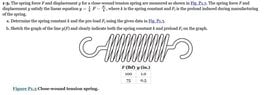
1-3. The spring force F and displacement y for a close-wound tension spring are measured as shown in Fig. P1.3 The spring force and displacement satisfy the linear equation y=((1/k)F-(Fi/k)
, where k is the spring constant and Fi is the preload induced during manufacturing of the spring.

(a) Determine the spring constant k and the pre-load F using the given data in Fig. P1.3. (b) Sketch the graph of the line y(F) and clearly indicate both the spring constant k and preload Fi using the given data.
Relevant Equations
y=((1/k)F-(Fi/k))
There is some discussion currently and I was hoping to get some opinions here. The question is in regard to a Hook's law problem. The text gives the problem as seen below. The text says the answer is 50lb/in. Several people have tried from several different approaches. Factoring the "y" equation to solve for Fi, straight method, etc.

In case the image does not work, here are the specifics:
k= spring constant
Fi=preload at manufacturing
F=spring force
y=displacement

Observations:
F(lbf) y(in)
100 1.0
75 0.5

The students are to determine the "Fi" and "k" values. The book states 50lb/in as the answer
 

Attachments

  • spring.JPG
    spring.JPG
    31.3 KB · Views: 146
Physics news on Phys.org
SShep71 said:
Observations:
F(lbf) y(in)
100 1.0
75 0.5

The students are to determine the "Fi" and "k" values. The book states 50lb/in as the answer
If the relationship between (total) applied force and (total) displacement is linear, then (using that data) an additional extension of 0.5 inches requires an additional force of 25 lbf. Hence ##k = 50## lbf per inch.
 
No disagreement from me, the logic is sound. I guess it's the method of algebraically solving it that seems to have a few "twisted-under britches" in this group.
 
SShep71 said:
No disagreement from me, the logic is sound. I guess it's the method of algebraically solving it that seems to have a few "twisted-under britches" in this group.
Note that your relevant equation:

Relevant Equations: y=((1/k)F-(Fi/k))

Can be simplified to:
$$\Delta y = \frac{\Delta F}{k}$$Which may help to straighten out your britches.
 
  • Haha
Likes   Reactions: berkeman

Similar threads

  • · Replies 17 ·
Replies
17
Views
2K
  • · Replies 3 ·
Replies
3
Views
2K
  • · Replies 8 ·
Replies
8
Views
2K
Replies
1
Views
2K
  • · Replies 3 ·
Replies
3
Views
2K
Replies
3
Views
2K
Replies
6
Views
3K
  • · Replies 3 ·
Replies
3
Views
2K
  • · Replies 5 ·
Replies
5
Views
3K
  • · Replies 6 ·
Replies
6
Views
2K