The Venturi Effect cannot explain how an eductor works

Click For Summary
SUMMARY

The discussion clarifies that the Venturi Effect cannot solely explain the operation of an eductor or ejector. It emphasizes that while the Venturi Effect describes how fluid velocity increases and pressure decreases in a restricted area, the creation of suction in an eductor involves energy conservation principles as described by Bernoulli's principle. The pressure at the throat of the eductor must be lower than ambient pressure to facilitate the suction of additional fluid. The design of eductors is critical, as they require a converging nozzle to achieve the necessary low pressure for effective operation.

PREREQUISITES
  • Understanding of Bernoulli's principle
  • Familiarity with fluid dynamics concepts
  • Knowledge of the Venturi Effect
  • Basic principles of energy conservation in fluid systems
NEXT STEPS
  • Study the design principles of water-motive eductors
  • Learn about the applications of ejectors in various industries
  • Explore advanced fluid dynamics simulations using software like ANSYS Fluent
  • Research the impact of friction losses in fluid systems and their mitigation techniques
USEFUL FOR

Engineers, fluid dynamics researchers, and students studying mechanical engineering or related fields will benefit from this discussion, particularly those interested in the practical applications of the Venturi Effect and eductor design.

nohappy
Messages
1
Reaction score
0
TL;DR
Bernoulli principle is only describing a fluid along a streamline while eductor's suction effect involves ambient air
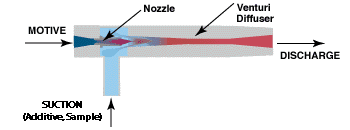
I've google all the keywords like "eductor", "ejector", "Venturi pump". All of them are the mechanism or applications that utilize "Venturi Effect". All of them are trying to explain the "suction effect" by saying that restriction area makes the fluid's velocity higher and hence lower pressure which is the definition of Venturi Effect. So far, I can comprehend that. That can be explained by Bernoulli's principle as well. However, it is the following statement that confuses me for couple of weeks - "..., and the lower pressure generate a kind of vacuum thus suck the ambient fluid or air in."

First of all, the definition of Bernoulli's principle only describes a single fluid along a streamline. I get that the fluid will have higher speed and lower pressure at the restriction area than the other point on its own path. But how can you prove that the "lower pressure point on its path" is lower than ambient pressure so that it can suck fluid or air from outside? And even if you can prove that effect by physics, how is that related to Venturi Effect or Bernoulli's principle if you're discussing two different fluid?
1583724582295.png


Secondly, if the suction is created by low pressure result from high speed, why do I need to create a restriction area that generates Venturi Effect? Why not just generate high speed air at the first place? In other words, I guess you can also make a eductor with a straight pipe? Again, if that assumption is correct, how is an eductor/ejector related to Venturi Effect?
 
Engineering news on Phys.org
A couple of things:

The low pressure is not 'created' by the high velocity. You have a fluid with a 'total energy' - potential [pressure] and kinetic [speed]. The converging nozzle causes an increase in speed (compared to a spot upstream of the nozzle) - this increases the kinetic energy. As energy is conserved, this has to be 'funded' from potential energy [pressure]. The pressure in the 'throat' of the device is lower than the pressure at the entrance to the nozzle. The fluid then enters a diverging nozzle - velocity is reduced and pressure increases (same mechanism). There are friction losses, but they can be surprisingly (to me, anyway) small for a properly designed device.

I'm familiar with water-motive eductors (air-motive, not so much). Eductors are designed so that there is 'space' for the 'pumped' fluid at the inlet to the diverging nozzle. It (the pumped fluid) enters the low pressure area of the eductor and is 'carried' into the diverging nozzle with the motive fluid. The designs diverge wildly, depending on the target motive/pumped fluids.

For the reasons described in the first paragraph, you can't make an eductor from a 'straight pipe.'
 
nohappy said:
how can you prove that the "lower pressure point on its path" is lower than ambient pressure so that it can suck fluid or air from outside?
It is assumed that the pressure somewhere upstream the venturi, is the same as the air outside, i.e ambient pressure. Therefore, the pressure in the venturi throat has to be lower than ambient pressure.
nohappy said:
how is that related to Venturi Effect or Bernoulli's principle if you're discussing two different fluid?
Having two different fluids doesn't change anything. If you can define a pressure at some point (say, the venturi throat), for one fluid, then this pressure is the same for another fluid at the same point.

For example, on the top of the ocean, the air pressure over it is 15 psi because there is 15 lb of air per squared inch on top of the water. The pressure on the water is also 15 psi at that point.
nohappy said:
if the suction is created by low pressure result from high speed, why do I need to create a restriction area that generates Venturi Effect?
I think the answer from @Dullard is clear when he talks about energy conservation. It is not just about accelerating the fluid, it is about accelerating the fluid without any energy input.
 
I have encountered a vertically oriented hydraulic cylinder that is designed to actuate and slice heavy cabling into sections with a blade. The cylinder is quite small (around 1.5 inches in diameter) and has an equally small stroke. The cylinder is single acting (i.e. it is pressurized from the bottom, and vented to atmosphere with a spring return, roughly 200lbs of force on the spring). The system operates at roughly 2500 psi. Interestingly, the cylinder has a pin that passes through its...

Similar threads

Replies
0
Views
2K
Replies
18
Views
3K
  • · Replies 31 ·
2
Replies
31
Views
4K
  • · Replies 11 ·
Replies
11
Views
3K
  • · Replies 16 ·
Replies
16
Views
4K
  • · Replies 9 ·
Replies
9
Views
4K
Replies
7
Views
53K
  • · Replies 6 ·
Replies
6
Views
3K
  • · Replies 12 ·
Replies
12
Views
5K
  • · Replies 6 ·
Replies
6
Views
3K