Theoretical Possibility of a N-methyl Polymer Structure

Click For Summary

Discussion Overview

The discussion revolves around the theoretical possibility of a polymer structure involving N-methyl groups and nitrogen atoms. Participants explore the bonding characteristics, potential stability, and related compounds, focusing on theoretical and experimental aspects of nitrogen chemistry.

Discussion Character

  • Exploratory
  • Technical explanation
  • Debate/contested

Main Points Raised

  • One participant questions the theoretical feasibility of a polymer structure with N-methyl groups, noting that while it does not violate elementary bonding rules, the strength difference between C-C and N-N bonds may lead to fragility.
  • Another participant references the strong triple bond in elemental nitrogen, suggesting that this bond's characteristics dominate nitrogen chemistry and may influence the stability of proposed structures.
  • A different participant discusses theoretical work on nitrogen allotropes, indicating that while hexagonal nitrogen could theoretically exist, it would likely be extremely explosive and challenging to synthesize.
  • One participant mentions the creation of fluorescent nanodots of carbon nitride, suggesting a potential pathway for polymerization through specific conditions involving diazine or unsaturated amines.

Areas of Agreement / Disagreement

Participants express a range of views on the feasibility and stability of the proposed polymer structure, with no consensus reached on its theoretical possibility or practical implications. Multiple competing perspectives on nitrogen chemistry and polymerization methods are present.

Contextual Notes

Limitations include the dependence on specific bonding characteristics and the unresolved nature of the proposed polymer's stability and synthesis conditions.

Mayhem
Messages
437
Reaction score
324
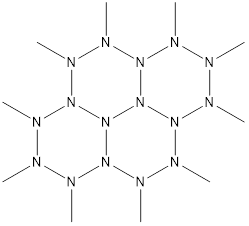
Out of sheer curiosity, would a polymer of the following structure be theoretically possible?
1607907642372.png

Imagine that the "N-methyl" groups are just the bounds of what is shown, and not actual carbon-containing substituents...

It doesn't seem to break any elementary bonding rules. However, the C-C bond is over twice as strong as the N-N bond, so in practical terms, it would be relatively fragile.
 
Last edited by a moderator:
Engineering news on Phys.org
  • Like
Likes   Reactions: Mayhem
There’s been a decent amount of theoretical work done on what allotropes of nitrogen are possible. You can get a rough estimate for the formation energy of hexagonal nitrogen relative to N2 by comparing binding energies. It comes out to somewhere around 250 kJ/mol. This quantifies a well-known phenomenon in highly nitrogenous compounds: even if hexagonal nitrogen were able to exist, it would be—at the very least—an extremely powerful explosive.

The research groups that study nitrogen-rich compounds generally consider other nitrogen allotropes as more realistic synthetic targets (but still likely impossible, and also extremely explosive). Some of these targets include azidoazide: N6 or (N3)2, a pseudohalogen analogous to cyanogen; and tetraazidoammonium azide: N16 or (N3)4N+N3-.
 
Last edited:
  • Like
Likes   Reactions: diogenesNY and jim mcnamara
I don't have the reference to hand, but I read recently that you can create fluorescent nanodots of carbon nitride derived from pyrolysis of citrazinic acid. Nominally, that would be hexagonal rings of alternating carbon and nitrogen atoms.

If I had to try this, I would be looking at conditions under which diazine could be polymerised or, if not possible, an unsaturated amine
 

Similar threads

  • · Replies 1 ·
Replies
1
Views
2K
  • · Replies 1 ·
Replies
1
Views
3K
  • · Replies 2 ·
Replies
2
Views
3K
  • · Replies 17 ·
Replies
17
Views
7K
  • · Replies 2 ·
Replies
2
Views
3K
  • · Replies 1 ·
Replies
1
Views
3K
  • · Replies 9 ·
Replies
9
Views
20K
Replies
1
Views
7K
  • · Replies 26 ·
Replies
26
Views
6K
  • · Replies 75 ·
3
Replies
75
Views
10K