Thermal Physics: Fermi Gas and chemical potential

Click For Summary
SUMMARY

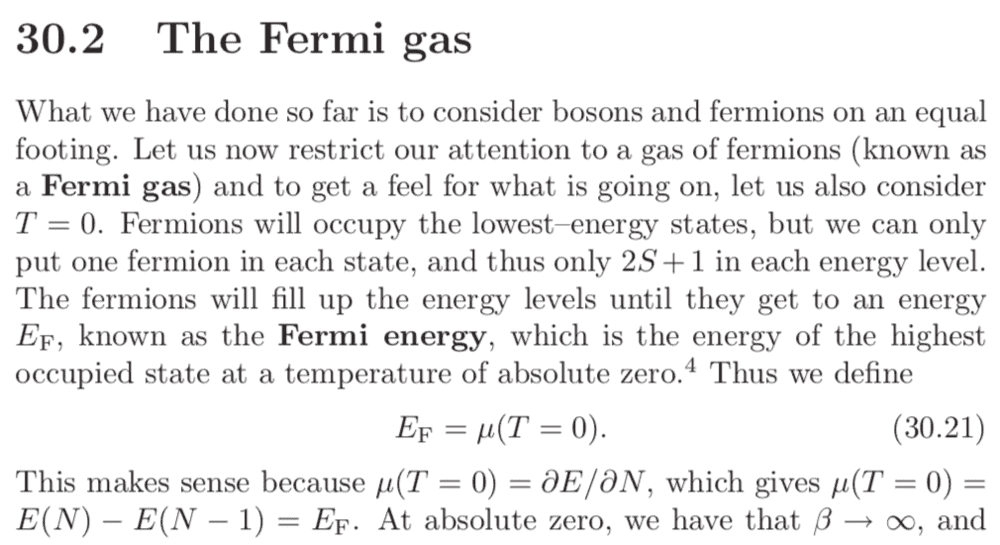
The discussion centers on the definition of the chemical potential, denoted as ##\mu_0 = E_F##, in the context of Fermi gases as explained in Blundell's textbook. It clarifies that at absolute zero temperature (T = 0), all energy states up to the Fermi energy level, ##E_F##, are filled. Consequently, adding an additional fermion to the system requires energy equal to the Fermi energy, establishing the equivalence of the chemical potential and the Fermi energy at T = 0.

PREREQUISITES
  • Understanding of Fermi gases and their properties
  • Familiarity with the concept of chemical potential in thermodynamics
  • Basic knowledge of quantum mechanics and particle statistics
  • Proficiency in interpreting energy levels and occupancy at absolute zero
NEXT STEPS
  • Study the derivation of the Fermi-Dirac distribution
  • Explore the implications of chemical potential in different thermodynamic systems
  • Investigate the role of temperature in modifying the occupancy of energy levels
  • Learn about the applications of Fermi gases in condensed matter physics
USEFUL FOR

Students and researchers in physics, particularly those focusing on statistical mechanics, condensed matter physics, and thermodynamics, will benefit from this discussion.

WWCY
Messages
476
Reaction score
15
Hi all, I have an issue trying to understand the following paragraph from Blundell's book.
Screenshot 2019-03-17 at 9.16.08 PM.png


How, exactly, does the definition of ##\mu_0 = E_F## "make sense"? In the sentence after 30.21, it seems to say that the mean energy for a system with ##N## particles differs from that of a system with ##N-1## particles by the highest occupy-able energy level at ##T = 0##, which is ##E_f##. What does this mean?

Many thanks in advance.
 

Attachments

  • Screenshot 2019-03-17 at 9.16.08 PM.png
    Screenshot 2019-03-17 at 9.16.08 PM.png
    53.4 KB · Views: 957
Science news on Phys.org
The chemical potential can be seen as the (Gibbs free) energy per particle, or the energy necessary to add one more particle to the system. With fermions at T = 0, all states up to ##E_F## are occupied, therefore the next fermion will add an energy of ##E_F## to the system. It does make sense to equate ##\mu(T=0) = E_F##.
 
  • Like
Likes   Reactions: WWCY

Similar threads

  • · Replies 6 ·
Replies
6
Views
2K
  • · Replies 16 ·
Replies
16
Views
3K
  • · Replies 1 ·
Replies
1
Views
2K
Replies
1
Views
1K
  • · Replies 37 ·
2
Replies
37
Views
5K
  • · Replies 2 ·
Replies
2
Views
1K
  • · Replies 5 ·
Replies
5
Views
3K
  • · Replies 1 ·
Replies
1
Views
4K
  • · Replies 21 ·
Replies
21
Views
10K
  • · Replies 1 ·
Replies
1
Views
1K