Thermo Camera and iridescence, a structural colours

Click For Summary

Discussion Overview

The discussion revolves around the challenges of measuring the temperature of a beetle using a thermo-camera in an experimental setup. Participants explore the discrepancies between thermometer readings and thermo-camera measurements, particularly in the context of iridescent beetles and the effects of reflected heat.

Discussion Character

  • Exploratory
  • Technical explanation
  • Debate/contested

Main Points Raised

  • Samuel Waldron describes an experiment to measure how quickly a beetle heats up under controlled conditions using a thermometer and a thermo-camera.
  • Some participants note that the thermo-camera measures temperature based on light response, which may not accurately reflect the temperature of the beetle due to its non-black body characteristics.
  • There is uncertainty about what the thermometer is measuring—whether it is the ambient temperature or the beetle's temperature—and whether the shell temperature can serve as a proxy for the beetle's temperature.
  • One participant suggests using thermocouples for more accurate measurements, while others discuss the limitations of calibrating the camera due to its automatic calibration feature.
  • Concerns are raised about the potential interference of the heat lamp's light on the thermo-camera readings, with suggestions to turn off the lamp during measurements.
  • Samuel mentions using a ceramic bulb that emits only heat to mitigate the effects of reflected light, and he draws a parallel between body heat reflection in a window and the beetle's shell.
  • There is discussion about the nature of the light emitted by the heat lamp, with clarification that it primarily emits infrared radiation.

Areas of Agreement / Disagreement

Participants express various viewpoints on the measurement discrepancies and calibration issues, with no consensus reached on the best approach to accurately measure the beetle's temperature. Multiple competing views remain regarding the impact of light reflection and the effectiveness of different measurement techniques.

Contextual Notes

Limitations include the automatic calibration of the thermo-camera, the ambiguity of what the thermometer measures, and the potential influence of ambient light and heat sources on the readings.

Samuels-art
Messages
18
Reaction score
0
Dear PF,

I am hoping you can help. I am trying to test the the speed that a beetle heats up under standardized conditions. I have buried a small container in crushed ice and place a beetle and thermometer inside. I wait until the thermometer and has reached 0°C, the idea then is to increase the the temperature with a heat lamp measuring the speed that the beetles heats up and resumes to forage.

I measure time, temperature and behaviour.

Now my problem is the relatively large differences between with the actual thermometer temperature and the reading I get with the thermo-camera (Model FLIR Systems, InfraCAM (Not the newer SD version)).

I have attached a .jpg showing the differences, where the 'Temperature' is recorded as the reading from the thermometer, the 'probe' is recorded as the thermometer probe in the ice chamber and the 'beetle' is the temperature of the beetle. X axis is the time in mins (at 20mins I moved the light source closer and you can see the sharp increase in temperature). The Y axis is the temperature in degrees Celsius.

I think the extra temperature is either a fault with the camera or some kind of reflected heat getting reflected from the beetle elytra (hard out 'shell' of a beetle). I mentioned iridescence and structural colours in the title. I did this because the beetles I will be using for the experiment will be iridescent. I wanted to ask if anyone knows of any pitfalls I may have when trying to measure temperature of a structural colour that is in a convex shape.

Kind regards and many thanks in advance.

Samuel Waldron
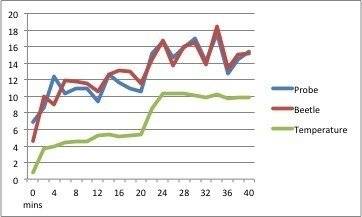
Test Data.jpg
 
Science news on Phys.org
Samuels-art said:
<snip>
Now my problem is the relatively large differences between with the actual thermometer temperature and the reading I get with the thermo-camera (Model FLIR Systems, InfraCAM (Not the newer SD version)).
<snip>

This is not surprising- the thermometer records temperature by responding to heat, while the camera records temperature by responding to the amount of light *and assumes the object is a black/grey body*. Clearly, the shell of the beetle is neither.

It's not clear from your description what object the thermometer is measuring- the container or the beetle? Can you use the shell temperature as a proxy for 'the' beetle temperature?

You have at least two options- instrument the beetle with thermocouples, or calibrate the camera using (perhaps) a dead beetle. Also, since you are radiantly heating the beetle, the thermocouples/camera should not be directly exposed to the lamp illumination.
 
Thank you kindly for your reply. Sorry it has taken so long to get back to you.

The thermometer is measuring the ambient temperature in the chamber. Unfortunately we can not use thermocouples. The problem with calibrating the camera is that it auto calibrates. So it does not allow calibration on a specific thing. Also very frustrating as it can calibrate during a replicate.

Lastly, how is it possible that the camera is not exposed to the light source? Do you mean I should turn the light off before measuring?

Kind Regards and again sorry for the speed of my reply and me thanking you for the help.

Samuel Waldron
 
Samuels-art said:
Lastly, how is it possible that the camera is not exposed to the light source? Do you mean I should turn the light off before measuring?

I'd try this and see if it does anything. It could be that reflection of the light source is messing with your camera.
 
Yea I had previously considered this, however the calibration is automatics and apparently does it regardless every 30 seconds or each minute.

I am using the FLIR Systams InfraCam 250. Has anyone had any experience. I can find no information about calibration on the internet. I find this very strange!
 
Well, regardless of the calibration issue, I'd take a few pictures with the heating lamp off and see if it helps at all.
 
Just tried, there seems to b little to no effect. However, to guard against it I have managed to find a ceramic bulb emitting only heat. It is used for terrariums, I will use the ambient light, two diffused strip lights to guard against reflection.

Just a side note, when I point the gun at the window I can see my body heat reflecting in it. Is this the same principle as the reflected heat from the light in the beetle elytra (shell!).
 
P.S. I never said before, but thank you for the replies and help. Regards

S.
 
Samuels-art said:
Just tried, there seems to b little to no effect. However, to guard against it I have managed to find a ceramic bulb emitting only heat. It is used for terrariums, I will use the ambient light, two diffused strip lights to guard against reflection.

To be clear, when I said "light", I meant IR radiation that your sensor detects. I thought your heat lamp emitted only IR radiation.

Just a side note, when I point the gun at the window I can see my body heat reflecting in it. Is this the same principle as the reflected heat from the light in the beetle elytra (shell!).

I believe so.
 
  • #10
Drakkith said:
To be clear, when I said "light", I meant IR radiation that your sensor detects. I thought your heat lamp emitted only IR radiation.

Hence no difference when the light is on or off! ;)

I'll let you know how it goes if you are interested. Hopefully the method will work tomorrow :)

Thanks again
 

Similar threads

  • · Replies 152 ·
6
Replies
152
Views
11K
  • · Replies 1 ·
Replies
1
Views
17K
  • · Replies 1 ·
Replies
1
Views
3K
  • · Replies 8 ·
Replies
8
Views
3K
  • · Replies 9 ·
Replies
9
Views
1K
  • · Replies 21 ·
Replies
21
Views
5K
Replies
3
Views
3K
Replies
1
Views
23K
  • · Replies 59 ·
2
Replies
59
Views
12K
  • · Replies 10 ·
Replies
10
Views
5K