Thermodynamic functions and state variables

Click For Summary
SUMMARY

This discussion focuses on thermodynamic functions and state variables, specifically examining the relationships between pressure (p), volume (V), temperature (t), and entropy (S) in a single-phase gas of constant composition. Participants confirm that according to the Phase Rule, only two independent state variables are necessary to describe the system. The conversation also introduces the concept of a 5D contact manifold to represent thermodynamic systems, emphasizing the importance of the first law of thermodynamics expressed as dU - TdS - pdV = 0. This mathematical framework aids in understanding the constraints among the five state variables (U, S, V, T, p).

PREREQUISITES
  • Understanding of the Phase Rule in thermodynamics
  • Familiarity with state variables: pressure (p), volume (V), temperature (t), and entropy (S)
  • Basic knowledge of thermodynamic laws, particularly the first law
  • Introduction to contact geometry and manifolds in mathematical physics
NEXT STEPS
  • Study the Gibbs Phase Rule and its implications for thermodynamic systems
  • Explore the concept of contact geometry in thermodynamics
  • Learn about Legendre transformations and their applications in thermodynamic potentials
  • Investigate the mathematical formulation of the first law of thermodynamics
USEFUL FOR

Students and professionals in physics, particularly those specializing in thermodynamics, as well as researchers interested in the mathematical modeling of thermodynamic systems.

cianfa72
Messages
2,953
Reaction score
308
Hi,

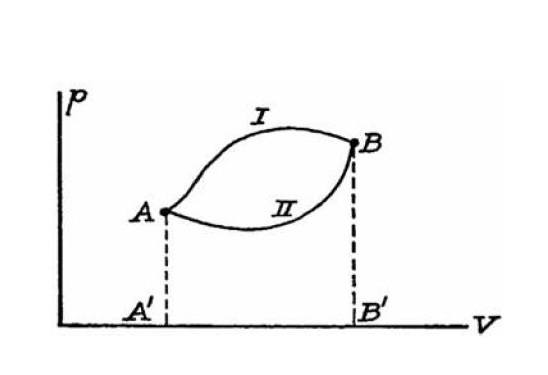
a basic doubt about thermodynamic functions and state variables. Take for instance transformations I and II in the following ##(p,V)## plane.
Capture.JPG


As far as I can tell, just because the transformations are drawn as continuous lines they are reversible by definition. Namely we can transform the system back in the other way and from a mathematical point of view it really makes sense (e.g. work and heat exchanged with the system's surrounding are the same as in the 'direct' transformation just with sign flipped).

By the way, given a system (e.g. a gas in a cylinder), there exist a pair of state variables for each way the system can exchange energy with the surrounding. In the above case the system can do work by means of gas thermodynamic pressure ##p## and exchange heat with the surrounding. Hence we have 2 pairs: ##(p,V)## and ##(t,S)## respectively.

Now my point is: how many are the independent state variables ?

The 'state equation' for the system involves the variables ##p,V,t## (take for instance the state equation of ideal gas) and I believe there exist another independent equation that involve the entropy ##S##. Thus in that case (system = gas in a cylinder) the independent state variables are just 2.

Does it makes sense ? Thank you.

Note: In the above I use lower case for intensive state variables and upper case the extensive ones.
 
Last edited:
Science news on Phys.org
If you are talking about a single phase gas of constant composition and believe the Phase Rule, it tells us that there are two independent state variables.
 
Chestermiller said:
If you are talking about a single phase gas of constant composition and believe the Phase Rule, it tells us that there are two independent state variables.
Yes, assume a single phase gas of constant composition (and believe in the Phase Rule).

Sorry, I didn't get your point: is the Phase Rule actually another 'state equation' relating the system's state variables ##p,V,t,S## ?
 
cianfa72 said:
Yes, assume a single phase gas of constant composition (and believe in the Phase Rule).

Sorry, I didn't get your point: is the Phase Rule actually another 'state equation' relating the system's state variables ##p,V,t,S## ?
Google Gibbs Phase Rule.
 
From a mathematical point of view, we can employ the 'contact manifold' geometry to represent a thermodynamic system (material/substance). Basically it is a 5D manifold endowed with a contact structure -- Contact geometry

This contact structure represents the thermodynamic first law:

$$ dU - TdS - pdV = 0 $$
##d\omega = dU - TdS - pdV## is the one-form contact structure defined on the 5D manifold. Each material/substance is actually represented by a 2D submanifold of it.

Basically the constrains between the 5 state variables ##(U,S,V,T,p)## define such submanifold and some of them are actually the 'state equations' for the given substance.

See the following:
thermodynamic formalism
MathThermoStates
 
  • Like
Likes   Reactions: vanhees71
cianfa72 said:
From a mathematical point of view, we can employ the 'contact manifold' geometry to represent a thermodynamic system (material/substance). Basically it is a 5D manifold endowed with a contact structure -- Contact geometry

This contact structure represents the thermodynamic first law:

$$ dU - TdS - pdV = 0 $$
##d\omega = dU - TdS - pdV## is the one-form contact structure defined on the 5D manifold. Each material/substance is actually represented by a 2D submanifold of it.

Basically the constrains between the 5 state variables ##(U,S,V,T,p)## define such submanifold and some of them are actually the 'state equations' for the given substance.

See the following:
thermodynamic formalism
MathThermoStates
I have no idea what any of this means, and, in my scheme of things (focused on solving actual problems), it doesn't matter.
 
Yes, mine was a theoretical approach to address the following: taking for instance the 'ideal gas substance' why its state can be described by just 2 state variables picked from the set of 5 state variables above ?
 
It should of course read
$$\mathrm{d} U-T \mathrm{d} S + P \mathrm{d} V=0.$$
Otherwise it's just the geometric intuition behind all the many Legendre transformations you do to transform from one thermodynamic potential to the other.
 
vanhees71 said:
It should of course read
$$\mathrm{d} U-T \mathrm{d} S + P \mathrm{d} V=0.$$
Oops, yes of course.
 
  • Like
Likes   Reactions: vanhees71

Similar threads

  • · Replies 9 ·
Replies
9
Views
3K
  • · Replies 3 ·
Replies
3
Views
2K
  • · Replies 15 ·
Replies
15
Views
3K
  • · Replies 4 ·
Replies
4
Views
2K
  • · Replies 1 ·
Replies
1
Views
2K
  • · Replies 1 ·
Replies
1
Views
2K
  • · Replies 5 ·
Replies
5
Views
2K
Replies
5
Views
660
  • · Replies 12 ·
Replies
12
Views
3K
  • · Replies 1 ·
Replies
1
Views
995